




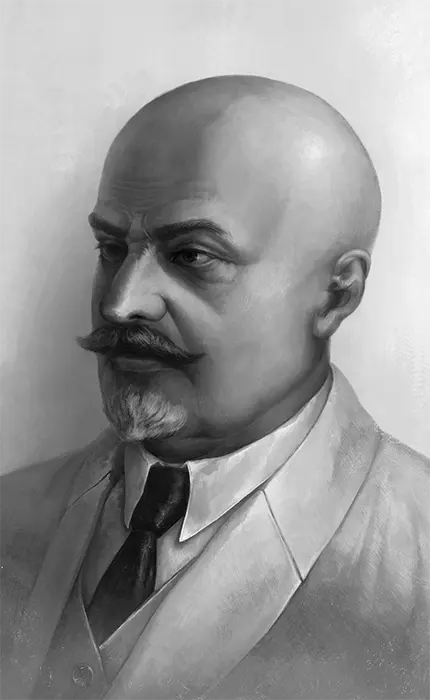
Alexander Milovich
Graduate of the Polotsk Cadet Corps (1893)
Alexander Milovich
A distinguished scholar in the field of hydraulics, hydraulic engineering structures, and hydraulic machinery.
Education
In 1893, he graduated from the Polotsk Cadet Corps and subsequently enrolled in the Moscow Technical School, where he qualified as a mechanical engineer. Beginning in 1900, he taught hydraulics at the Kharkov Technological Institute. He also completed a nearly three-year traineeship at universities in Germany and Switzerland.
Teaching and Research Activities
In 1908, A.Ya. Milovich was appointed, following a competitive selection process, as an Extraordinary Professor at the Tomsk Technological Institute. He remained there for only one year before moving to Novocherkassk, where he headed the Department of Applied Mechanics and Hydraulics at the Don Polytechnic Institute until 1921.
During this time, he developed a new theory for the calculation and design of Francis turbine blades, the fundamentals of reaction turbine design, the theory of draft tubes and turbine spiral casings, the vortex theory for hydraulic engine calculation, the theory of non-working flow deflection, and the hydrodynamic principles of jet flows. He also wrote textbooks on hydrodynamics and organized a hydraulic laboratory at the institute that brought him renown. As a leading theoretician, Milovich invariably tested all his conclusions empirically, was a passionate advocate for the unity of theory and practice, and actively strove to implement his scientific achievements in practice.
During the First World War, the scientist contributed to the victory of Russian arms by submitting his work, “Hydrodynamic Principles of Gas Warfare”, to the command.
In 1921, Alexander Yakovlevich moved to Moscow and headed the Department of Hydraulics at the Petrovskaya Agricultural Academy until 1935. During this period, he designed and built a hydraulic laboratory at the Institute of Water Management, a workshop-factory for the production of hydraulic measuring instruments, and published a series of significant works.
In 1935, Milovich was repressed and, until 1939, led research on the structures of the Moscow-Volga Canal in the hydraulic laboratory in Dmitrov, serving as an unescorted prisoner. At the Moscow Canal, he tested up to 150 hydraulic structures. He effectively became the founder of hydraulic model studies for water-passing structures of large and medium-sized domestic hydraulic complexes. He conducted research on spillway dams, locks, and hydroelectric power plants of the Upper Volga hydraulic complexes and the Moscow-Volga Canal.
Between 1939 and 1941, under the direction of A.Ya. Milovich, the largest hydrotechnical laboratory in the USSR was established during the construction of the Kuibyshev HPP, where comparative studies of turbine chambers were conducted.
From 1943, Alexander Yakovlevich returned to Moscow for scientific work at the All-Union Research Institute of Hydraulic Engineering and Melioration (VNIIGiM). His most notable works during this period included “Fundamentals of Fluid Dynamics”, “Theory of Dynamic Interaction of Bodies and Fluid”, “Theory of Flow Division and Combination”, “Theory of the Suction Tube”, and “Theory of Sources and Its Applications”, all presented with accessible clarity for a broad range of specialists.
Alexander Milovich’s fruitful scientific career spanned 60 years, consistently focusing on solving crucial national economic problems. He generously shared his knowledge with his students.
Later Life
The scientist passed away in 1958 in Moscow.

