




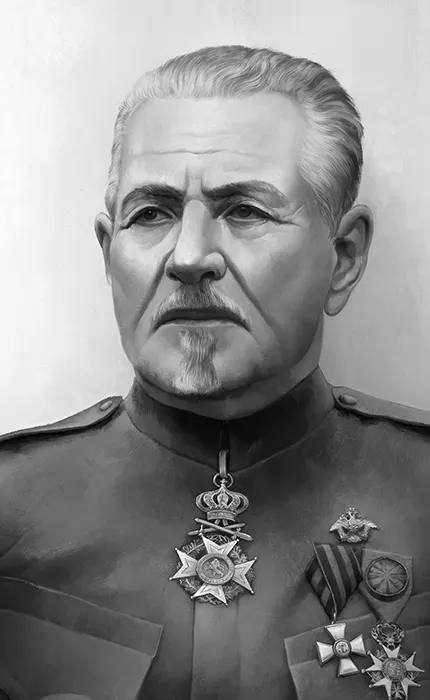
Nikolai Brzhozovsky
Graduate of the Polotsk Cadet Corps (1874)
Nikolai Brzhozovsky
Lieutenant General, Russian commander who served in multiple campaigns including the Russo‑Turkish War (1877–1878), the China expedition (1900–1901), the Russo‑Japanese War, World War I and the Russian Civil War.
Education
Brzhozovsky graduated from the Polotsk Military Gymnasium in 1874 and from the 2nd Konstantinovsky Military School in 1876. He began his service as an officer with the 16th Artillery Brigade in Volkovysk.
Military career
He fought in the Russo‑Turkish War and later distinguished himself during the China expedition (1900–1901), earning promotion to lieutenant‑colonel. He was active in the Russo‑Japanese War (1904–1905), where he was wounded and concussed.
Promoted to colonel in 1905, he became commander of the artillery at the Łomża fortress in 1906 and, from December 1911, commander of the Osowiec fortress artillery with the rank of major general.
The Osowiec fortress, close to the East Prussian border, defended the approaches to Białystok, Grodno and Minsk. During World War I German forces repeatedly attacked the fortress.
In September 1914 Brzhozovsky’s artfully handled artillery repelled the first assault; in February 1915 a second German attack again failed.
Soldiers admired Brzhozovsky’s devotion and leadership; his loyalty to the emperor and to his men earned him comparisons with Suvorov. One episode from the fortress’s defense has entered military legend as the Attack of the Dead Men.
After a withering bombardment and a chlorine‑bromine gas assault that left defenders grievously wounded, about a hundred survivors of the 8th and 13th companies rose in a bayonet counterattack shouting "Hurrah!" Their ghastly, bandaged appearance so unnerved the German infantry that the attackers retreated. Brzhozovsky ordered this famous counterattack.
When Russian forces withdrew from parts of Poland the high command decided to end defensive operations and evacuate the garrison. The stubborn defense of Osowiec later earned it the informal title "the Brest Fortress of World War I."
In June 1916 Brzhozovsky was appointed commander of the newly formed 44th Army Corps and in December was promoted to lieutenant general. He refused to recognize the October Revolution and joined the White Movement, serving in the reserve of the Volunteer Army.
In summer 1919 he was assigned to the Northern Region forces, where he commanded the Arkhangelsk garrison, served as deputy governor‑general of the Northern Region, and led the defense of Arkhangelsk. After the Civil War he emigrated to Montenegro and managed the Russian invalids’ home in Prčanj.
Awards
Orders: St. Anna 4th class (1877); St. Vladimir 4th class with swords and bow (1878); St. Anna 3rd class (1893); St. Stanislaus 2nd class (1896); St. Vladimir 3rd class with swords (1905); Golden Saber For Bravery (1905); St. Stanislaus 1st class (1913); St. George 4th class (1915); St. Anna 1st class with swords (1915); St. Vladimir 2nd class with swords (1915).
Death
The exact date and place of burial of Nikolai Aleksandrovich Brzhozovsky remain unknown.

