




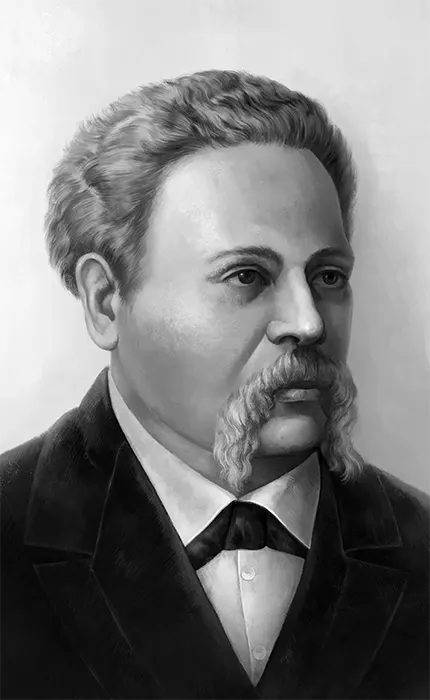
Nikolai Pisarevsky
Graduate of the Polotsk Cadet Corps (1839)
Nikolai Pisarevsky
An outstanding engineer in the field of electrical communications, photography, and topography, the organizer of the first higher electrical engineering educational institution in Europe, and a Privy Councillor.
Education
Having graduated with honors from the Polotsk Cadet Corps in 1839, he continued his studies at the Noble Regiment (1843) and the Military Academy (1847). Upon graduating from the academy, he was assigned to the General Staff in the geodesy department of the Military-Topographic Directorate. In 1855, he was appointed head of the photographic department of the General Staff. N.G. Pisarevsky was the first to propose the application of photography in geodesy.
In 1858, Nikolai was sent abroad “to gather information on the art of photography”. He visited London, Paris, and Berlin and attended a course of lectures on physics at the Sorbonne. Pisarevsky’s versatile and deep technical knowledge, coupled with his excellent command of foreign languages, enabled him to thoroughly study all the new developments known at that time in the field of photography.
Teaching and Scientific Activities
N.G. Pisarevsky was actively involved in educational activities. From 1850 to 1852, he prepared the textbook “Popular Physics”, and in 1854, he published the manual “Popular Mechanics as Applied to Agriculture, Industry, and Household Management” in two parts. In 1860, he organized the educational publishing society “Public Benefit”. He was the editor of the newspaper “Russkiy Invalid” and published in many major journals.
During the period of rapid development of the electromagnetic telegraph, domestic specialists became in demand. In 1868, Pisarevsky was appointed Inspector of Telegraphs in the Telegraph Department. In 1878, he published “A Guide to the Construction of Aerial Telegraph Lines”, which was at the time the only handbook for telegraph workers, and in 1881, he published the book “Telephones and Their Practical Application”, which went through eight editions. From 1868 to 1886, Nikolai Grigorievich published 19 books and over 20 scientific articles on physics and its role in electrical communications, paying particular attention to electrical measurements.
In the 1870s and 1880s, under the direct leadership of N.G. Pisarevsky, the construction of telegraph, and later telephone, communication lines began on a large scale in Russia. Under his management, the laying of underground telegraph lines was successfully carried out for the first time in the country. In 1879, Pisarevsky supervised the laying and testing of Russia’s first underwater cable from Baku to Krasnovodsk, and a cable was also laid between St. Petersburg and Kronstadt.
The country required trained specialists in such a new and complex field of knowledge as electrical engineering, and in the early 1880s, Pisarevsky headed a commission to develop a project for an electrical engineering education system. As a result of the commission’s work, the School of the Postal and Telegraph Department was opened in 1886, and Nikolai was appointed its director. On June 11, 1891, by Imperial decree, the School was transformed into the Electrotechnical Institute (currently the Saint Petersburg State Electrotechnical University “LETI” named after V.I. Ulyanov (Lenin)). Its first director, naturally, was N.G. Pisarevsky. By the beginning of the 20th century, the Electrotechnical Institute had become a center for electrical engineering science and education in Russia.
End of Life
Nikolai Grigoryevich Pisarevsky passed away in 1895 in St. Petersburg.

