




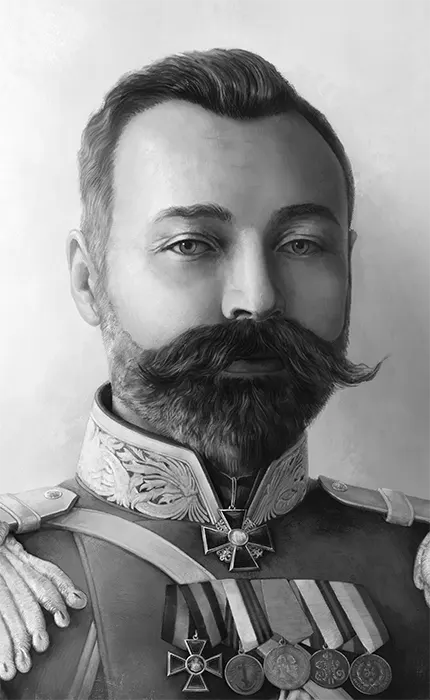
Roman Kondratenko
Graduate of the Polotsk Cadet Corps (1874)
Roman Kondratenko
A Russian military commander, Lieutenant General, and a hero of the Russo-Japanese War of 1904–1905.
Education
He was educated at the Polotsk Military Gymnasium, and after graduating in 1874, he enrolled in the Nikolaev Engineering School. From 1877, he served as a military engineer in the Caucasus. In 1882, Kondratenko graduated from the Engineering Academy, after which he joined the Main Engineering Directorate, where he worked on the project for the construction of the Mikhailovsky Fortress. In 1886, he completed a course at the General Staff Academy, then served on the staff of the Vilna Military District, successively commanding a company and a battalion.
Role in the Russo-Japanese War
In 1903, Roman Kondratenko was appointed commander of the 7th East Siberian Rifle Brigade, which was reorganized into a division in Port Arthur in 1904. At the outbreak of the Russo-Japanese War, he became the chief of land defenses for the fortress. Thanks to his organizational skills and knowledge of engineering, he played a decisive role during the defense of Port Arthur.
Under R.I. Kondratenko’s leadership, the system of engineering structures (two defensive lines) was practically re-established from scratch. In the besieged city, production was organized for hand grenades and spherical mines, which were rolled down hills onto attacking enemy columns. Mortars, electrified wire entanglements, and other new technical means were invented and employed. During night battles, searchlights taken from ships were widely used, as were landmines, and underground mining warfare was waged.
Kondratenko insisted on the necessity of defending the narrow position of the Isthmus, 20 km from Port Arthur, contrary to A.N. Kuropatkin’s directive not to defend it. Construction of fortifications there had only begun with the start of hostilities. The Russian forces' holding of this position delayed the siege of the fortress by a month. Roman Isidorovich skillfully directed the repulsion of four Japanese assaults, effectively positioned artillery and reserves in areas of likely defensive breakthroughs, and promptly reinforced and built additional engineering structures there. During the fighting, he inspired soldiers by his own example, thereby earning genuine respect. He was called the “soul” of the Port Arthur defense.
On December 15, 1904, while presenting awards to distinguished soldiers, R.I. Kondratenko was killed along with a group of officers as a result of a direct hit by a howitzer shell on a fort's casemate. With the death of the most steadfast defender, the moral core vanished. This core had fortified the resolve of the fortress command, which, despite this loss, was still capable of resisting and holding back enemy forces. On December 20, the senior commanders, General Stessel and General Fock, with suspicious haste, surrendered the city to the Japanese.
Tributes and Remembrance
During his service, Roman Kondratenko was awarded the Orders of Saint Stanislaus (2nd and 3rd classes), Saint Anna (2nd and 3rd classes), Saint Vladimir (3rd class with swords and 4th class), and Saint George (3rd and 4th classes). He was posthumously promoted to the rank of Lieutenant General.
The gratitude of the army and all segments of Russian society for his valiant service was so profound that, after the war ended, the hero’s remains were transported to St. Petersburg for a solemn reburial. Thousands of citizens and military personnel accompanied him to the Nikolsky Cemetery of the Alexander Nevsky Lavra. Later, a magnificent marble monument was erected at his burial site. Commemorative obelisks for R.I. Kondratenko were also installed at the Nikolaev Engineering School, at the 20th Rifle Regiment in Suwałki, and at the Polotsk Cadet Corps.
In 1910, by imperial decree, the Polotsk Cadet Corps was renamed the Polotsk General Kondratenko Cadet Corps.

