




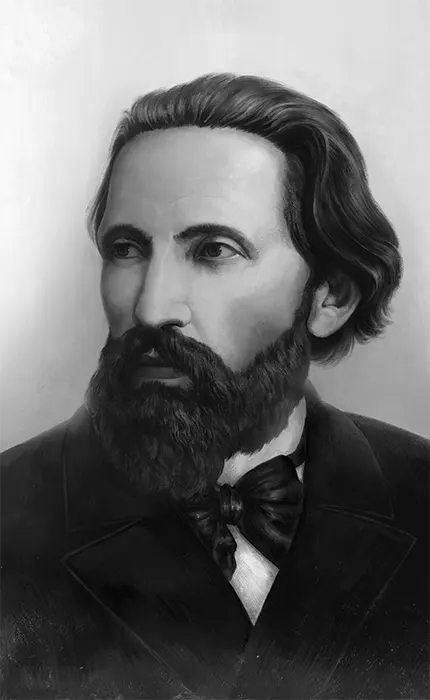
Viktor Kirpichev
Graduate of the Polotsk Cadet Corps (1862)
Viktor Kirpichev
Victor Kirpichev, rightfully called the "father of Russian engineers", was an organizer of higher technical education in Russia, the founder and first director of the Kharkiv Practical Technological Institute and the Kyiv Polytechnic Institute, the creator of a scientific school in mechanics and mechanical engineering, and an Actual Privy Councilor.
Education
In 1856, he enrolled in the Polotsk Cadet Corps, where he received his initial military education. His four brothers – Lev, Nil, Konstantin, and Mikhail –also studied there, and all later became renowned scientists.
The level of training at the Cadet Corps was high. Even then, Victor Kirpichev began reading scientific articles and literature and studying foreign languages. He excelled in mathematics. He graduated from the Cadet Corps in 1862. After his studies at the Mikhailovsky Artillery School, he served in the Kronstadt Fortress Artillery. In 1865, he entered the Mikhailovsky Artillery Academy, where he was later retained as a tutor. A year later, he became a lecturer, teaching his first-ever course on the strength of materials while simultaneously managing the affairs of one of the commissions of the Artillery Committee.
Teaching and scientific career
However, the young scientist was not drawn to a military career, and in 1870, Victor Kirpichev transferred to the St. Petersburg Institute of Technology. During his years there, he gained fame as an outstanding lecturer. His works, "The Law of Similarity" and "The Law of Uniformity", were published in 1878 and 1881. Between 1872 and 1874, he participated in research led by the great scientist D. I. Mendeleev on describing the properties of real gases. In 1876, Kirpichev was elected a Professor and Secretary of the Institute's Academic Committee. He not only taught numerous courses but also headed the mechanical laboratory. During this period, he published a series of articles and took an active part in the work of the Imperial Russian Technical Society, serving as a member of its Council.
In 1885, as an eminent scientist and experienced educator, Victor Kirpichev was entrusted with organizing the Kharkiv Practical Technological Institute and was appointed its first director. Between 1885 and 1898, he succeeded in creating a model institution of higher technical education. For the first time in Russia, he implemented a new, progressive approach to structuring the educational process, which harmoniously combined theoretical training, practical and laboratory work, and industrial internships. Within the institute's walls, Victor Kirpichev prepared and delivered a series of courses, including Strength of Materials, Graphic Statics, Machine Components, Thermodynamics, and Theoretical Mechanics, among others. He generated relevant ideas and gathered like-minded followers around him. He aspired for the engineers educated at KhPTI to be not only scientists and technical specialists but also organizers of industrial production.
In 1897, Victor Kirpichev's textbook "Foundations of Graphical Statics" was published in Kharkiv. The first printed edition of his famous textbook "Strength of Materials. Part I: The Study of the Strength of Structures and Machines" was also produced in Kharkiv in 1898, with the second part published in 1900. This work became a standard reference for many generations of students and engineers.
Kirpichev organized his work on the close connection between science and industry. This was an advanced step compared to the system of engineering training abroad.
In 1898, Victor Kirpichev became the first director of the newly established Kyiv Polytechnic Institute, founding the Kyiv school of mechanics. The institute's work was based on the principle of combining technical education with scientific experiment. N. Zhukovsky and D. Mendeleev spoke highly of the educational standards and noted the exceptional quality of specialist training at the institute. During his time in Kyiv, he published a series of remarkable scientific works. In 1902, his work "Graphical Statics" was published, which remains in print to this day. In 1903, he published "Redundant Unknowns in Structural Mechanics", one of his most outstanding works.
In the spring of 1902, the Kyiv Polytechnic Institute was closed due to student unrest and the participation of its students. Victor Kirpichev was transferred to St. Petersburg and appointed a member of the Council for Educational Affairs of the Ministry of Finance.
Prime Minister Sergei Witte, who highly valued Kirpichev's organizational talent, appointed him chairman of the Construction Commission to complete the construction of the St. Petersburg Polytechnic Institute. Later, Victor Kirpichev returned to scientific and pedagogical work, teaching the first course in Russia on "Applied and Structural Mechanics". He established an applied mechanics laboratory and a special friction laboratory at the institute, where the study of elastic deformations using optical methods began. On this topic, he authored the monograph "Optical Study of Elastic Deformations" (1913), which remains relevant today.
The teaching methods and educational materials developed by Victor Kirpichev significantly influenced the training of engineers worldwide.
Final years
The unexpected death on October 7, 1913, interrupted the work of the greatest scientist who dedicated his life to the advancement of the science of mechanics and higher technical education.

