




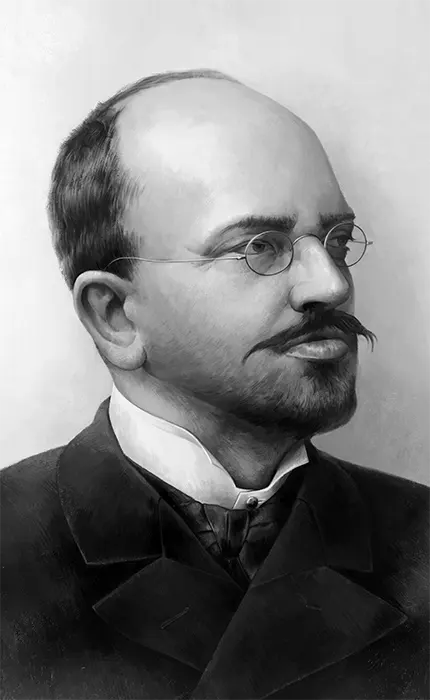
Vladimir Chizh
Graduate of the Polotsk Cadet Corps (1872)
Vladimir Chizh
A renowned psychiatrist, writer, and the first Russian psychiatrist to employ experimentation in his clinical and psychological research. He was also one of the founders of the psychological theory of personality and individuality.
Education
In 1872, he graduated from the Polotsk Military Gymnasium, and in 1878, he graduated with honors from the Imperial Military Medical Academy. He initially served as a naval physician at the Kronstadt Military Hospital, where he developed an interest in psychiatry. Subsequently, he worked in civilian medical institutions.
Teaching and Scientific Activity
In 1883, V.F. Chizh earned his Doctor of Medicine degree. He was later sent for an internship in Europe, where he worked at Wilhelm Wundt’s Psychological Institute in Leipzig, as well as in the psychiatric clinics of Paul Flechsig (in Leipzig) and Jean-Martin Charcot (in Paris).
In 1886, Chizh became a Privat-dozent at the Imperial Military Medical Academy in Psychiatry and Nervous Diseases. In 1888, he became a Privat-dozent at the Faculty of Law of St. Petersburg University, lecturing on forensic psychopathology. In 1891, he was appointed Professor of Psychiatry and Neurology at the University of Dorpat (later Yuryev, now Tartu) and in 1904, was elected Dean of the Faculty of Medicine.
Vladimir spent a quarter of a century in Yuryev, heading the Department of Psychiatry, managing the Clinic for Mental and Nervous Diseases, and delivering numerous courses, including one on forensic medicine – a true innovation for its time. Furthermore, he was one of the first Russian psychiatrists to give public lectures.
The lecture halls where the young professor, gifted with a rare talent for public speaking, delivered his courses were always packed. Chizh captivated the youth with his novel approach to the pressing issues of the time, encompassing medical, philosophical, and even legal questions. He often reiterated that “medicine is not only a science but also an art”, and continuously developed ideas about the interconnection of psychology and psychiatry, emphasizing the necessity of deeply penetrating the “core of the personality”. He instilled in future physicians that a doctor’s success depends on the combination of specialized knowledge with an understanding of history, art, and literature. Chizh himself, with his scientific authority, vast erudition, and high culture, was a living embodiment of this approach.
V.F. Chizh participated in the first international psychology congresses held at the end of the 19th century. He was elected a member of several domestic and foreign scientific societies, including the Moscow Psychological Society, the Russian Society for Normal and Pathological Psychology, and others. He served as the editor for the section on social psychology in the journal “Vestnik Psikhonevrologicheskogo Instituta” (Bulletin of the Psychoneurological Institute). He authored approximately 200 printed works, including several monographs on various aspects of psychiatry, neuropathology, criminal anthropology, and psychology. Among his notable works are “Scientific Psychology in Germany”, “The Scope of Consciousness in Healthy and Mentally Ill Individuals”, “Lectures on Forensic Psychopathology”, “Hypnosis and Suggestion”, “Pleasure and Suffering”, “Criminal Anthropology”, and “The Psychology of Love”, among others.
Being a physician with broad interests, Chizh constantly sought ways and means to penetrate the essence of mental illnesses. In 1886, he published the results of an experimental study titled “Apperceptive Processes in the Mentally Ill”. This was the first experimental-psychological study conducted in Russia in line with the views of W. Wundt. Over the following decade, the scientist conducted a series of further studies of the same kind.
V.F. Chizh was renowned as an experienced clinician and a talented writer on psychopathology, a connoisseur of history and literature, who studied the psychology of prominent individuals through the traces of their life activities. Among his works were psychiatric analyses of the biographies and literary legacies of F.M. Dostoevsky ("Dostoevsky as a Psychopathologist"), A.S. Pushkin (“Pushkin as an Ideal of Mental Health”), I.S. Turgenev (“Turgenev as a Psychopathologist”), N.V. Gogol (“The Illness of N.V. Gogol”), and others. He authored a number of works on the lives of political and literary figures, in whose behavior he attributed much to the pathological traits of their personalities.
Participation in World War I
During World War I, Vladimir served as a physician on the theater of military operations until May 1917. In the same year, he was appointed authorized representative of the Russian Red Cross in Kyiv, where he was involved in organizing public assistance for mentally ill soldiers of the Russian army.
End of Life
Vladimir Chizh passed away in 1922 at a home for elderly writers near Kyiv.

