




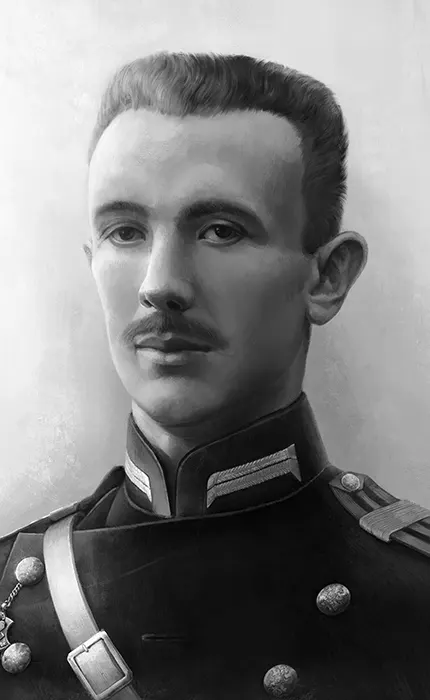
Vladimir Grushvitsky
Graduate of the Polotsk Cadet Corps (1907)
Vladimir Grushvitsky
Chemist and professor at the Leningrad Pharmaceutical Institute; a notable Soviet science‑fiction writer under the pen name Vladimir Orlovsky.
Education and early career
Grushvitsky graduated from the Polotsk Cadet Corps in 1907 among the top students, and in 1910 from the Konstantinovsky Artillery School in Saint Petersburg. Before World War I he attended the Nikolaev Engineering Academy. From 1914 to 1917 he served at the front; after the October Revolution he sided with the Bolsheviks and until 1920 served in the 9th Army of the Southern Front as head of engineering services.
In 1921 he enrolled at the Faculty of Physics and Mathematics of Leningrad State University and graduated in 1927. He then worked at the Leningrad Pharmaceutical Institute, became a professor, and headed the Department of Inorganic Chemistry.
Scientific and literary work
At the Pharmaceutical Institute he published innovative research in chemistry—especially in halurgy—and helped establish the field academically in the USSR. He was a founder in 1935 of the All‑Union Research Institute of Halurgy (VIG) under the People’s Commissariat of Heavy Industry.
In 1937 he issued a methodological guide on applying physicochemical analysis to halurgy and proposed a method to construct crystallization vectors for studying mutual solubility diagrams.
Grushvitsky also explored scientific ideas through fiction. His literary activity began early—while a cadet he edited the journal Polochanin in 1906–1907. Under the pen name Vladimir Orlovsky he published The Terror Machine, stories such as From Another World, Timmy’s Illness, The Man Who Stole Gas, Shtekerit, No Ether, and in 1928 his best‑known novel The Revolt of the Atoms, which imagines the catastrophic dangers of a global atomic disaster. In hindsight, some of his visions eerily foreshadow later real events.
His imaginative motifs influenced contemporaries: the fiery sphere from The Revolt of the Atoms was echoed by A. Kazantsev in The Burning Island, while elements from The Terror Machine and The Man Who Stole Gas found parallels in A. Belyaev’s The Lord of the World and The Seller of Air.
Death
Vladimir Evgrafovich Grushvitsky died in 1942 in besieged Leningrad from exhaustion.

