




The 28th International Exhibition for the Chemical Industry and Science Chemistry-2025 is being held from November 10 to 13 at the Timiryazev Center exhibition complex in Moscow.
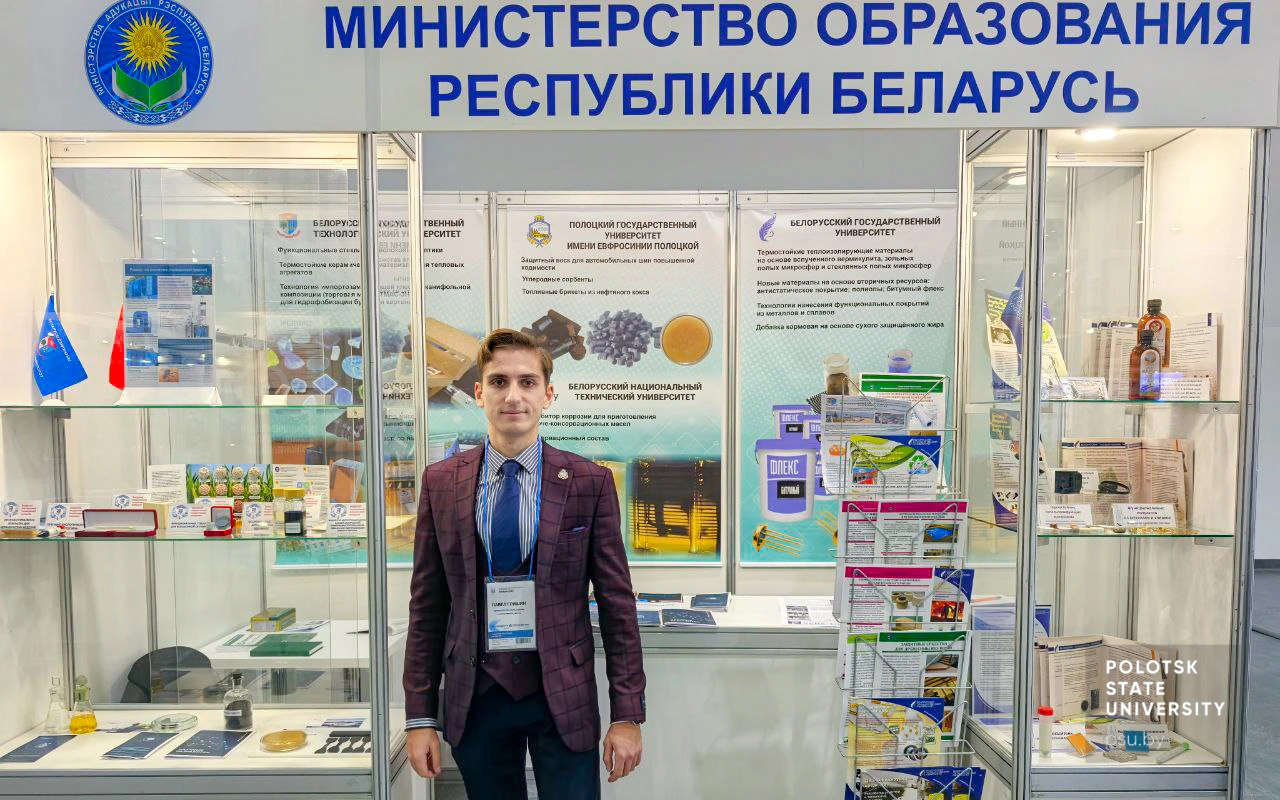
Senior Lecturer at the Department of Technology and Equipment of Oil and Gas Processing Pavel Grishin at the exhibition "Chemistry-2025"
The forum is organized by JSC "Expocentre" with the support of the Ministry of Industry and Trade of the Russian Federation, the Russian Union of Chemists, the "Roskhimreaktiv" Association, the Faculty of Chemistry of Lomonosov Moscow State University, the D.I. Mendeleev Russian University of Chemical Technology, and under the patronage of the Chamber of Commerce and Industry of the Russian Federation.
The exhibition has been held since 1965 and marks its 60th anniversary this year. The event has established itself as a platform for bringing together manufacturers of chemical products and services, suppliers of advanced technologies and equipment, and consumers from various industries worldwide. Today, this authoritative forum covers all areas of the chemical sector and provides a comprehensive overview of modern achievements in chemical science.
Chemical products and services at the exhibition are represented by 516 companies from eight countries: Russia, Belarus, India, Iran, Kazakhstan, China, Turkey, and Uzbekistan. In addition, national expositions from Belarus, India, Iran, and China are featured here.
Part of the delegation of the Ministry of Education of the Republic of Belarus:
- Mikhail Dyadenko – Head of the Research Department, Leading Research Associate at the Department of Glass and Ceramics Technology, Belarusian State Technological University.
- Pavel Grishin – Senior Lecturer at the Department of Technology and Equipment of Oil and Gas Processing, Euphrosyne Polotskaya State University of Polotsk.
- Marina Golmont – Research Associate of the State Scientific and Scientific-Technical Programs Support and Coordination Group, BSU "Research Institute of Physical and Chemical Problems".
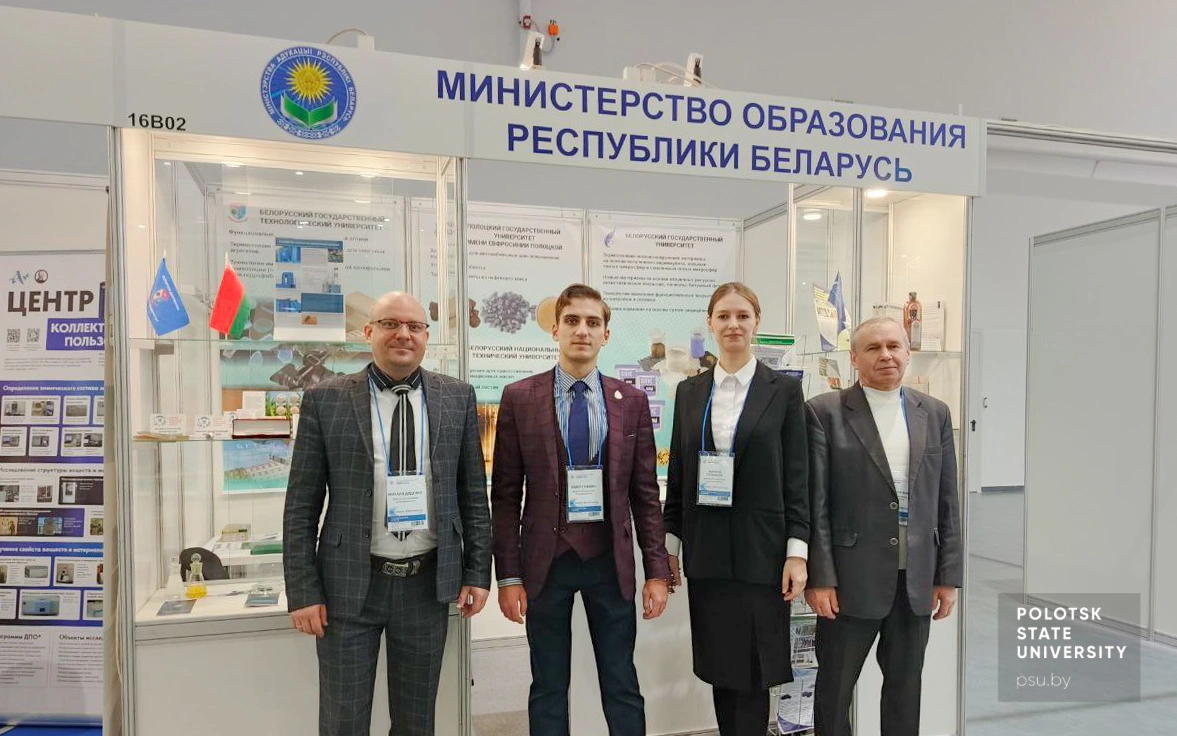
Belarusian delegation
The stand features physical prototypes of developments by scientists from Polotsk University:
- Protective Wax: Used in rubber compounds for the production of automotive tires. Its properties are equivalent to imported analogues. This development promotes the import substitution of raw materials and reduces the cost of finished products through the use of a domestic product.
- Organic Oil: Designed for the production of a polishing diamond-containing suspension used for double-sided polishing of silicon wafers. The oil's properties are equivalent to imported analogues and it is planned for use at JSC "Integral" in Minsk.
- Carbon Sorbents: Designed for use in the purification of aqueous and gaseous media from toxic contaminants, serving as filters for capturing gasoline vapors and other light hydrocarbons. They offer a solution for the rational use of high-sulfur petroleum coke and the disposal of coke dust and PET waste.
- Fuel Briquettes from Petroleum Coke: These briquettes address the problem of waste disposal, reduce dependence on traditional resources, and provide thermal energy. They have a high combustion heat, are environmentally friendly, and can be used as alternative fuel for industrial and communal-domestic needs, especially in regions with limited access to natural gas.
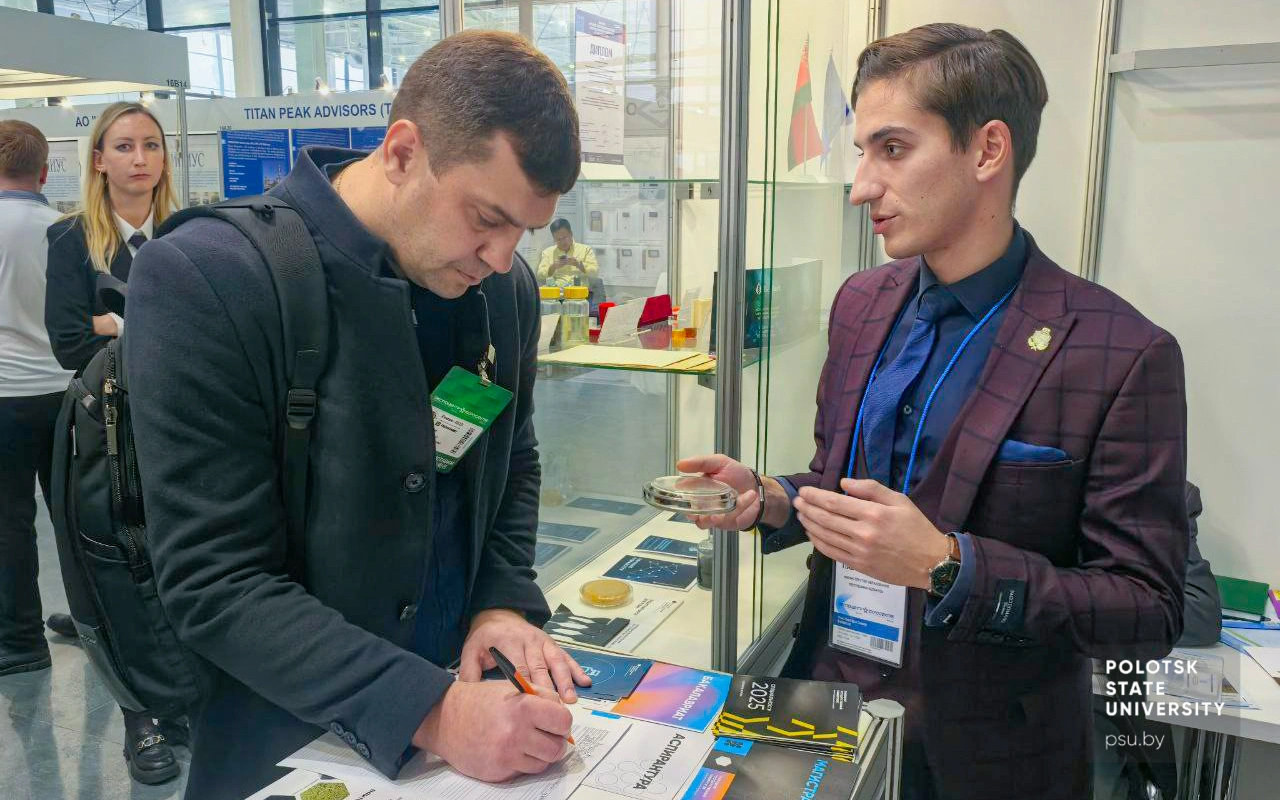
Pavel Grishin presents scientific developments
A number of events dedicated to key issues of the chemical industry's development are scheduled as part of the exhibition's business programme. The central event will be a plenary session focused on technological leadership, its challenges, and achievements.
During the panel discussions, experts will discuss the development of industry infrastructure and current trends in production digitalization. Special attention will be paid to import substitution in the low-tonnage chemicals segment, as well as an analysis of the current state and future prospects of the international chemical market. The business program will conclude with a large-scale event – the Congress of the Russian Union of Chemists.
The "Chemistry-2025" International Exhibition served as a communication platform for productive dialogue between science, business, and the state. The event laid a solid foundation for the next stages of development in the chemical industry.

