


Judicial Executor Through the Pages of History

Mobile Exhibition “Judicial Executor Through the Pages of History” of the Compulsory Enforcement Department of the Main Justice Directorate of the Vitebsk Regional Executive Committee
The concept of the project is to create a unique mobile and digital complex designed to educate citizens about the profession and service of judicial executors from the mid-16th to the early 21st centuries.
The project was developed on the basis of a permanent exhibition established at the Compulsory Enforcement Department in 2017. The initiative and direct involvement came from S.P. Konopelko, the Head of the Main Justice Directorate of the Vitebsk Regional Executive Committee.
The exhibition features archival original documents concerning the foundation of the Judicial Executor service of the Republic of Belarus. It also presents entirely authentic historical documents that reflect the early organization and functioning of the Judicial Executor service (then known as bailiffs) in the city of Vitebsk and the Vitebsk region, as well as subsequent periods in the development of the system.
The project is divided into six sections:
- Vitebsk Court Bailiff // 16th – 18th Centuries
- Police Rank of the Vitebsk Governorate // 18th Century
- Vitebsk Bailiff // 19th Century
- Soviet Judicial Executor // 20th Century
- Judicial Executor of the Republic of Belarus // 1991 – 2014
- Judicial Executor of the Republic of Belarus // Present Day
Each section is supplemented with QR codes. Using a mobile device to follow the exhibition route, visitors can independently take a full and engaging tour through the history of the development of compulsory enforcement bodies.
The uniqueness of this exhibition lies not only in its presentation of the historical development of the enforcement system in the Vitebsk region but also in its abundance of concrete facts, dates, surnames, and cartographic-topographic references. The mobile exhibition was developed using documents from the archives of institutions under the Department of Archives and Records Management of the Ministry of Justice of the Republic of Belarus, paintings by Belarusian artist B.G. Lalyko, as well as photographs and visual materials from the Ministry of Justice of the Republic of Belarus.
The implementation of the mobile exhibition project was carried out under the auspices of N.F. Ryazyapov, the Chief Judicial Executor of the Vitebsk Region. Technical support was provided by faculty and students of Euphrosyne Polotskaya State University of Polotsk.
The mobile exhibition has been featured on the popular science program “Science Nearby”.
Vitebsk Court Bailiff //
16th–18th Century
Vitebsk Court Bailiff // 16th–18th Century
The court bailiff (Latin: ministerialis) was a lower court official in Poland and the Grand Duchy of Lithuania. He delivered court summons and performed the duties of an investigator, bailiff, and court attendant. The waywode appointed the bailiff from among the local nobility based on the selection made by the land court and the nobility. After taking an oath, the bailiff’s name was entered into the court records, marking the formal start of his tenure. Each district had several bailiffs, with the chief among them known as the general (Latin: ministerialis generalis). Before the office of bailiff appeared in the Grand Duchy of Lithuania, another court official performed his duties.
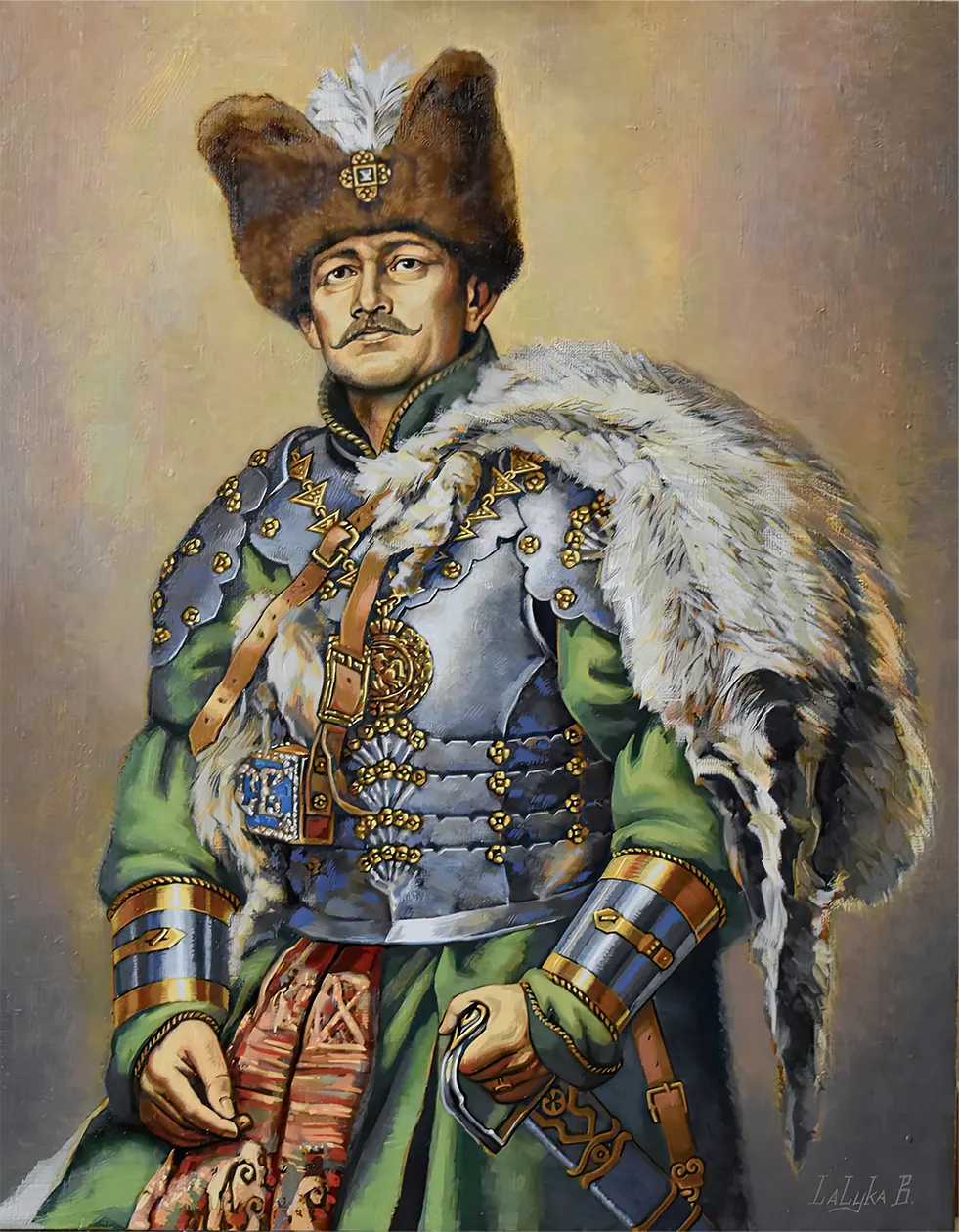
“Vitebsk Court Bailiff”
Painting by artist Boris Lalyko
The Statutes of 1566 and 1588 established the procedure for election and appointment, as well as the competence of the bailiffs. Bailiffs were elected at local assemblies in the presence of land court judges from among people “good, trustworthy, virtuous, and settled in the same district”. After election, the future bailiff received a “certificate of virtue and good conduct”. The waywodes then administered the oath and performed the symbolic “tonsure” ritual, which involved a ceremonial cutting the bailiff’s hair.
Oath of the Court Bailiff
“I, … , swear to the Lord God, One in the Holy Trinity, that as court bailiff in this district, I will conduct myself faithfully, virtuously, piously, and justly in this office. I will deliver and serve summons and all letters of His Grace the Sovereign and of the courts justly and diligently, and place them upon estates. I will truthfully testify without delay to what I am taken by a party and what I justly see and hear, having examined assaults, beatings, wounds, and damages, and report them truthfully into the court records immediately without procrastination. I will perform all other duties belonging to my office, not for bribes, gifts, promises, friendship, enmity, or fear of any threats, but acting according to God and holy justice. I will ride for every person in need without any contrived excuses or delay for legal purposes. So help me God, and if unjustly — may God strike me dead”.
Statute of the GDL (1588), Section IV, Article 8 “On the Appointment of Bailiffs and Their Oath”
After taking the oath and receiving the patent, the new bailiff’s full name was entered into the court records of both the castle court and land court of the district. In rotation, two or three bailiffs were required to perform constant duty at the castle court “for all incidental needs”. The number of bailiffs in a district depended on the size of its territory. Records show that the Slonim District elected nine bailiffs in 1565, while the Orsha District had twelve in 1589.

Statute of the Grand Duchy of Lithuania, 1588
Court bailiffs acted as judicial enforcers, government couriers, and performed notarial and police functions, including being obliged to detain criminals caught in the act, conduct inquiries, and escort detainees to places of confinement and court buildings. The law guaranteed the personal inviolability of the bailiff. Insulting a bailiff resulted in a double monetary fine and 12 weeks of imprisonment. Killing him carried a double monetary compensation to the victim’s relatives and the death penalty. Furthermore, Article 6 of Section III of the 1588 Statute of the GDL stipulated that bailiffs “for such local services shall be free from military service”. This exempted them from personal participation in the levée en masse during military campaigns. In turn, for lying during official testimony, a bailiff faced the death penalty. For other offenses, he received 12 weeks of imprisonment and monetary fines.
The 1588 Statute of the GDL also provided for the introduction of “general” bailiff in all districts starting in 1589 (Section IV, Article 104). He served as the head of all bailiffs in a district. After the district assembly approved a candidate for general bailiff, the district nobility presented him to the monarch for confirmation. In the 17th century, contrary to the 1588 Statute of the GDL, several general bailiffs operated simultaneously not only in Samogitia but also in some other districts. General bailiffs had the right to perform their functions on the territory of other districts as well.
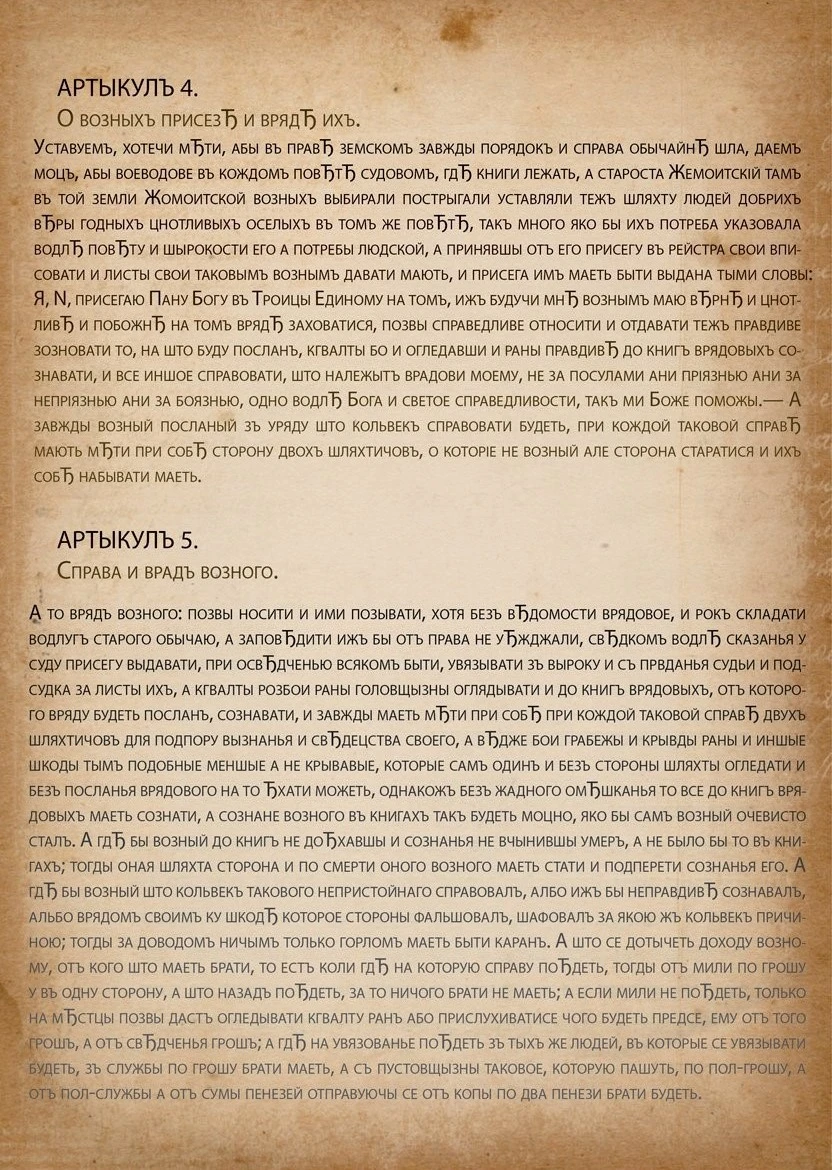
Statute of the GDL, 1566. Article 4.
On the oath of bailiffs and their office
Article 5.
The duties and office of the bailiff
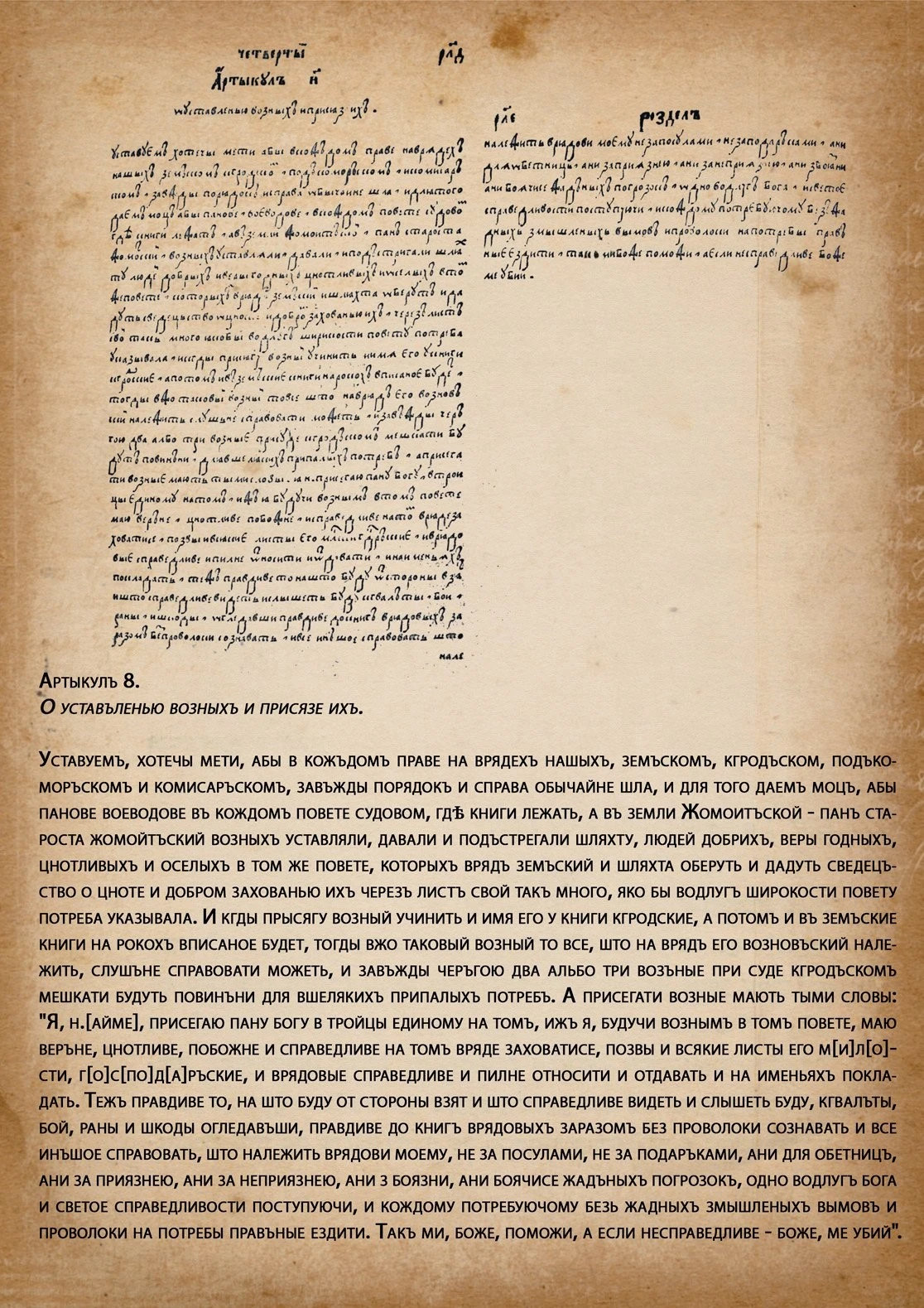
Statute of the GDL, 1588. Article 8.
On the appointment of bailiffs and their oath
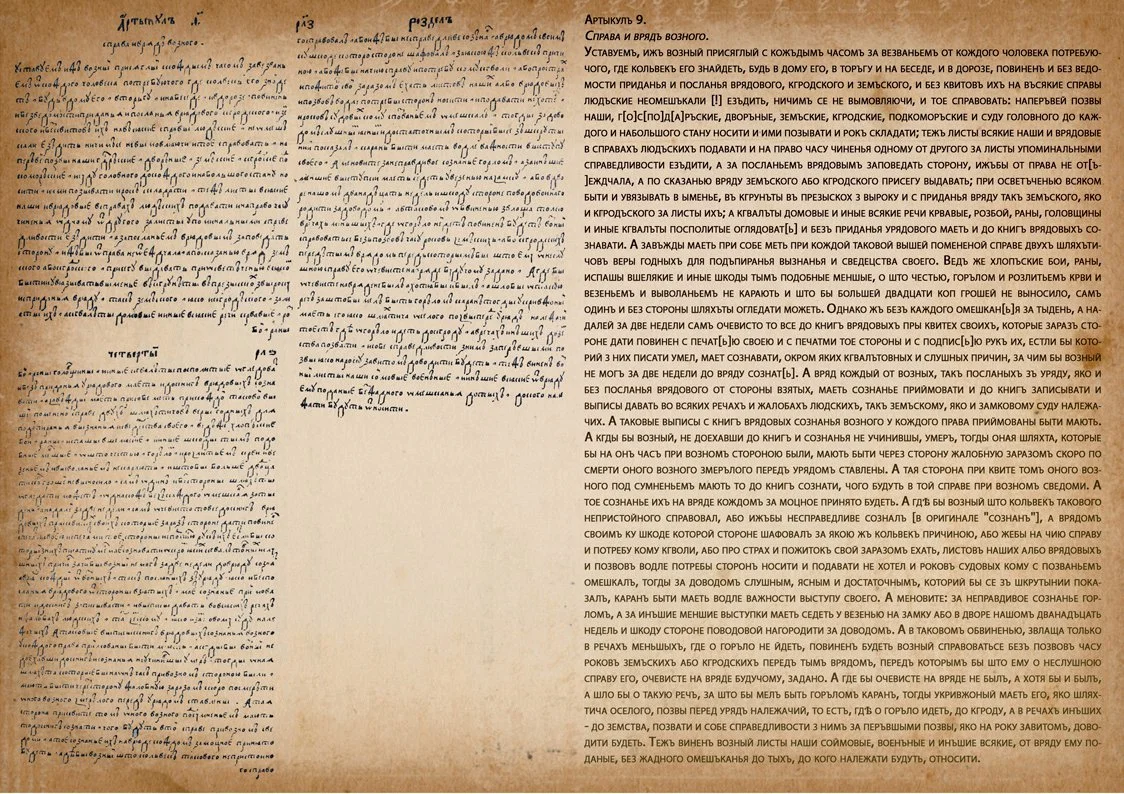
Statute of the GDL, 1588. Article 9.
The duties and office of the bailiff
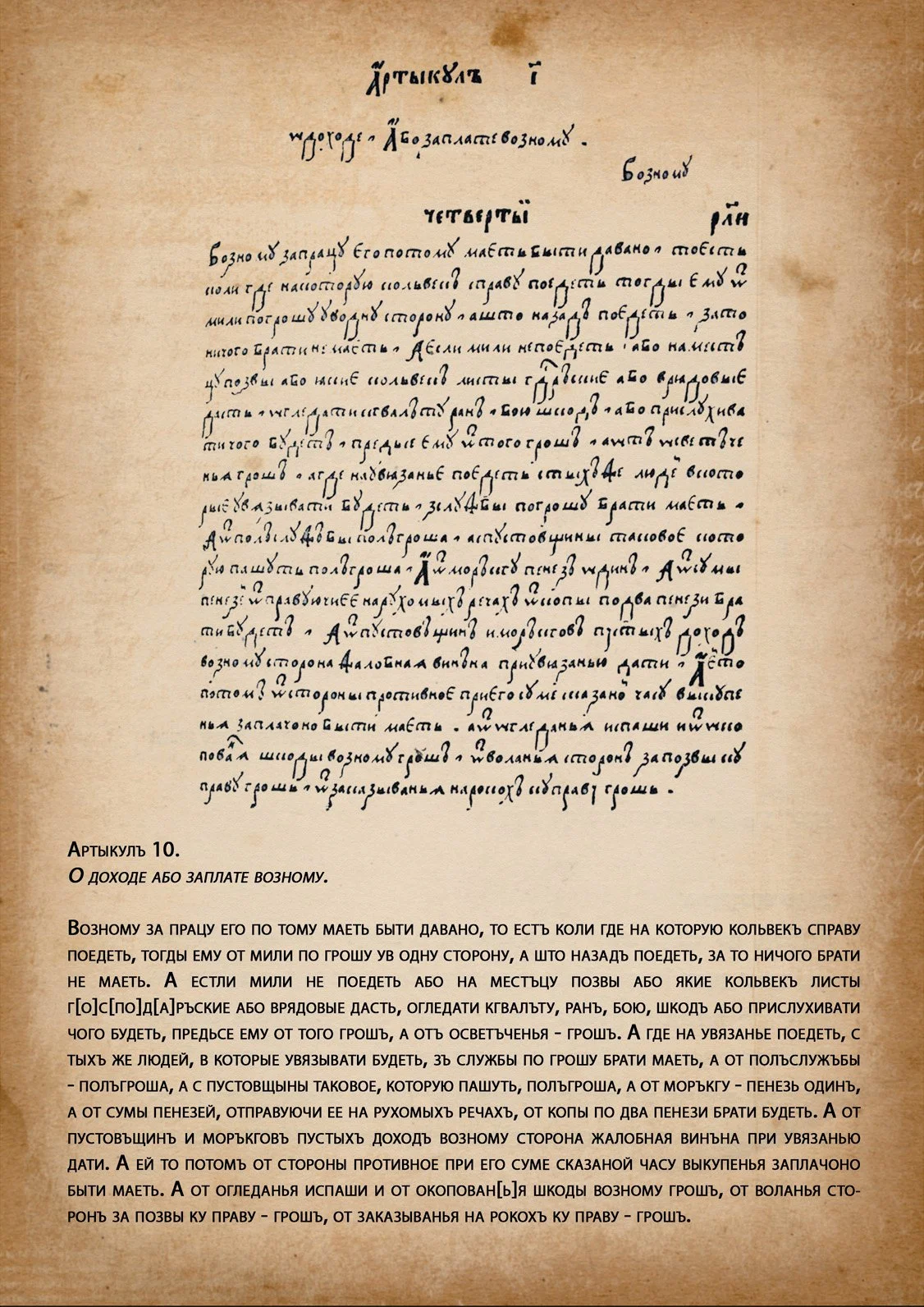
Statute of the GDL, 1588. Article 10.
On the fees or payment to the bailiff
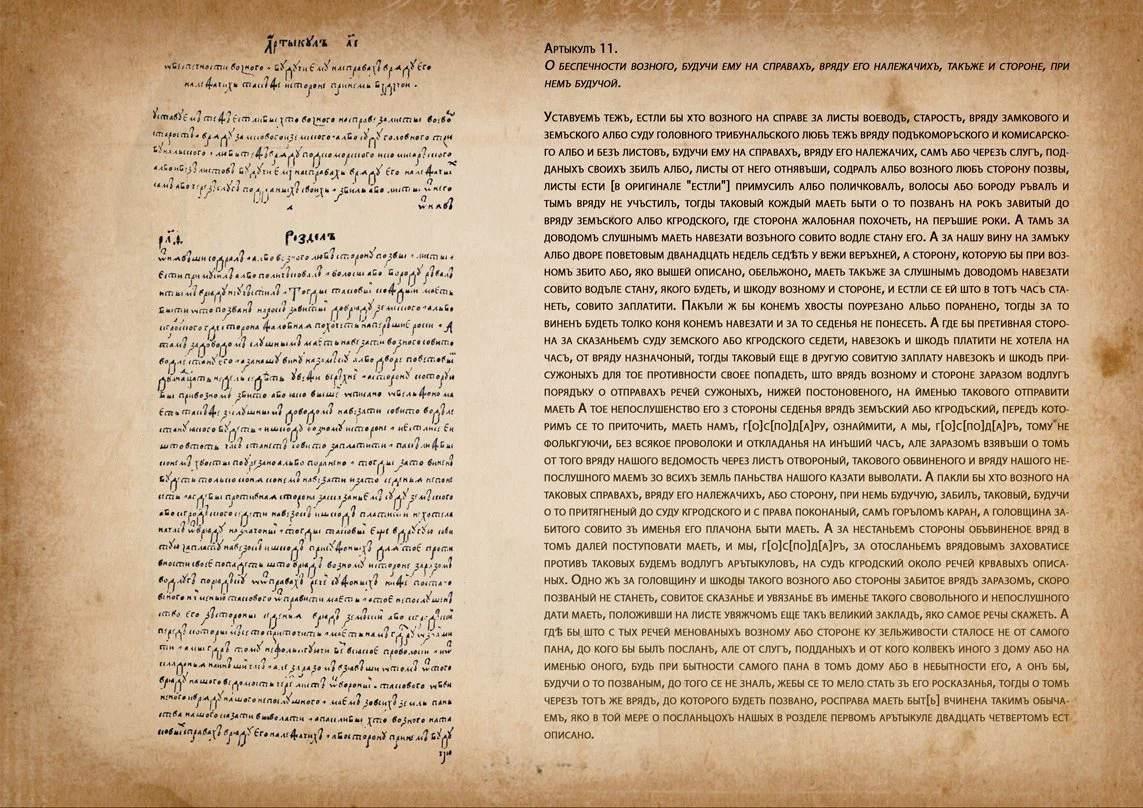
Statute of the GDL, 1588. Article 11.
On the inviolability of the bailiff and the party accompanying him during his official duties
Police Rank of the Vitebsk Governorate //
18th Century
Police Rank of the Vitebsk Governorate // 18th Century
In 1768–1772 Commissions of Good Order (boni ordinis) were established in the cities of the Grand Duchy of Lithuania that were under royal jurisdiction (Mogilev, Polotsk, Vitebsk, and others). These local administrative bodies were responsible not only for urban planning according to new regulatory plans and for fire safety, but also acquired certain police functions in the modern sense of the term. In 1775, the Permanent Council (Rada Nieustajaca) was created as the central administrative body of the Polish–Lithuanian Commonwealth, functioning from 1775 to 1789. One of its five departments was the Department of Police, also known as the Department of Good Order. This department consisted of eight members, including senators and representatives of the entire nobility, who made decisions collectively by an absolute majority of votes. Initially, the competence of the Police Department was quite narrow, limited to overseeing the activities of the Commission of the Marshals of Both Nations established in 1776. The law "On the Duties and Authority of the Departments in the Permanent Council", passed later that same year, significantly expanded the Department’s powers. It received the right to audit the accounts of royal cities and allocate part of their revenues for police needs. Nevertheless, attempts to extend the Department's authority over the Commissions of Good Order failed, these commissions never became local branches of the Department.

“Police Rank of the Vitebsk Governorate of the 18th Century”
Painting by artist Boris Lalyko
On November 6, 1789, civil and military "order" commissions were established. From February 1790 onward, they functioned as permanent local executive bodies. Each commission consisted of 15 commissioners elected by local assemblies for two-year terms from among the settled nobility. There were 23 such commissions operating in the administrative centers of the Grand Duchy of Lithuania. Their responsibilities included organizing fire services, resolving disputes between military and civilian personnel, overseeing compliance with government orders, monitoring population movement, and adjudicating cases of administrative offenses. Their decisions on such offenses were final and without appeal, provided the penalty did not exceed 50 zlotys and three days in jail. Other cases, submitted by "district overseers", were referred to the Police Commission of the Two Nations for final resolution. The order commissions didn’t handle criminal cases.
On May 3, 1791, the Four-Year Sejm adopted the Constitution, drafted with the participation of Hugo Kołłątaj and Ignacy Potocki. This Constitution implemented the principle of separation of powers for the first time. The highest executive authority of the Commonwealth became the Guardians of the Laws, the central government of the federation, which included a Minister of Police. This position could be held either by the Grand Marshal of the Crown or the Grand Marshal of the Grand Duchy of Lithuania. On June 28, 1791, the Police Commission of the Two Nations was established and subordinated to the Guardians of the Laws, which was a prototype of a federal Ministry of Internal Affairs. It was a central collegiate body responsible for maintaining public safety and executing court decisions. Its activities were directed by the Court Marshals assisted by a chancellery of six persons. The Commission consisted of 15 commissioners, including three senators and six sejm deputies elected by the general sejm for two-year terms, as well as six plenipotentiaries from cities. The "Reciprocal Guarantee of Two Nations" of the Polish Crown and the Grand Duchy of Lithuania dated October 20, 1791, stipulated different principles for forming the "great" commissions. It was a treaty supplementing the Union of Lublin. While the Finance and Military Commissions were formed on a parity basis for the two federation members (the Crown and Lithuania), the Commission of Police of Two Nations was formed on a parity basis for the three provinces of the Commonwealth: Greater Poland, Lesser Poland, and Lithuania. Each province delegated one-third of the Commission’s members.
The competence of the Police Commission, which oversaw the administrations of royal cities, encompassed the entire sphere of so-called "order-based civil police". This included ensuring the safety and tranquility of residents, combating crime, organizing prisons, as well as matters of "public benefit", in other words, a broad understanding of administration. Consequently, the Commission was responsible not only for law enforcement but also for urban planning, social welfare (directing beggars and the destitute to forced labor houses), public health, trade regulation, copyright protection, supervision of communications, and the collection of statistical data. To enforce its decisions, the Police Commission had two cavalry banners at its disposal and, if necessary, could call upon regular military units. The entire territory of the Commonwealth was divided into 26 police districts subordinate to the Police Commission, which were called intendancies and were headed by police intendants assisted by guards. The Commission of Police of Both Nations was abolished by decision of the Targowica Confederation and the Confederation of the Grand Duchy of Lithuania on August 24, 1792.
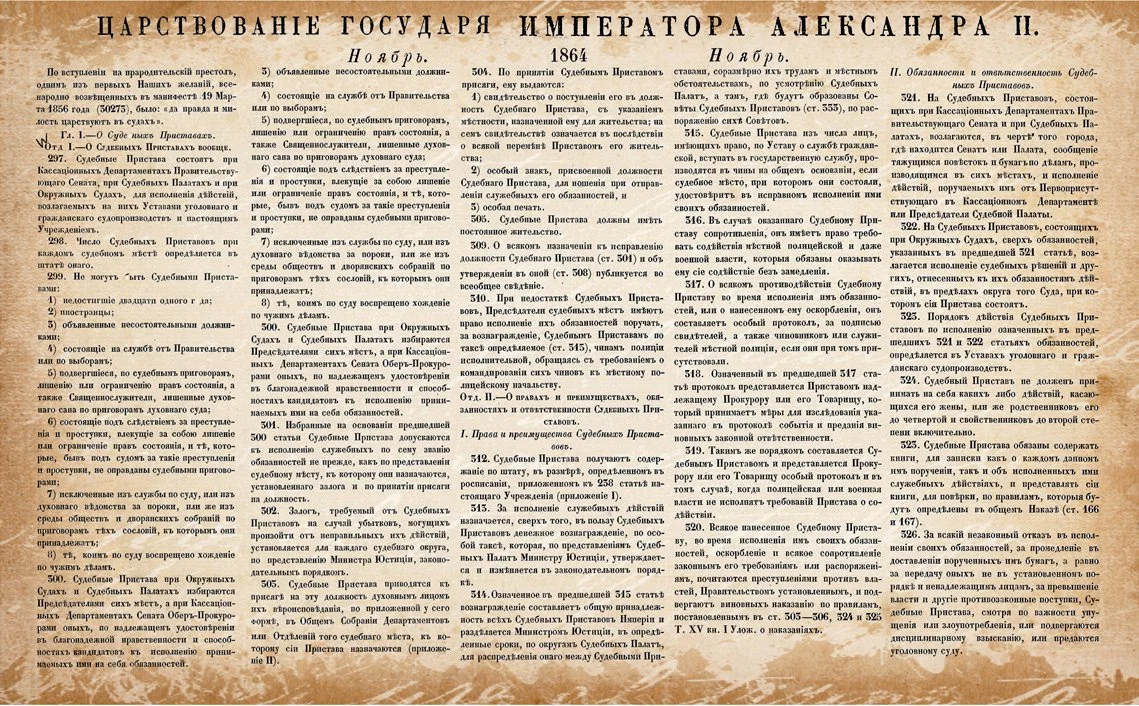
His Imperial Majesty's Approved Establishment of Judicial Institutions
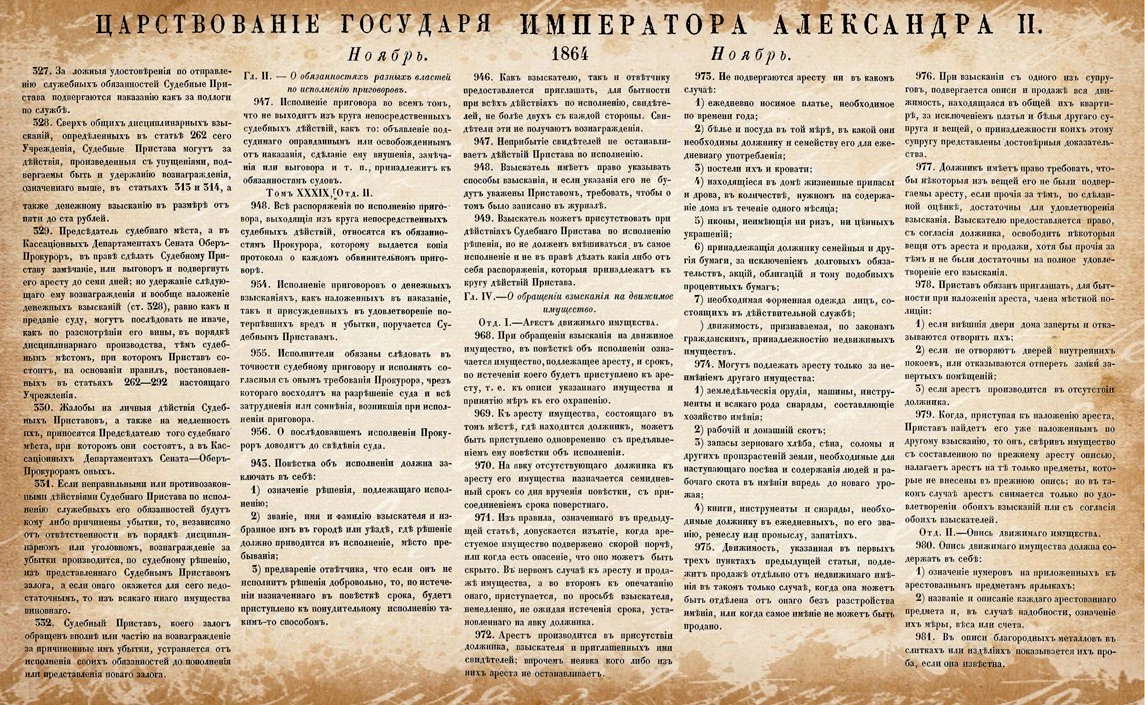
His Imperial Majesty's Approved Statute of Civil Procedure
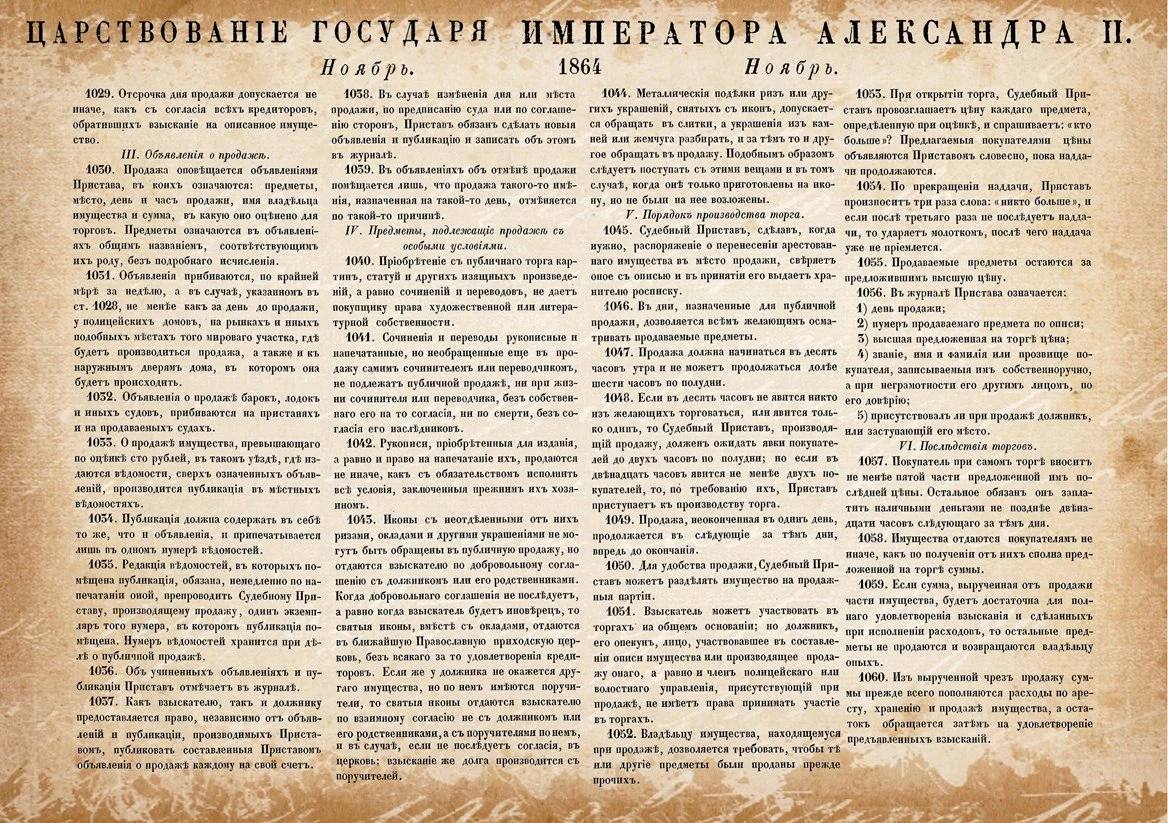
His Imperial Majesty's Approved Statute of Civil Procedure
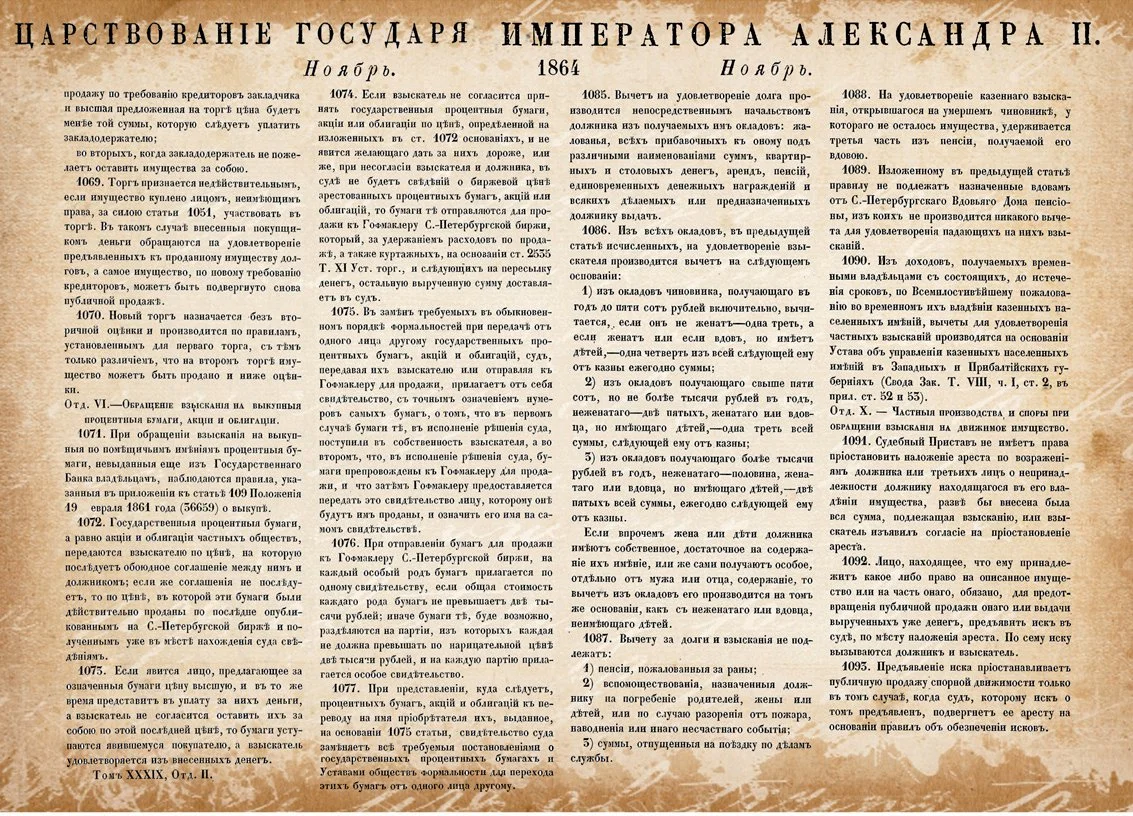
His Imperial Majesty's Approved Statute of Civil Procedure
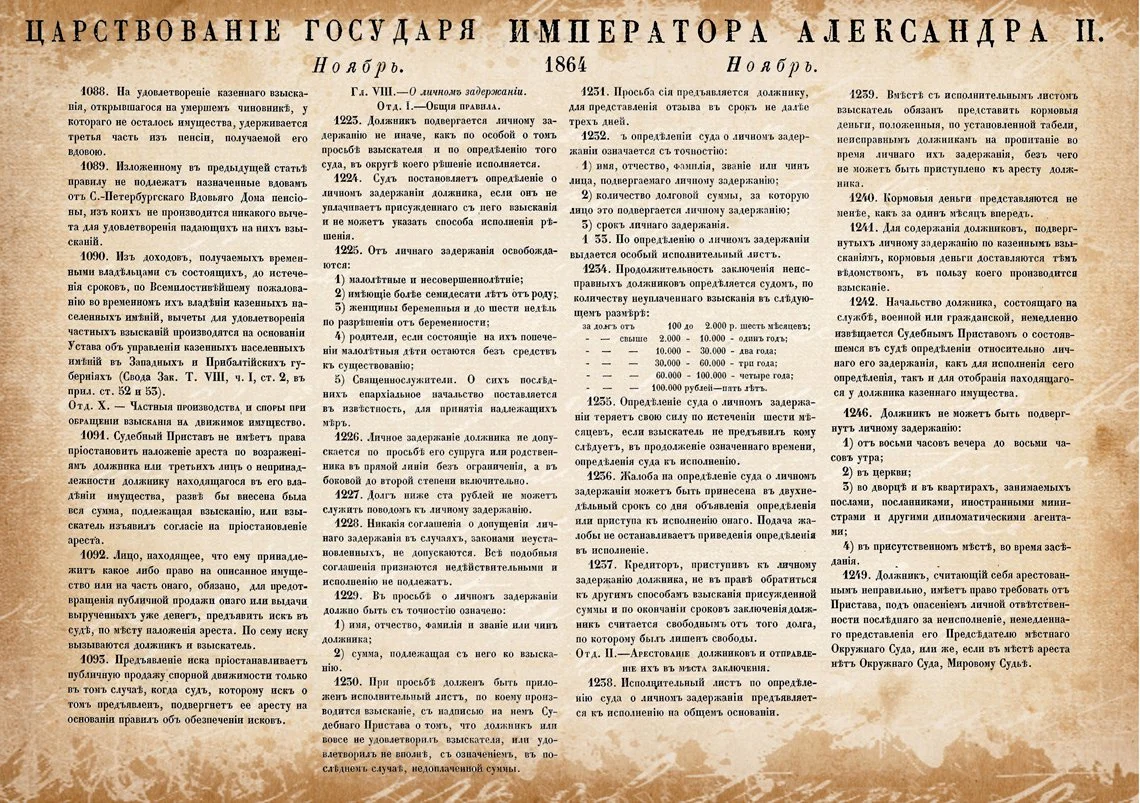
His Imperial Majesty's Approved Statute of Civil Procedure
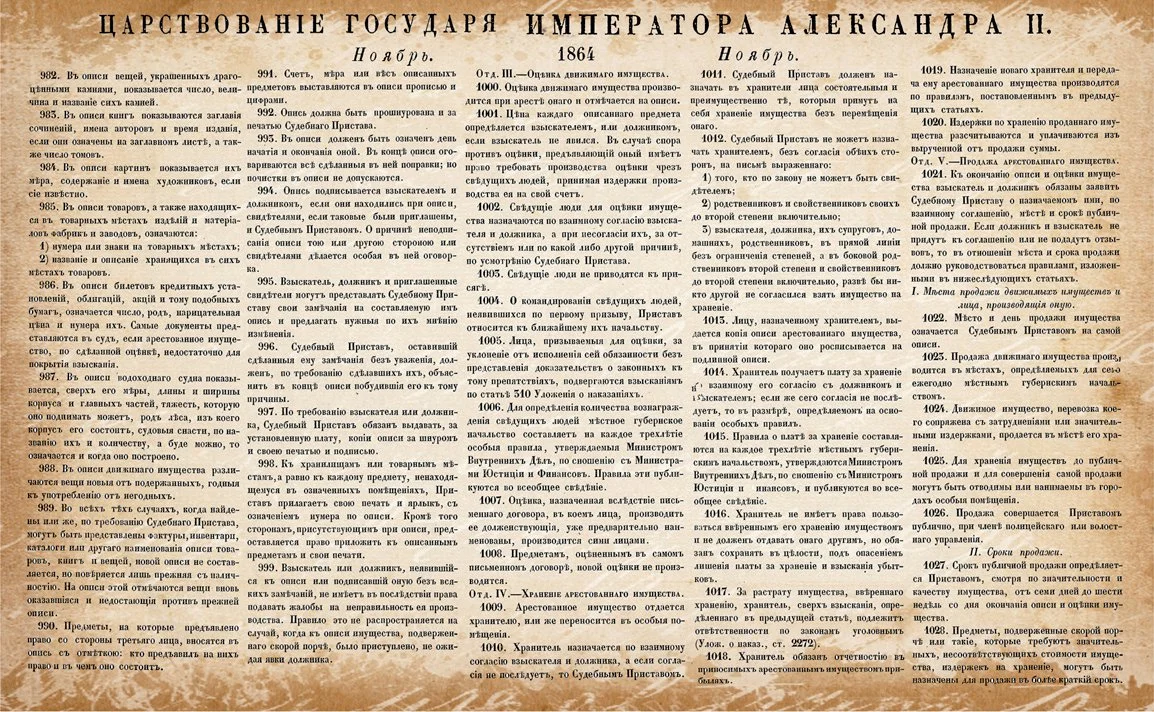
His Imperial Majesty's Approved Statute of Civil Procedure
Vitebsk Bailiff // 19th Century
Vitebsk Bailiff // 19th Century
The Vitebsk Governorate, established at the beginning of the 19th century, was part of the Russian Empire. The judicial system and the apparatus for executing court decisions were built on national legislative acts. The work of bailiffs was guided by the rule that justice was considered accomplished only when the court's decision had been executed.
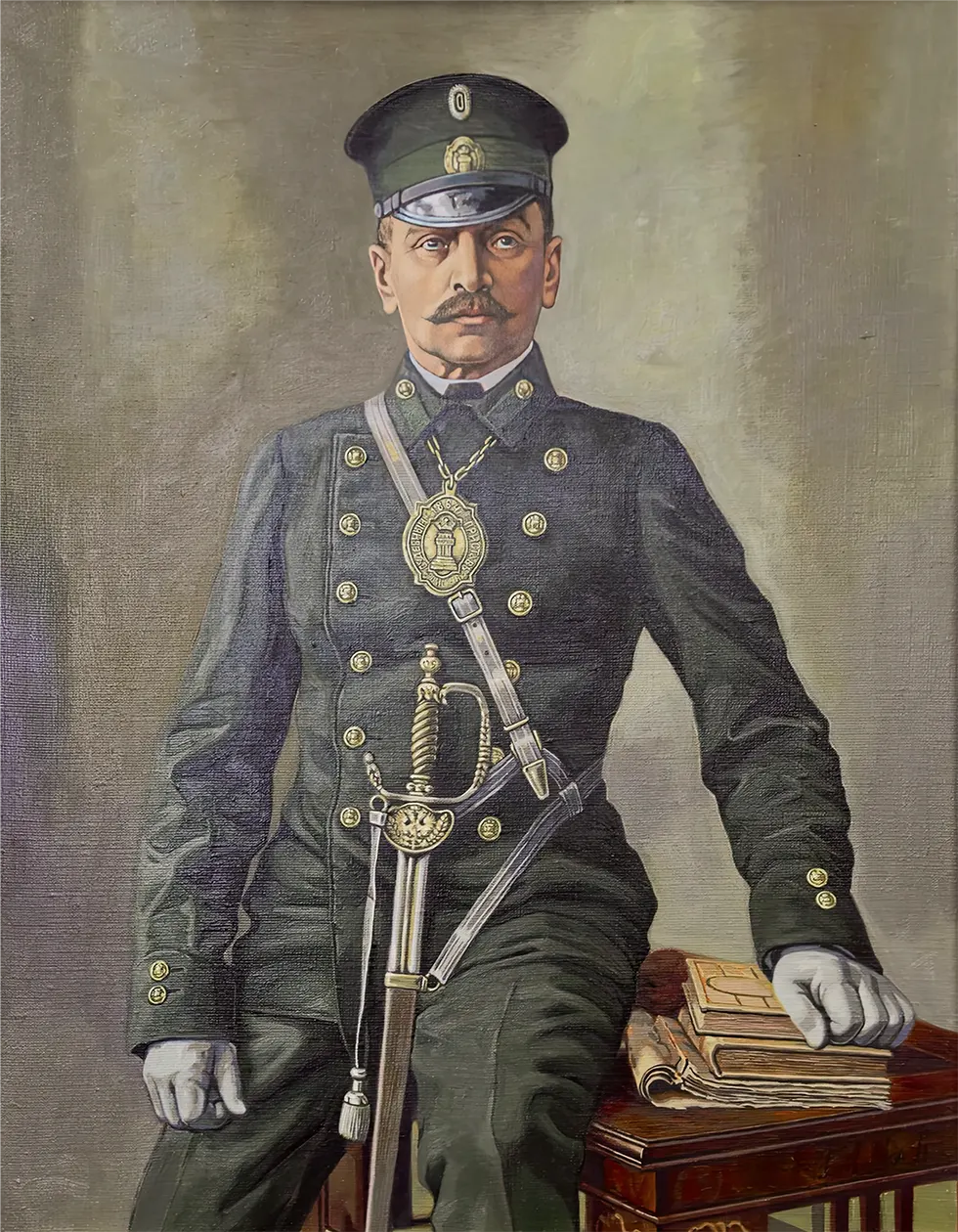
“Vitebsk Bailiff of the 19th Century”
Painting by artist Boris Lalyko
After the February Revolution (1917), the Vitebsk Governorate became part of a new administrative-territorial formation — the Western Oblast. The Oblast was created by new bodies — the Soviets — and existed without official status. Legally, the Vitebsk Governorate continued to be part of Russia, and this situation led to the absence of any changes in the judicial system and the procedure for executing court decisions.
The October revolutionary events not only led to the governorate being officially included in the Western Oblast (from 13.09.1918 — the Western Commune) as of 07.11.1917, but also completely changed the principles of operation of courts and bailiffs[1, pp.5-6]. Despite the fact that the Oblast, and later the Commune, were autonomous units, all decrees and resolutions of the central bodies of the new Soviet Russia, which received the official name of the Russian Soviet Republic (from 19.07.1918 — the Russian Socialist Federative Soviet Republic (RSFSR)), applied to them.
Thus, the Decree of the Council of People's Commissars (CPC) of 24.11.1917 "On Court" (hereinafter — Decree No. 1) abolished all general judicial institutions that existed before October 1917 on the territory of the former Russian Empire (district, commercial, military and naval courts of all types, judicial chambers and the governing Senate with all departments), as well as judicial investigators. Prosecutorial supervision, the activities of justices of the peace, juries, and private attorneys were suspended. Decree No. 1 did not directly mention the abolition of the institution of bailiffs, but such a conclusion suggests itself, firstly, because the imperial system of legal proceedings was completely abolished; secondly, Decree No. 1, from 25.10.1917, suspended the running of all procedural deadlines. Even earlier, the CPC Decree of 11.11.1917 postponed for two months payments on promissory notes and writs of execution [2].
Having abolished the pre-revolutionary judicial system, Decree No. 1 introduced a new one — a system of local people's courts, but did not define a new procedure for executing court decisions.
On 15.02.1918, the All-Russian Central Executive Committee of Soviets of Workers', Soldiers' and Peasants' Deputies (VTsIK) issued Decree "On Court" No. 2[3] to develop and supplement Decree No. 1. On 20.07.1918, the CPC of the RSFSR adopted Decree "On Court" No. 3[22]. In accordance with them, district people's courts were established to hear cases exceeding the jurisdiction of the local people's court. Decree No. 3 renewed the running of deadlines for all cases that had been suspended since 25.10.1917, starting from 1 August 1918.
It was also established that legal proceedings, both in civil and criminal cases, were to follow the rules of the Judicial Statutes of 1864, insofar as, on the one hand, they had not been repealed by the new government, and on the other, they did not contradict the revolutionary legal consciousness of the working people. At the same time, judges were advised to rely primarily on socialist legal consciousness when making decisions. But most importantly, Article 35 of Decree No. 2 determined that "the execution of decisions and sentences, pending a special decree on elected enforcement bodies, shall be carried out in the previously existing procedure, with members of the militia replaced by the Red Guard." Thus, it can be concluded that with the abolition of the institution of bailiffs in November 1917, their duties were transferred to the militia bodies, which were being created in accordance with the resolution of the People's Commissariat for Internal Affairs (PCIA) of 28.10.1917; and after 15.02.1918, the execution of court decisions could be carried out both by militia bodies and by Red Guard formations. The duties of executing court decisions by militia bodies were also enshrined in point 28 of the "Instruction on the Organization of the Soviet Workers' and Peasants' Militia," approved by a joint resolution of the People's Commissariat of Justice (PCJ) and the PCIA of the RSFSR of 13.10.1918[4]. Unfortunately, due to the lack of archival sources, it is impossible to determine exactly how the judicial enforcement system worked in the Vitebsk Governorate during this period. At the same time, there is no reason to believe that it could have functioned on any special principles.
On 23.07.1918, the PCJ of the RSFSR approved by its resolution the instruction "On the Organization and Operation of Local People's Judges"[5]. Although it did not resolve the main issues of enforcement proceedings, Article 47 of the instruction stated that the local people's court immediately executes sentences imposing punishment of no more than 7 days of imprisonment or a monetary penalty not exceeding 500 rubles, as well as decisions in civil cases awarding no more than 500 rubles. Thus, a third structure was included in the judicial enforcement system — the people's courts (narcourts). For this purpose, judicial executors were introduced into their composition. This term was first used in the "Regulation on the People's Court" (hereinafter — the Regulation on the Court), approved by the Decree of the VTsIK of the RSFSR of 30.11.1918, where Article 80 stated that judicial executors enforce decisions in civil cases and "any monetary penalties"[6, sh.5].
An analysis of archival documents has not yet made it possible to determine exactly when judicial executors first appeared in the Vitebsk Governorate. A letter from the department of justice (gubernia department of justice) of the Executive Committee of the Vitebsk Governorate Soviet of Workers', Peasants' and Red Army Deputies (gubernia executive committee) dated 06.05.1919 No. 1242 states that the institution of judicial executors has already existed for about a year and that "the activity of judicial executors is increasing every day"[7, sh. 114]. Thus, the beginning of their activity on the territory of the Vitebsk Governorate could be attributed to the summer of 1918. However, no national documents using the term "judicial executor" have been identified before November 1918. This suggests that the period of activity of judicial executors should be counted no earlier than the end of 1918. Moreover, they did not exist as an independent structure but were included in the composition of the Vitebsk Governorate Council of People's (Local) Judges (gubernia council of people's judges). This is confirmed by data from the "List of Workers and Employees of the Gubernia Department of Justice for the Liquidation of Cases of the District People's Court, the Governorate Council of Local Judges and the Revolutionary Tribunal" as of 01.01.1919, where in the section "Investigative Commission under the Governorate Council of Judges" two judicial executors are listed[8, sh.4]. In other words, in the Soviet judicial system, judicial executors were civil servants.
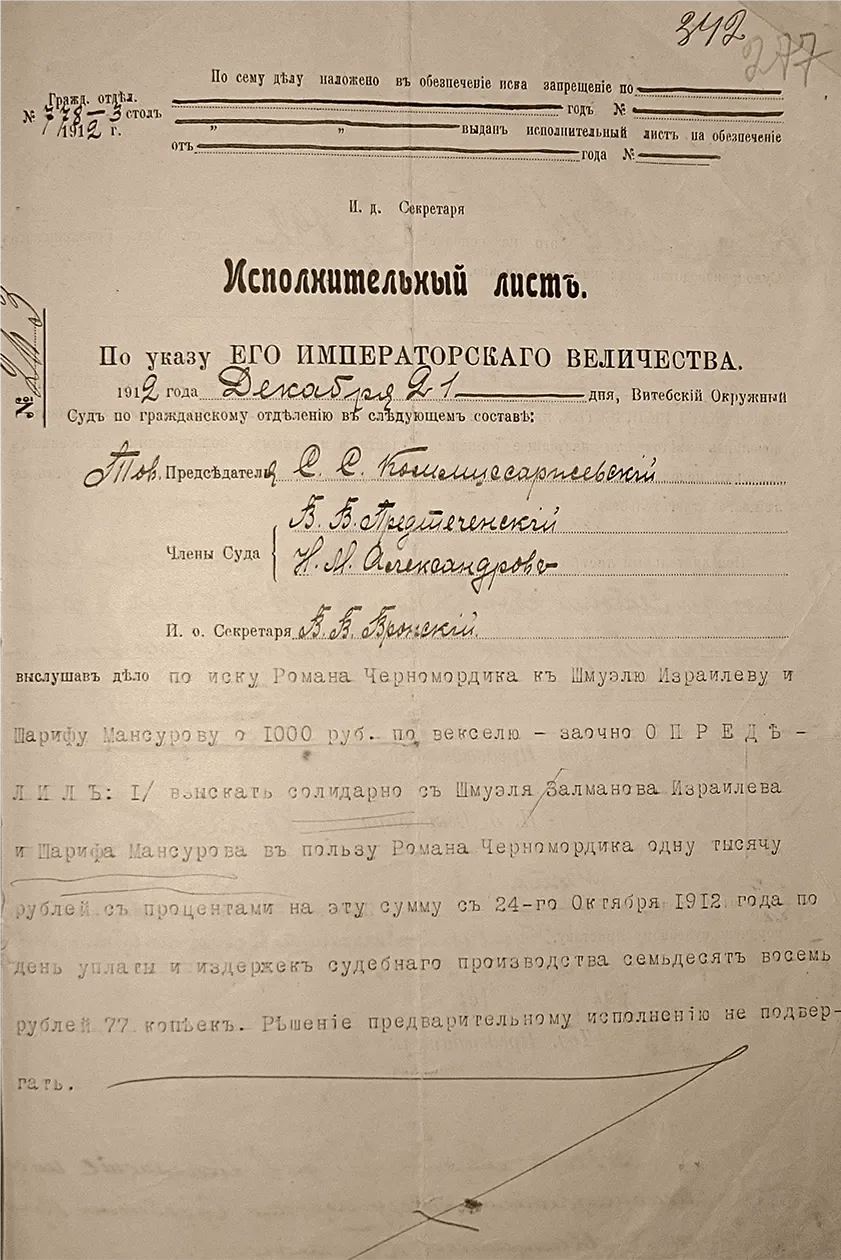
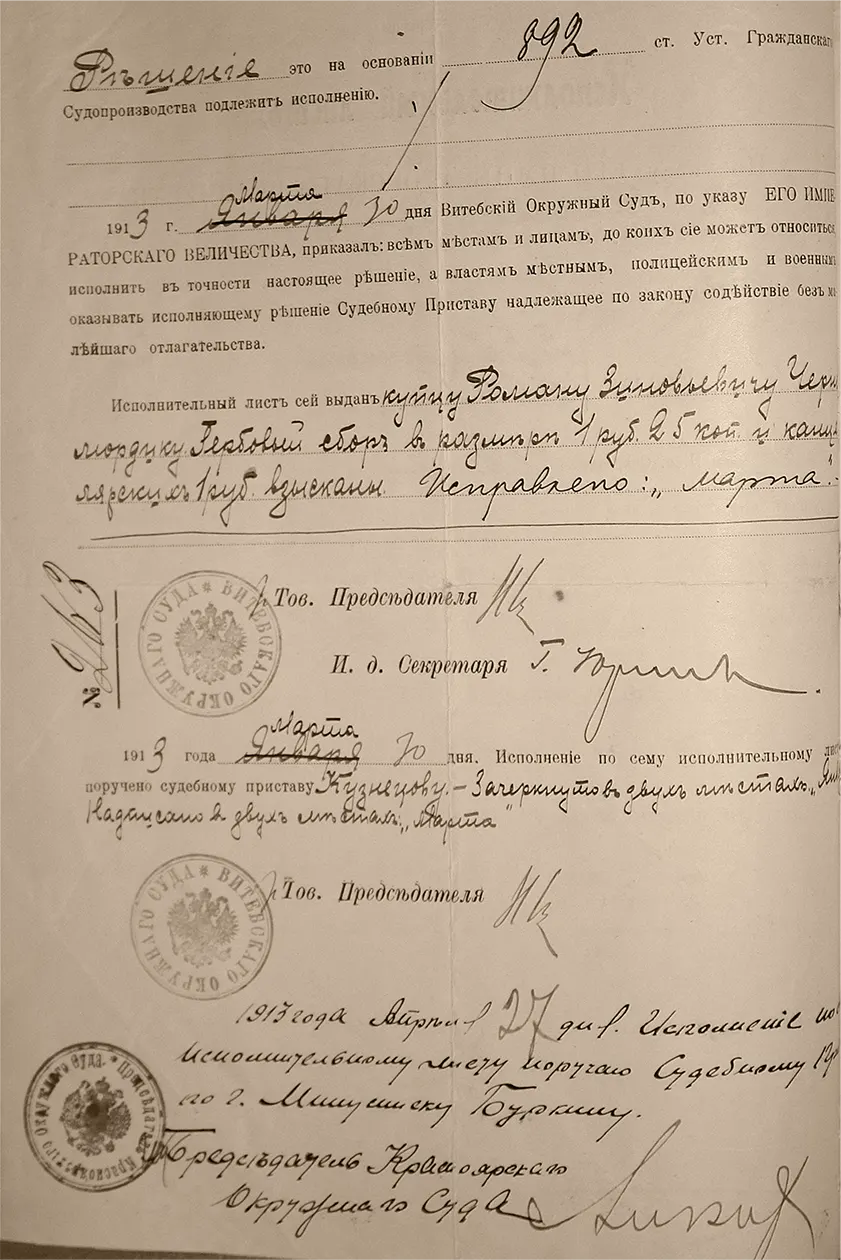
Writ of Execution by Decree of His Imperial Majesty, 1912
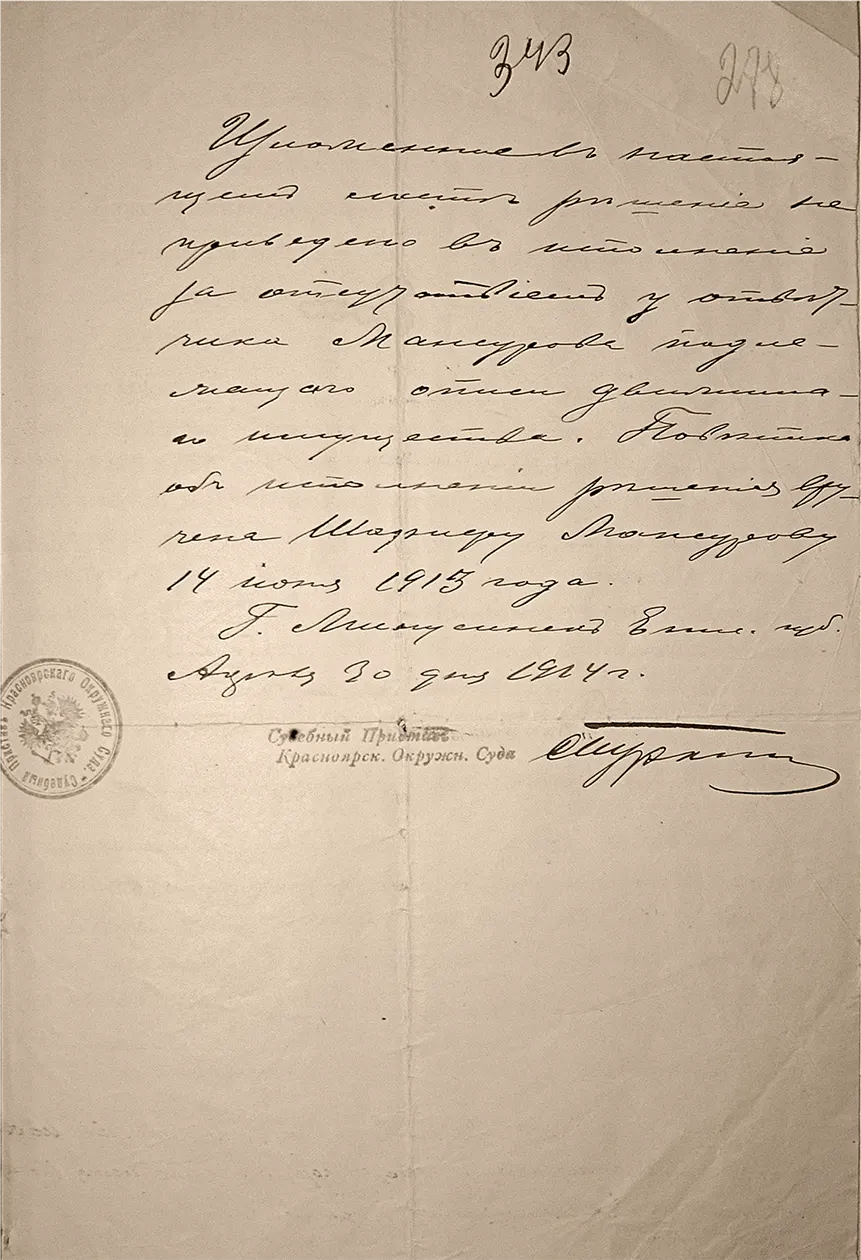
Appendix to the Writ of Execution by Decree of His Imperial Majesty, 1912
At the same time, references to the use of the Red Guard for executing court decisions cease to appear, which cannot be said about the militia. Moreover, the network of organizations involved in the execution of court decisions gradually expanded: local government bodies began to be involved in this work. As a result, Article 4 of the circular of the PCJ of the RSFSR dated 08.09.1923 No. 181 "On the Procedure for Collection, Delivery and Accountability for Disputes over the Actions of Judicial Executors" stated that by law, the execution of court rulings and decisions was entrusted not only to judicial executors, but also to the militia, village (volost) Soviets. The circular proposed to call all three structures "enforcement bodies," without making any distinction between them[9].
At the end of 1918, a new restructuring of the judicial system began.
A telegram from the Commissioner of Justice of the Western Oblast (Yustzap), received on 18.12.1918 from Smolensk to the Vitebsk Gubernia Department of Justice, stated that according to a telegram from the PCJ of the RSFSR based on the Regulation on the Court, district courts and uyezd councils of judges were to be liquidated no later than 15.01.1919[10, sh.27]. The new procedure of legal proceedings was reflected in the "Regulation on Departments of Justice" and in the "Instruction for Implementing the Regulation on the Unified People's Court," approved by the PCJ of the RSFSR on 30.01.1919 and 15.03.1919, respectively [10, sh.30-31, 50-51; 16, sh.9]. To carry out the reorganization of the judicial system, the first Vitebsk Governorate Congress of Judges was convened in March 1919 [11, sh.19].
The reorganization of the judicial system coincided with a change in the administrative-territorial division. From 01.01.1919, the Vitebsk Governorate became part of the Socialist Soviet Republic of Belarus, but from 01.02.1919 it was transferred to the RSFSR, where it remained until March 1924[1, p.111].
After the reorganization, in rural areas, the judicial system consisted of a set of independent judicial districts within the uyezd. The districts were served by people's judges. The uyezd assemblies of people's judges elected from among themselves the uyezd bureau of justice (ubjust), which, among other duties, supervised the work of judicial executors.
An analysis of the correspondence of the gubernia department of justice showed that all-Russian normative documents on the work of executors did not reach the governorate during this period. The gubernia department of justice specifically appealed to the PCJ asking to send instructions on the work of executors or to grant the gubernia department of justice the right to issue them independently [7, sh.114]. It should be emphasized that the first instructions on the need to regulate the activities of judicial executors by special instructions appeared only in the "Regulation on Local Justice Bodies," approved by the PCJ of the RSFSR on 27.08.1920. However, until 1922, such documents never appeared[12].
Regarding the number of judicial executors working during this period in the district courts of the Vitebsk Governorate, information has only been found for the Polotsk Uyezd. The list of employees as of 11.08.1919 shows one executor per judicial district [13, sh. 291]. Based on this information with a certain degree of probability, it can be assumed that in all other uyezds, each judicial district had or could have its own judicial executor. Moreover, during this period, technical workers could be assigned to the judicial executor. This is evident, for example, from the list of laid-off workers of the Polotsk Ubjust for 1919, which includes, among others, a courier attached to a judicial executor [14, sh.48, 51].
On 03.06.1919, the PCIA of the RSFSR sent a circular to the localities regarding staff reductions, according to which the reduction was to be between 20 and 50% of institution employees [11, sh. 108]. Although this reorganization, actively carried out from September 1919, did not fundamentally change the judicial system, it significantly affected the work of judicial executors. Firstly, the number of judicial executors on the staff of the gubernia department of justice and its subordinate institutions was reduced almost 3.5 times; secondly, a practice was established whereby executors were included in the staff only of the governing body — the gubernia department of justice and/or ubjust — and not of the district people's courts. Comparing the standard staff lists approved by the PCJ for 1919 for gubernia departments of justice and their subordinate institutions (letters of 07.05.1919 and August 1919), the Vitebsk Gubernia Council of People's Judges lists 47 judicial executors in the first half of the year, and 13 judicial executors in the second [10, sh.58, 60; 20, sh.44; 11, sh. 44]. Reductions were also made among judicial executors in district courts. It was probably during this period that district judges, whose duties included monitoring the execution of judicial acts, began actively involving village (volost) executive committees in this work. For example, extensive correspondence has been found between the local judge of the 4th district of the Gorodok Uyezd and volost executive committees regarding the execution of court decisions and sentences [11, sh.52-64, 69, 74].
On 21.10.1920, the VTsIK issued the Decree "Regulation on the People's Court of the RSFSR" [15]. Article 82 of the Regulation stated that sentences are enforced by militia bodies, while decisions and any monetary penalties are enforced by judicial executors or militia bodies. The appearance of the Regulation led to a new stage of reorganization, which was completed by March 1921 [16, sh.1ob.].
In late autumn of 1921, in accordance with a telegram from the gubernia department of justice of 20.09.1921 No. 1600 and the circular of the PCJ of the RSFSR of 02.12.1921 No. 1633, another reorganization and staff reduction was carried out [14, sh. 24, 31, 41]. During this period, an additional position of judicial executor was introduced into the staff of the gubernia department of justice. For example, in the statement of personnel as of 01.01.1921, under No. 16 it is indicated that there are 3 judicial executors working in the gubernia department of justice [17, sh.46-47], which is confirmed by lists of employees as of 03.03.1921, 01.10.1921, 26.12.1921 [17, sh.319ob.; 14, sh.2,3ob.; 21, sh.40, 75ob.]. It is likely that the increase in their staff within the gubernia department of justice was due to the fact that after the reorganization, the Vitebsk Ubjust lacked the position of judicial executor and had no plans to introduce it, so the judicial executors of the gubernia department of justice enforced decisions not only of the district courts of Vitebsk city, but also of the Vitebsk Uyezd [14, sh.95ob., 96]. This peculiarity of the work of the judicial executors of the gubernia department of justice is also indicated in their personal identification cards [21, sh.100].
In the uyezds, the number of judicial executors was set at the rate of one executor per entire uyezd, regardless of the number of judicial districts. From the list appended to the minutes of the meeting of the board of the Velizh Ubjust of 03.12.1921, it is evident that enforcement proceedings were not included in any of the structures. The minutes themselves state that the judicial executor serves the entire city and district, and therefore a correspondent was provided to him on staff [14, sh.20-21, 23]. At the same time, in the lists of employees of the remaining ubjusts, judicial executors are in some cases included in the "bureau of justice" section, but more often information about them is placed at the end of the list separately from all other structures. The presence of 9 judicial executors under the ubjusts is also indicated in the consolidated list of employees compiled by the gubernia department of justice as of 01.01.1922 [14, sh.23, 27ob, 35, 38ob., 41 ob., 44, 58, 63, 68ob, 77] and in the "Protocol of Fixed Staff Lists from the Vitebsk Gubernia Department of Justice and Judicial-Investigative Bodies to Cancel Minimum Staff Lists and Subsequent Changes, with Reference to the Communication of the PCJ" of 02.02.1922 No. 497 [14, sh.95ob., 96].
- decisions of people's courts in civil cases and arbitration courts;
- rulings of people's courts on securing claims; sentences of revolutionary tribunals and people's courts in criminal cases regarding property penalties;
- compulsory execution of extrajudicial amicable settlements approved in the established judicial procedure.
It was determined that the execution of court decisions consists of: seizing the awarded property and transferring it either into the possession of the person to whom it was awarded, or to the relevant state bodies; levying a monetary penalty on the debtor's movable property, monetary sums and buildings, as well as on payments and disbursements due to him from third parties. Additionally, it was established that if the debtor fails to fulfill the requirements of the judicial executor within the set deadline, his property is inventoried and seized. The procedure for property seizure was defined [18, sh.9-40].
The results of the congress were consolidated by the resolution of the VTsIK "On Implementing the Regulation on the Judicial System of the RSFSR" of 11.11.1922. Moreover, on 10.07.1923, the first Civil Procedure Code (CPC) of the RSFSR in the history of the Soviet state was introduced [19]. The Code established the rules for considering and resolving civil cases in courts of general jurisdiction and defined all stages of the civil process — from initiating a case to executing a decision. The CPC of the RSFSR was put into effect throughout the territory of the BSSR from 01.03.1923 by a resolution of the Presidium of the Central Executive Committee of the BSSR, which included the Vitebsk Governorate from 03.03.1924.
Thus, the period from November 1917 to July 1923 can be considered the initial period during which the search for optimal ways to organize a new, revolutionary system of enforcement proceedings on the territory of the Soviet state as a whole and the Vitebsk Governorate in particular was carried out. During this period, a norm was established according to which the responsibility for monitoring the execution of judicial acts was placed on the courts themselves. In order to fulfill these duties, courts involved various state structures and paramilitary formations: the Red Guard, the Workers' and Peasants' Militia, local Soviets; as well as bodies that organized the work of the courts (gubernia departments of justice and ubjusts), which included special workers — judicial executors. In other words, the Soviet judicial system abandoned the independent service for the execution of judicial acts, which in the Russian Empire was represented by bailiffs.
The first document at the national level that summarized the procedure for appointing judicial executors and regulated the execution of judicial acts was the resolution of the 4th All-Russian Congress of Soviet Justice Workers, held on 26-30.01.1922. At the level of national legislative acts, the procedure for the work of enforcement bodies was established with the introduction of the CPC of the RSFSR on 10.07.1923, the fifth part of which is devoted to the execution of court decisions.
Soviet Judicial Executor //
20th Century
Soviet Judicial Executor // 20th Century
The formation of the young Belarusian state after the Great October Socialist Revolution of 1917 in Russia took place in stages, due to the continuation of the First World War with Germany.
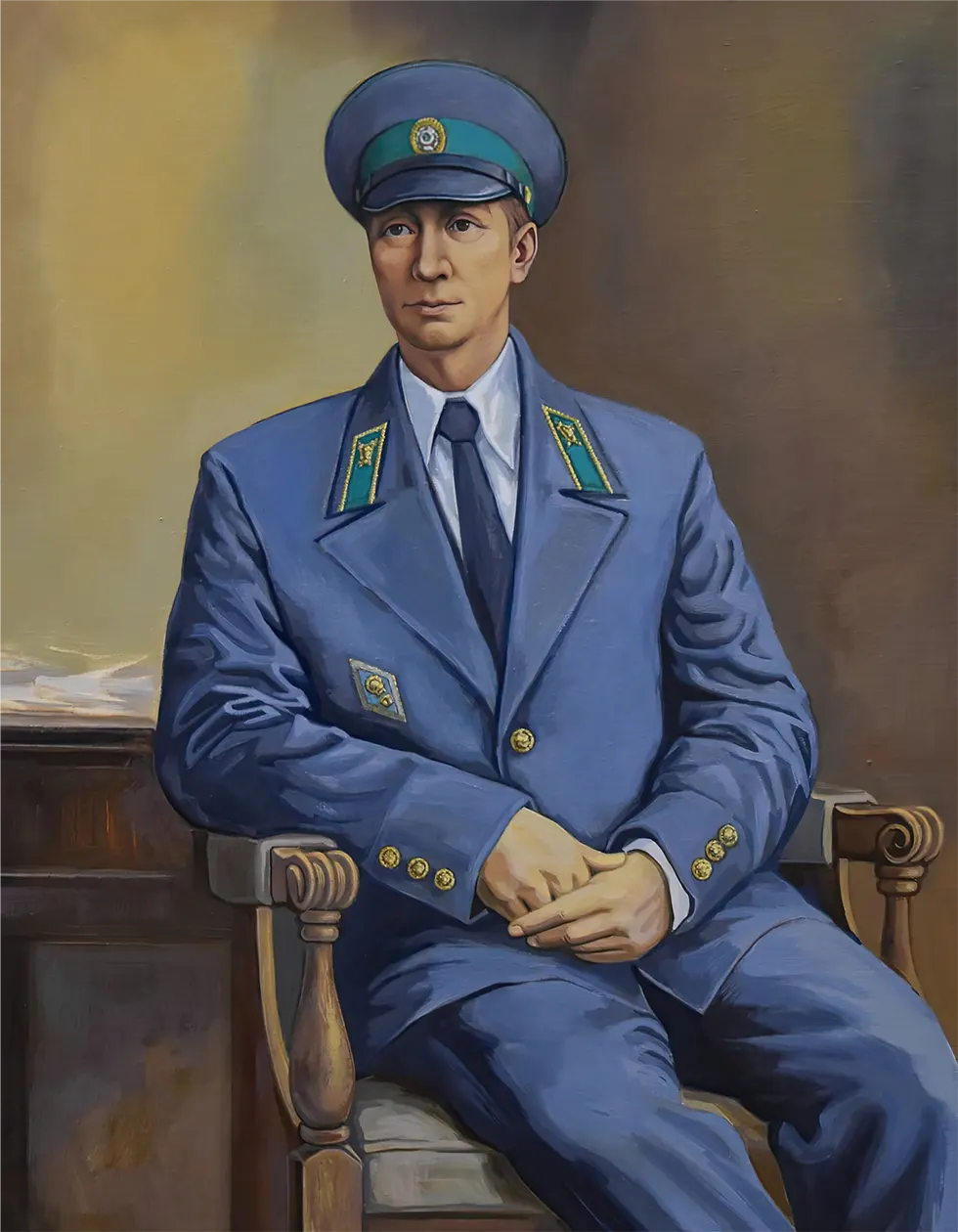
“Soviet Judicial Executor”
Painting by artist Boris Lalyko
In November 1918 -- February 1919, the Red Army carried out the so-called "Belarusian Operation" to occupy Belarusian territories being abandoned by German troops.
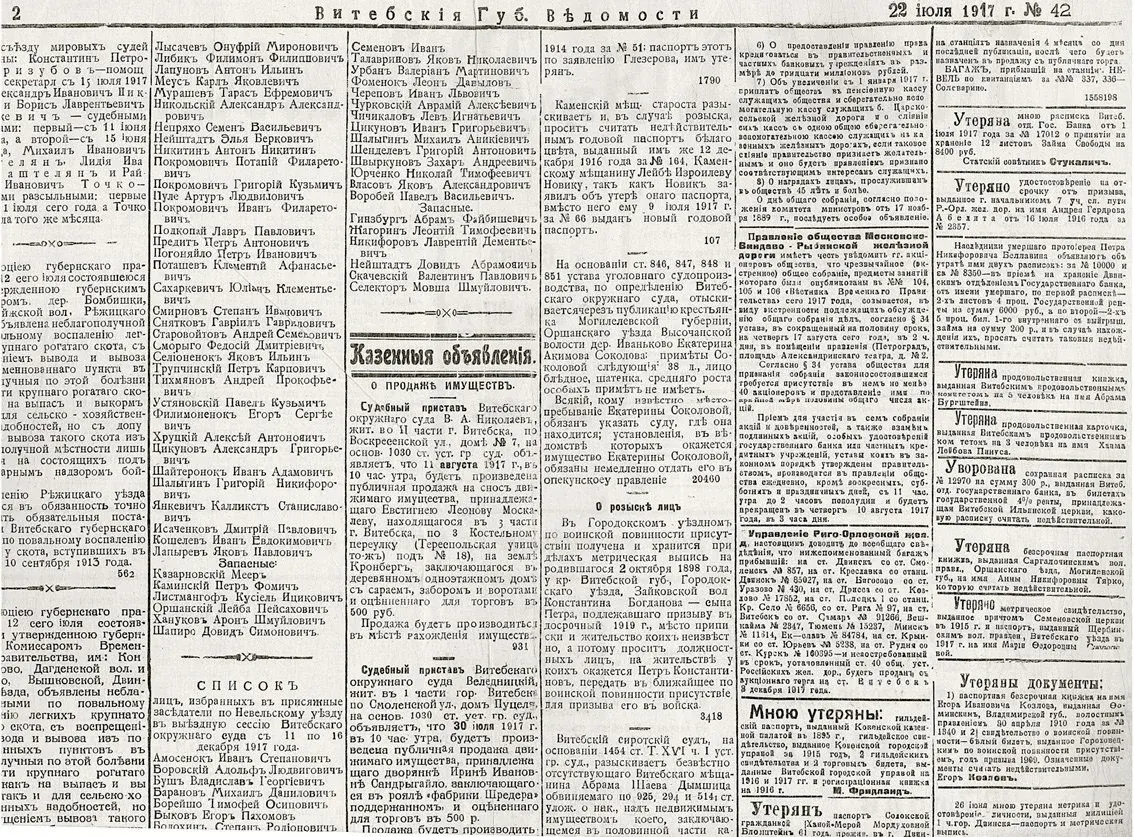
Announcements of bailiffs in the newspaper Vitebsk Gubernia Gazette No. 42. July 22, 1917 (photo 1)
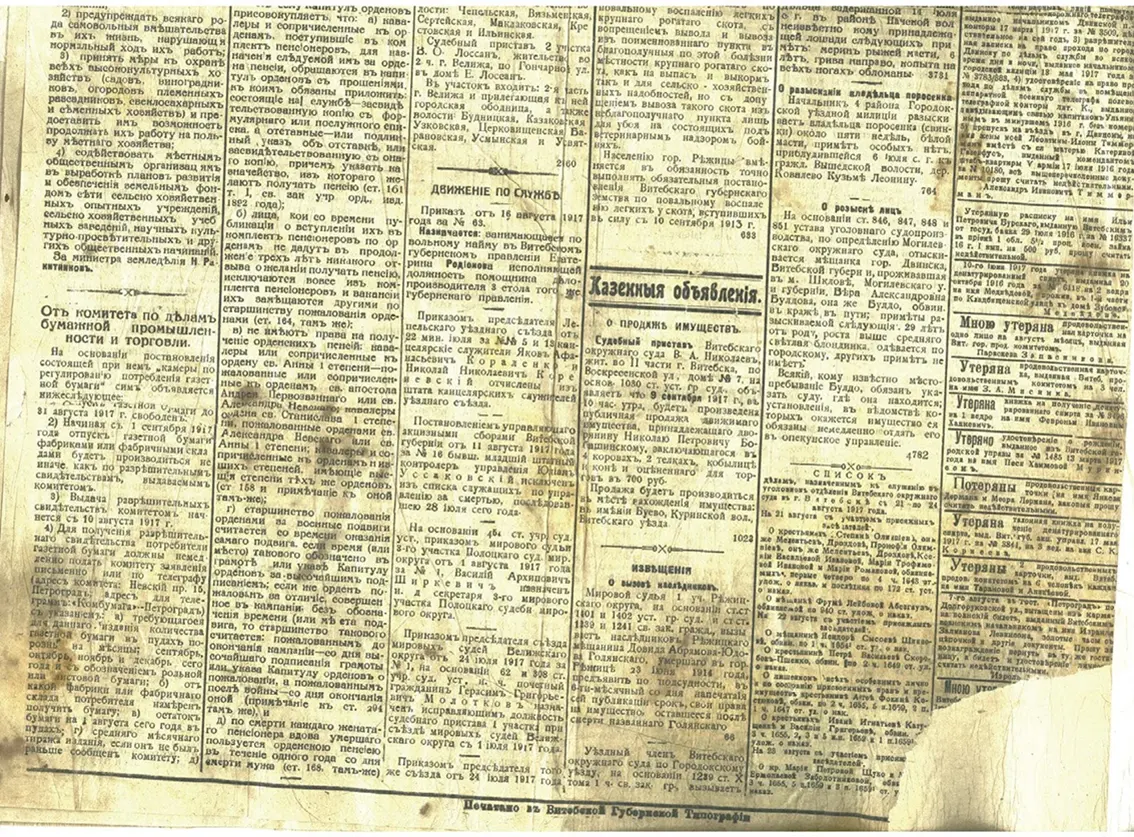
Announcements of bailiffs in the newspaper Vitebsk Gubernia Gazette No. 49 August 19, 1917 (photo 2)
In February 1919, the 1st Congress of Soviets of Workers', Peasants' and Red Army Deputies of Belarus adopted the Constitution of the Socialist Soviet Republic of Belarus, which established the supremacy of the authority of the Congress of Soviets, and in the periods between congresses — the Central Executive Committee. In accordance with the Constitution, the Central Executive Committee of Belarus was the highest legislative, administrative and controlling body.
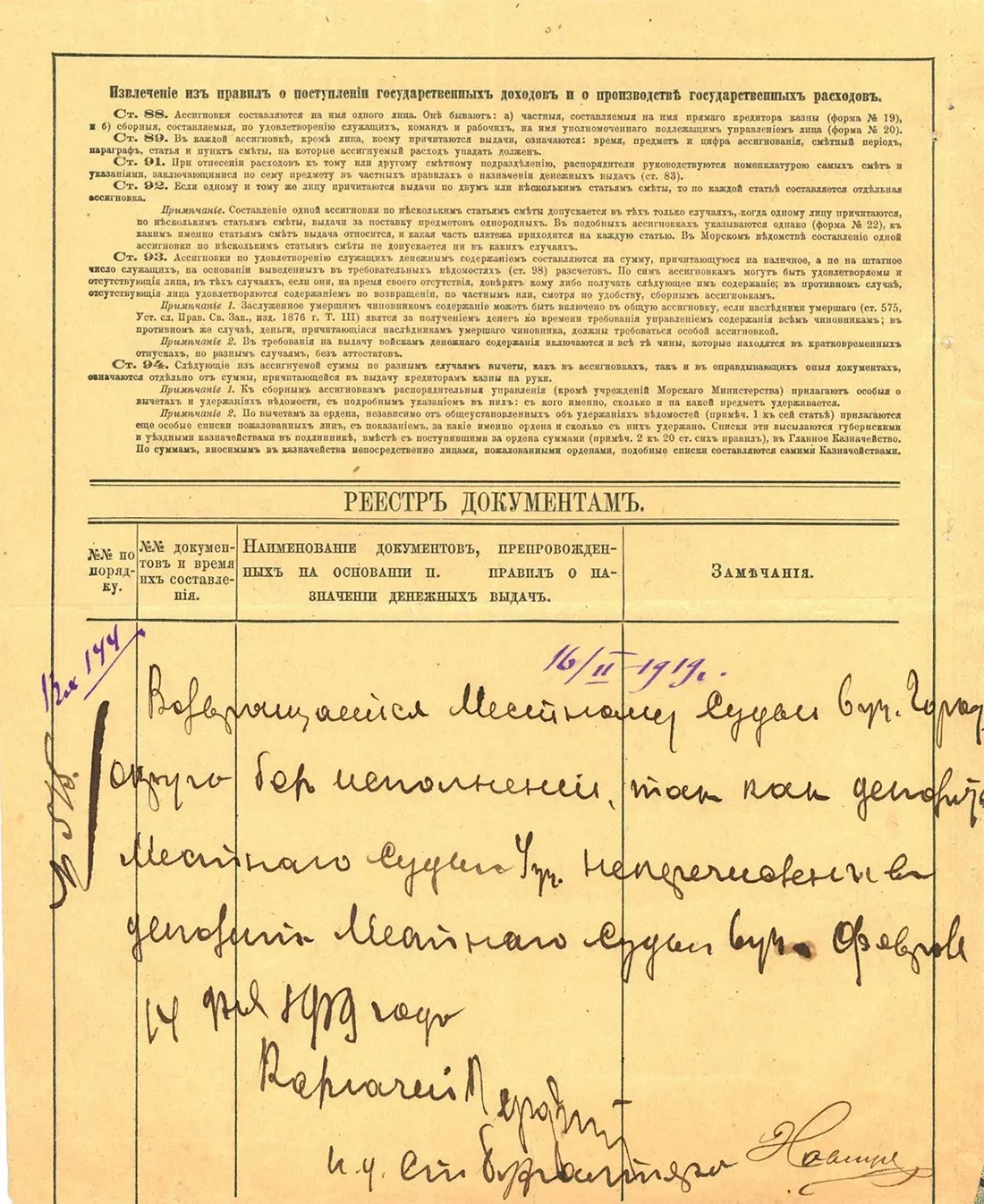
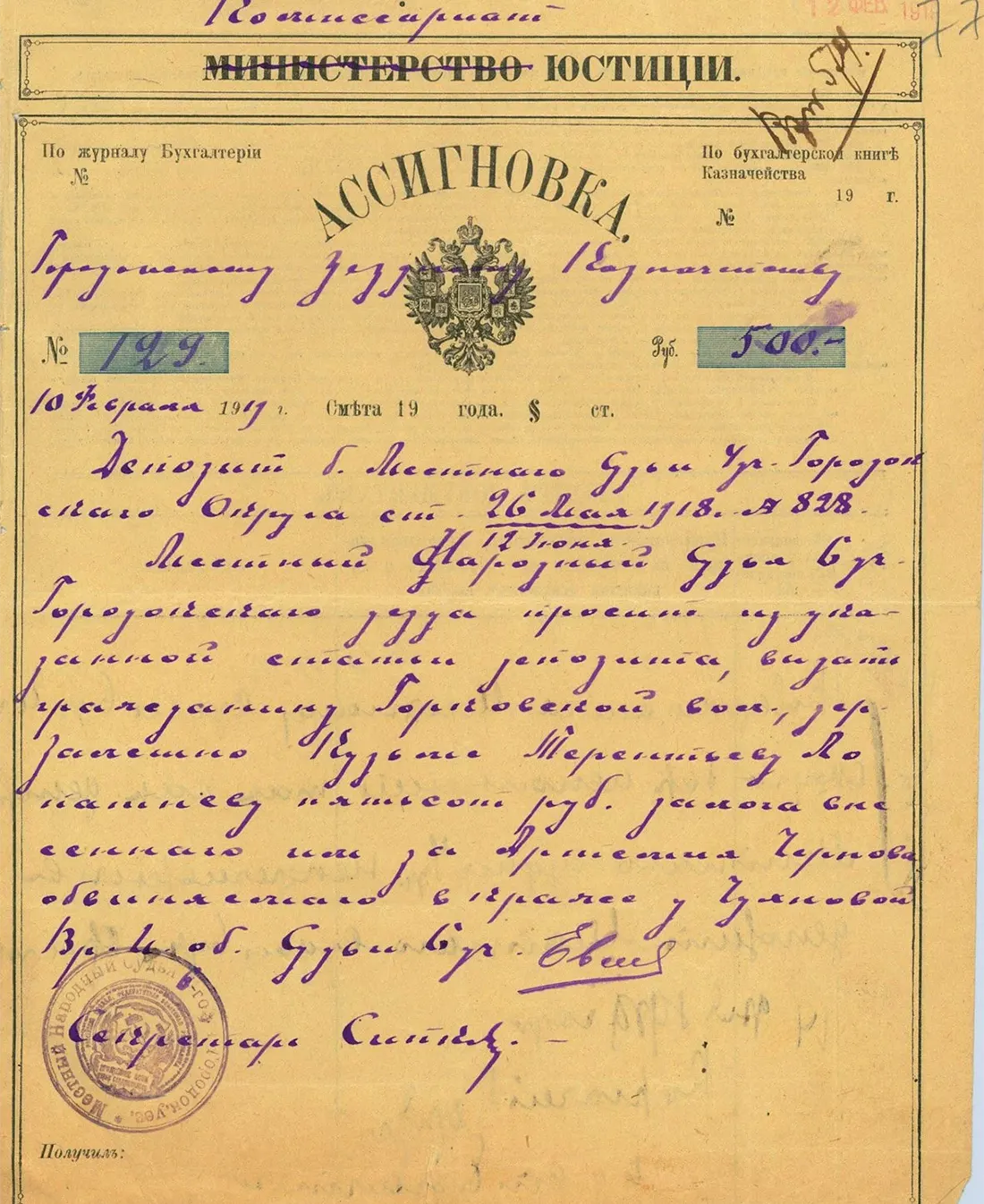
Allotment order dated 10.02.1919 No. 129 issued by the local people's judge
In February 1919, Polish troops invaded the territory of Belarus. After the liberation of Belarus, the activity of the People's Commissariat of Justice of the Socialist Soviet Republic of Belarus resumed: from July 1920 — as a department of justice of the Minsk Gubernia Revolutionary Committee, from 1 August 1920 — a department of justice of the Military Revolutionary Committee of the SSRB, from 26 August 1920 — the Commissariat of Justice of the Military Revolutionary Committee of the SSRB.
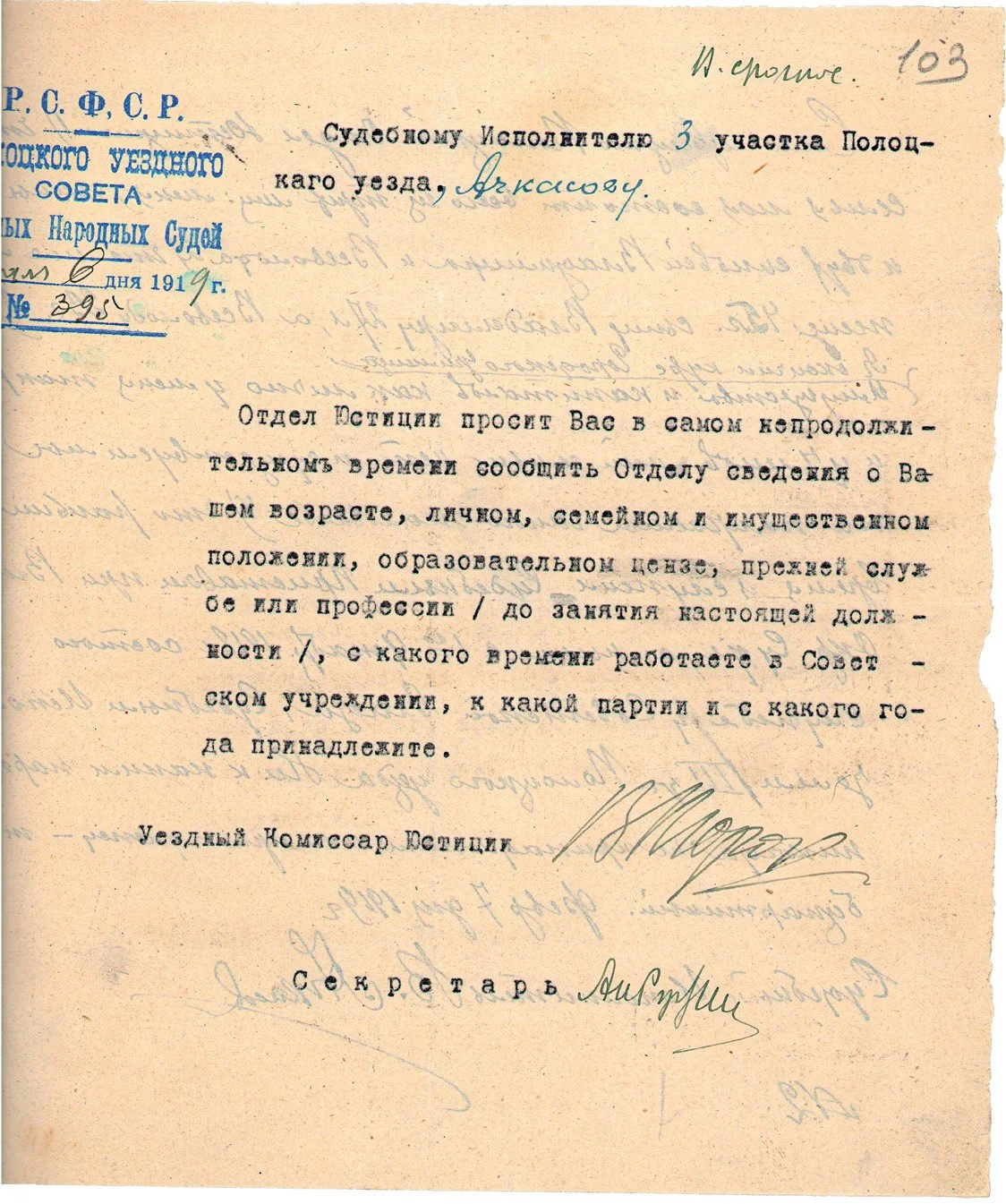

Letter from the department of justice of the Polotsk Uyezd Executive Committee to judicial executor of the 3rd precinct V. Achkasov requesting biographical data. February 6, 1919 (photo 1)
Letter from judicial executor V. Achkasov to the department of justice of the Polotsk Uyezd Executive Committee providing biographical data. February 7, 1919
The 2nd Congress of Soviets of the SSRB, held on December 14-20, 1920, introduced amendments to the Constitution of the Socialist Soviet Republic of Belarus, establishing the formation by the Central Executive Committee of Belarus of the Council of People's Commissars. The CPC was responsible for the general administration of the affairs of the Socialist Soviet Republic of Belarus, which was carried out through the creation of 15 people's commissariats, including the People's Commissariat of Justice. Under each people's commissar, collegiums were formed under his chairmanship, whose members were approved by the CPC.
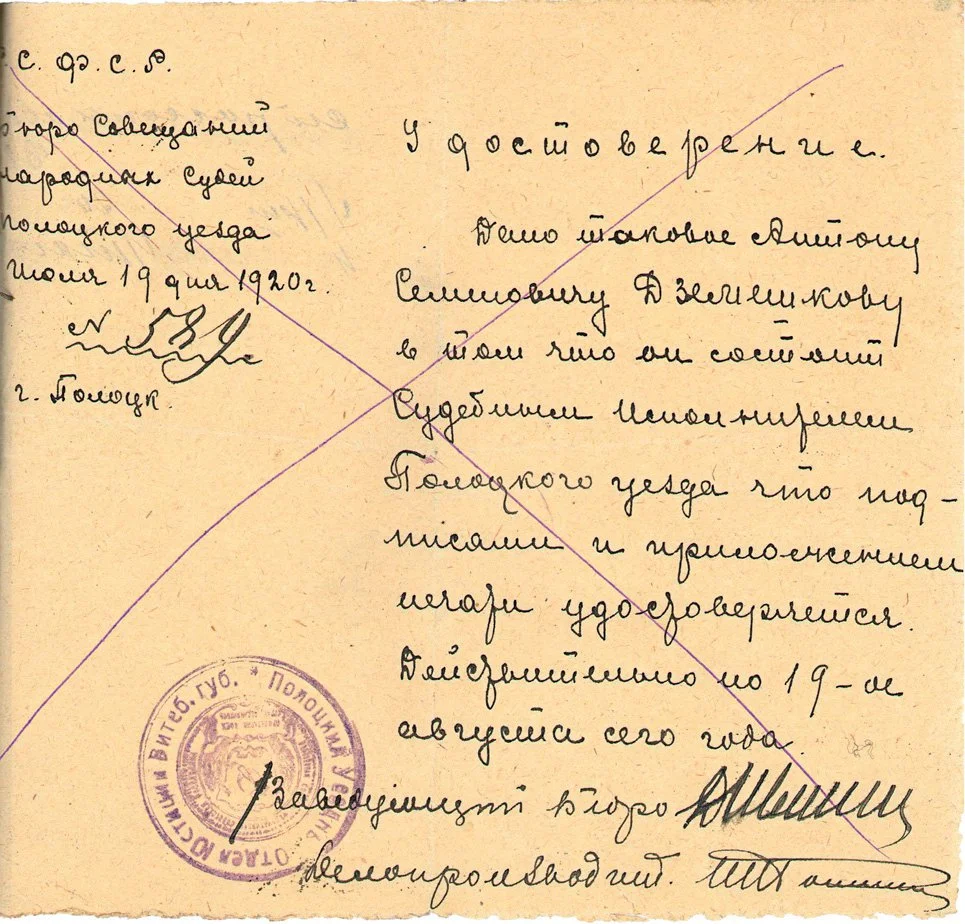
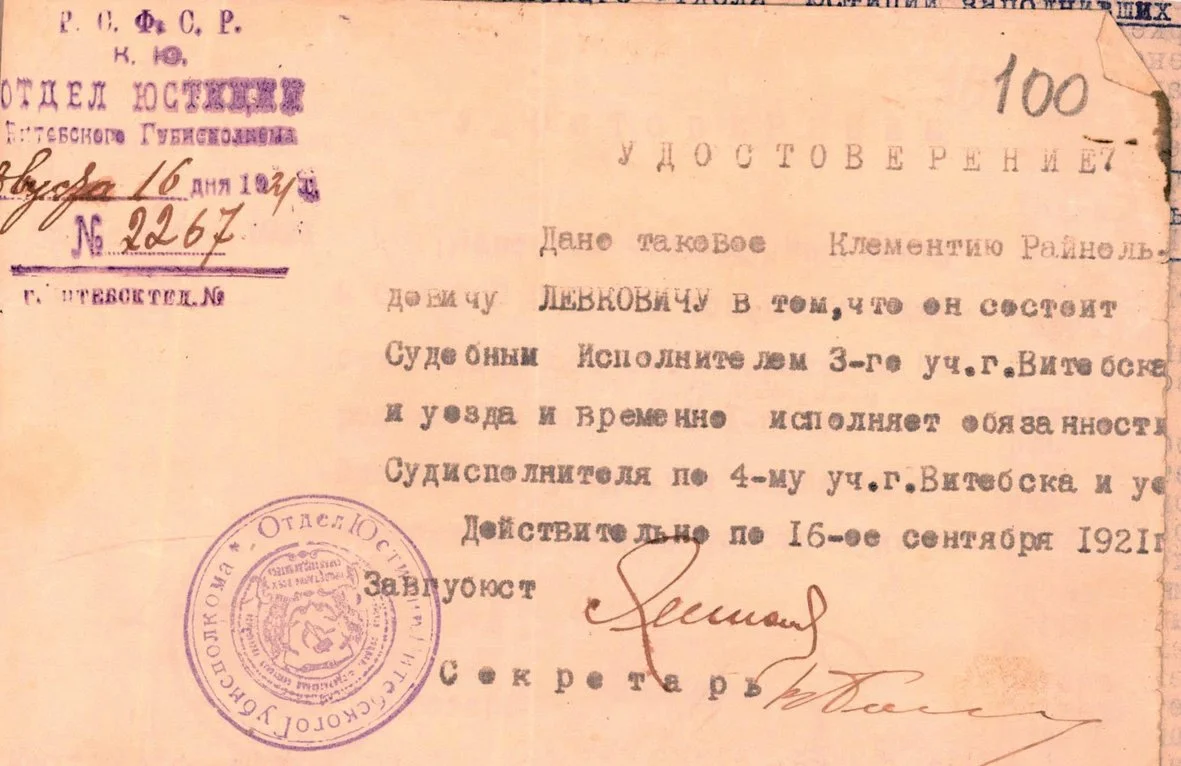
Identification card of judicial executor of Polotsk Uyezd A.S. Dzameshkaw July 19, 1920 (photo 1)
Identification card of judicial executor K.R. Levkovich issued 16.08.1921 (photo 2)
The People's Commissariat of Justice included the General Department, the Department for the Protection of Revolutionary Legality, the Legislative-Codification Department, and the Correctional Labor Department.
In 1922, structural changes occurred in the justice bodies: the Council of People's Judges and the Revolutionary Tribunal were merged into a single Supreme Court of the Republic, and the Department of the Procuracy was established under the People's Commissariat of Justice.
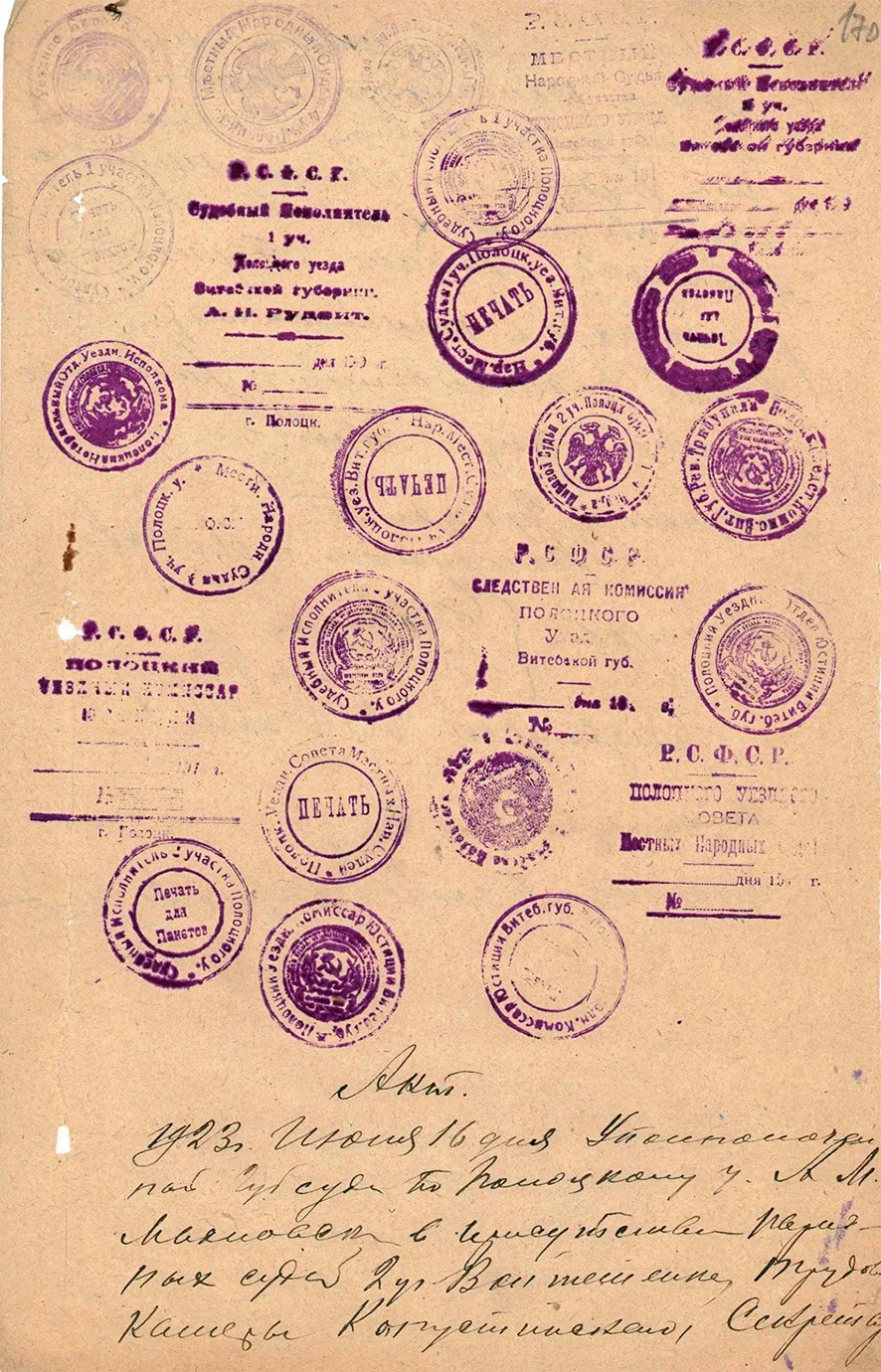
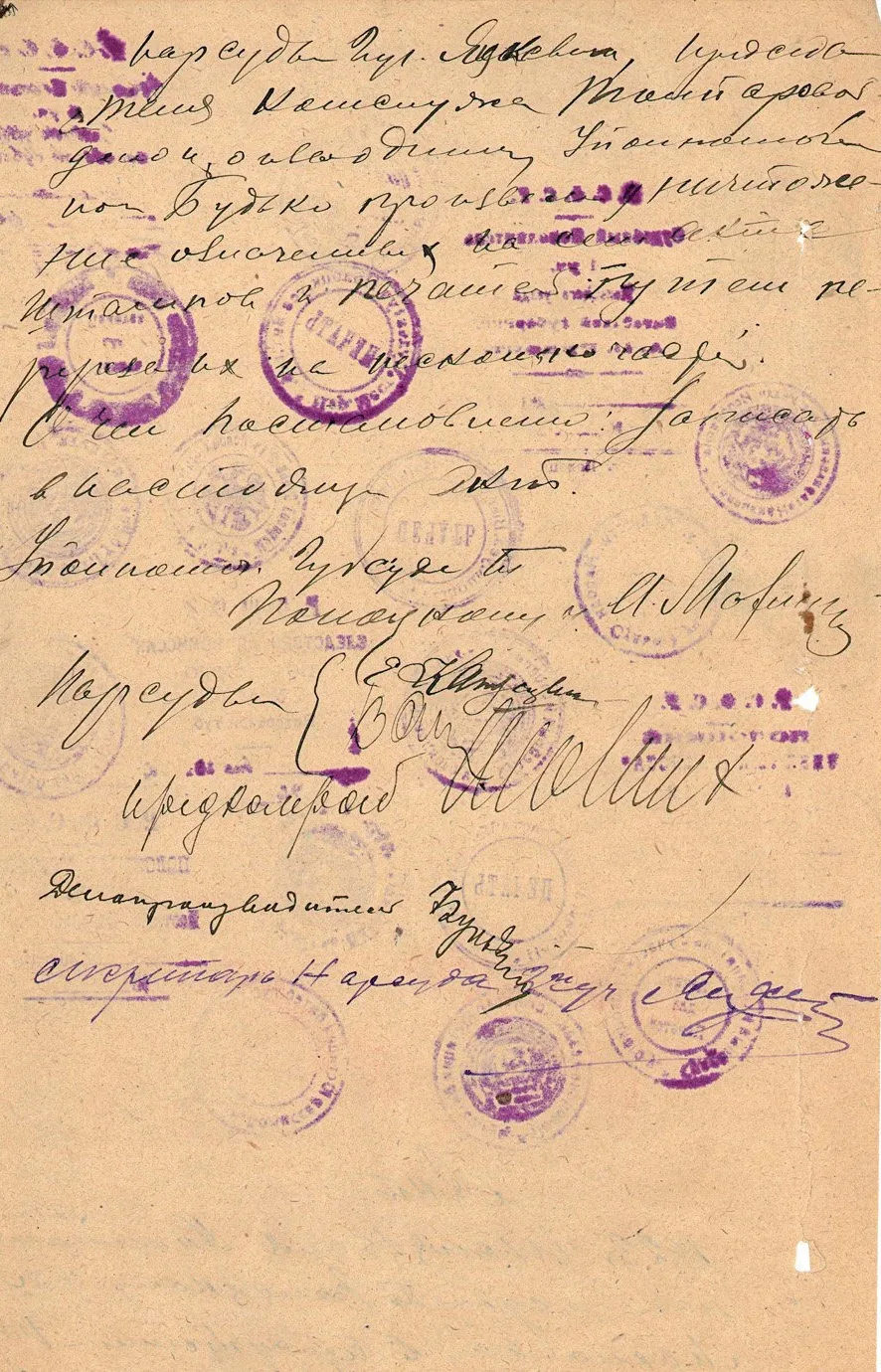
From the act on the destruction of stamps and seals of judges and judicial executors of Polotsk Uyezd. June 16, 1923
The Department of Cults was formed within the apparatus of the People's Commissariat of Justice, and the Notarial Department became an independent structural unit. The Commissioner of Justice simultaneously became the Prosecutor of the Republic.
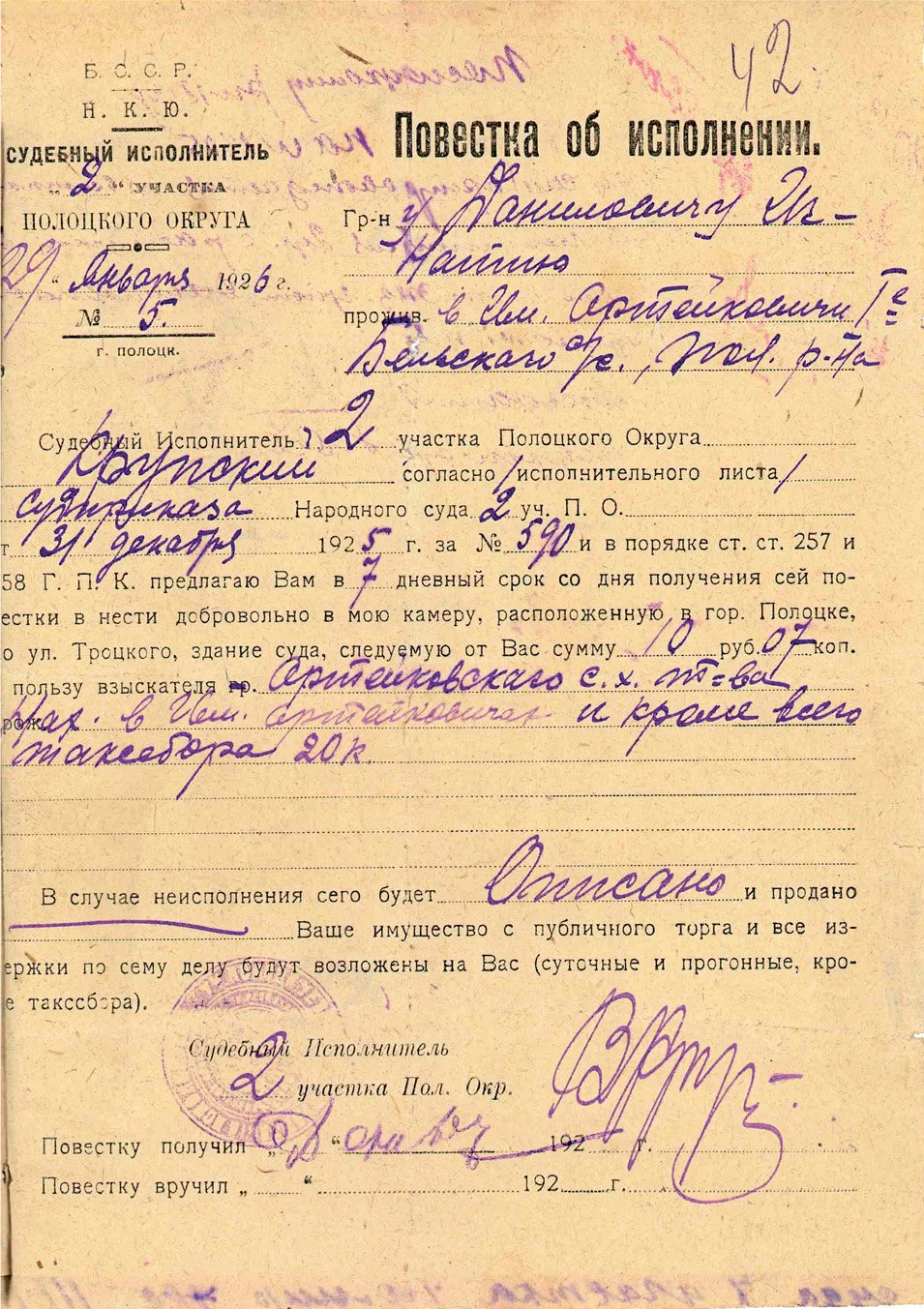
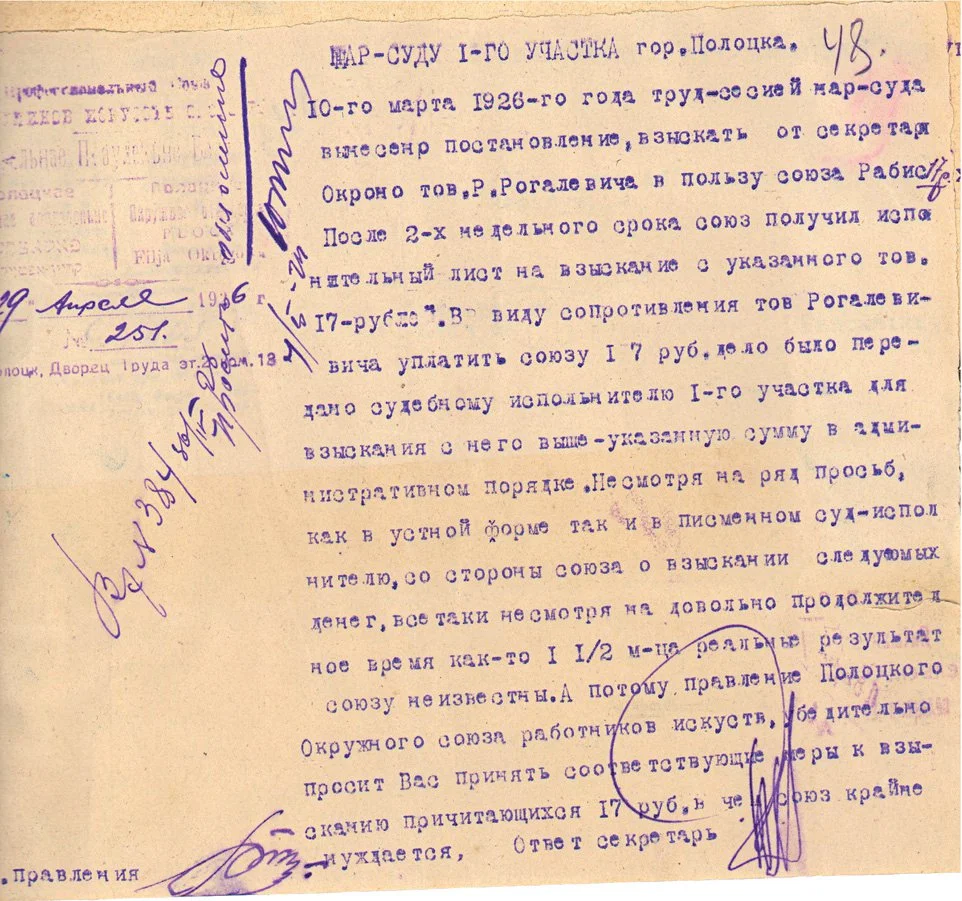
citizen I. Danilovich. January 29, 1926 (photo 1)
Letter from the Polotsk Okrug Union of Arts Workers to the people's court of the 1st precinct of Polotsk regarding the recovery of funds. April 29, 1926. (photo 2)
On October 3, 1928, at a meeting of the Collegium of the People's Commissariat of Justice, the issue of the institution of judicial executors and the transfer of its functions to the militia was considered. By a resolution of the Council of People's Commissars of the BSSR of March 23, 1931, the institution of judicial executors under the jurisdiction of the People's Commissariat of Justice of the BSSR was abolished from April 1, 1931, and its functions were transferred to the militia bodies.
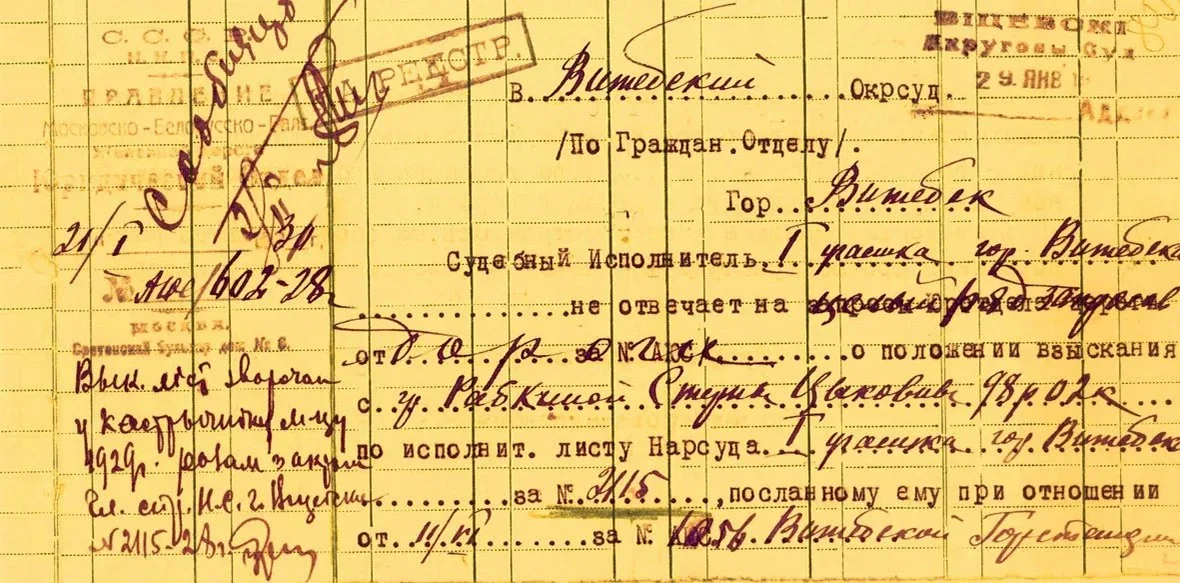
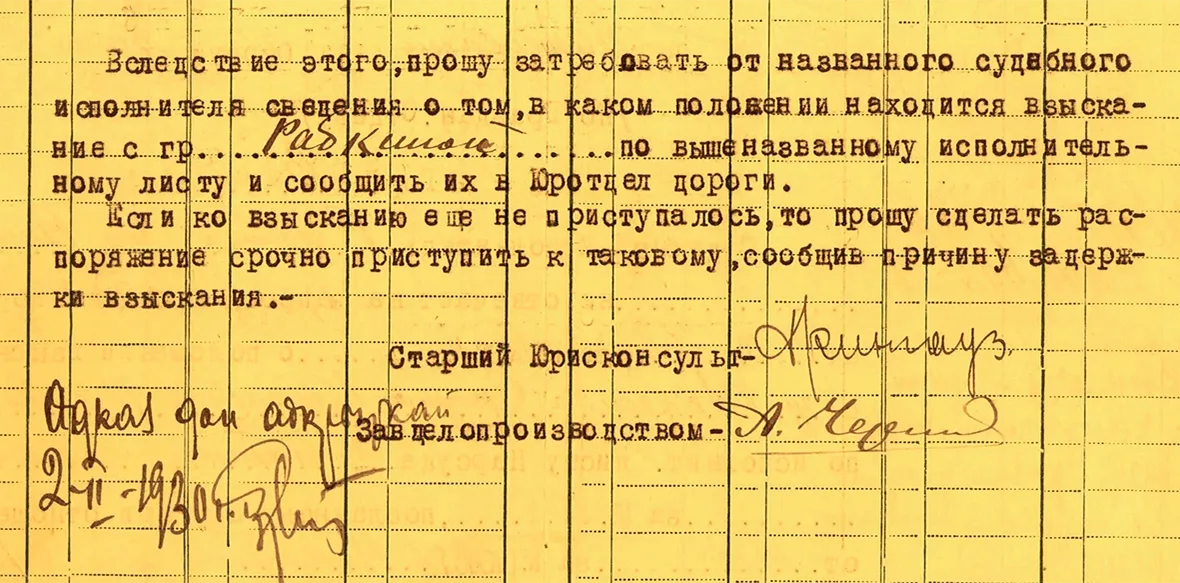
Letter from the legal department of the Moscow-Belarus-Baltic Railway Directorate
Subsequently, the institution of judicial executors was returned to the People's Commissariat of Justice of the BSSR.
During this transition period, the system of compulsory enforcement of the Socialist Soviet Republic of Belarus was formed.
Due to the transformation of state authorities and administration, and with the adoption in August 1938 of the Law of the Supreme Soviet of the USSR "On the Judicial System of the USSR, Union and Autonomous Republics," a draft was prepared and a new Regulation on the People's Commissariat of Justice of the BSSR was adopted, approved by a Resolution of the Council of People's Commissars of the BSSR of October 8, 1939.
The People's Commissariat of Justice of the BSSR was entrusted with the leadership of the departments of justice under the regional Soviets of Working People's Deputies, organization of the activities of courts, leadership of the activities of notarial bodies, organization and leadership of the activities of the bar, training and retraining of personnel for justice bodies, courts, procuracy, notariat, bar and arbitration, systematization and preparation of materials for the codification of legislation of the Byelorussian SSR.
In July 1953, a new structure and staff of the Ministry of Justice of the BSSR were approved. The bodies directly subordinate to the Ministry of Justice included 12 departments of the Ministry of Justice of the BSSR under the regional Soviets of Working People's Deputies (Baranovichi, Bobruisk, Brest, Vitebsk, Gomel, Grodno, Mogilev, Molodechno, Minsk, Pinsk, Polessk, Polotsk), the same number of regional courts and presidiums of collegiums of advocates, permanent 3-month refresher courses for judicial executors and secretaries of people's courts in Minsk, and a Research Criminalistics Laboratory in Minsk.
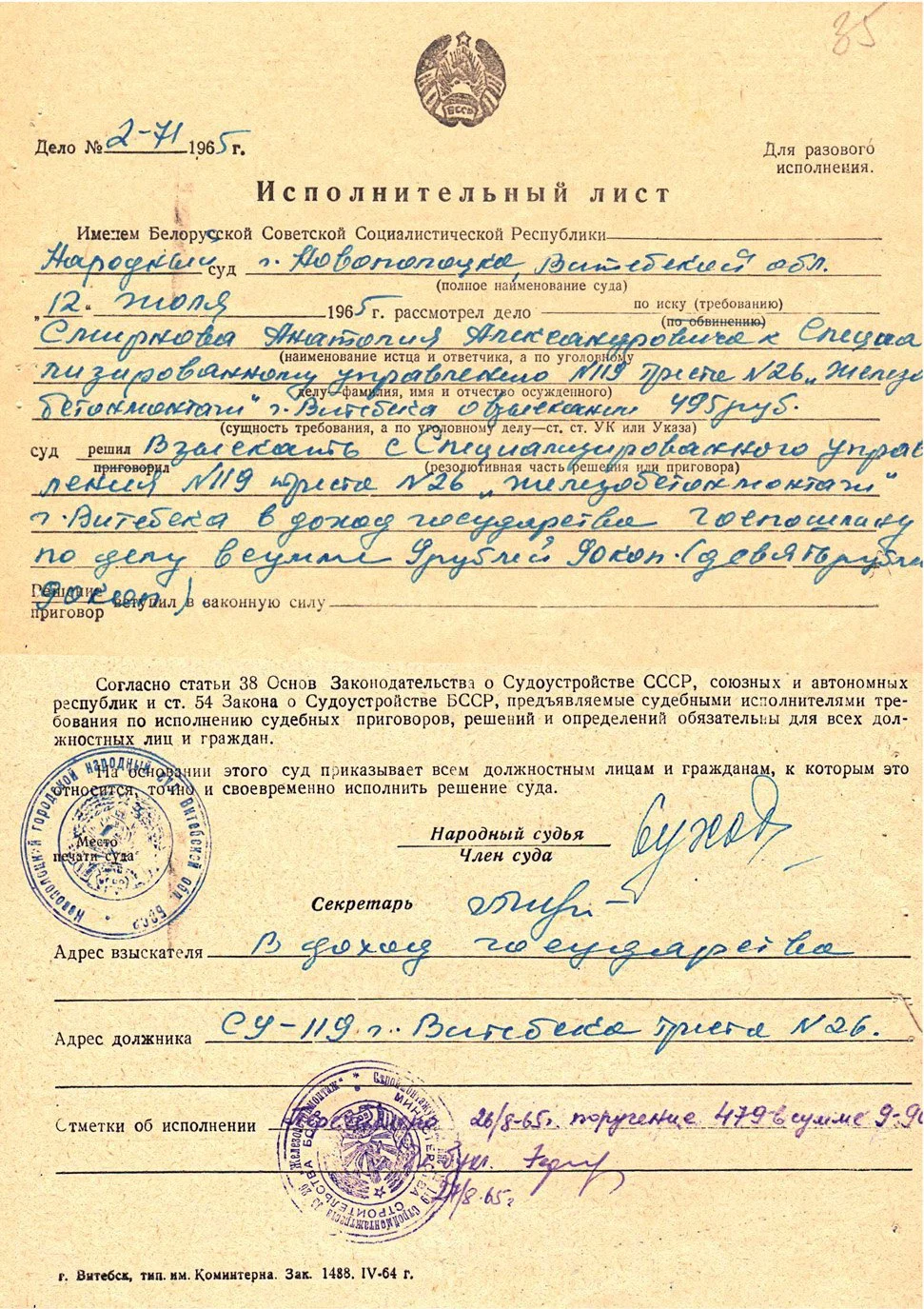
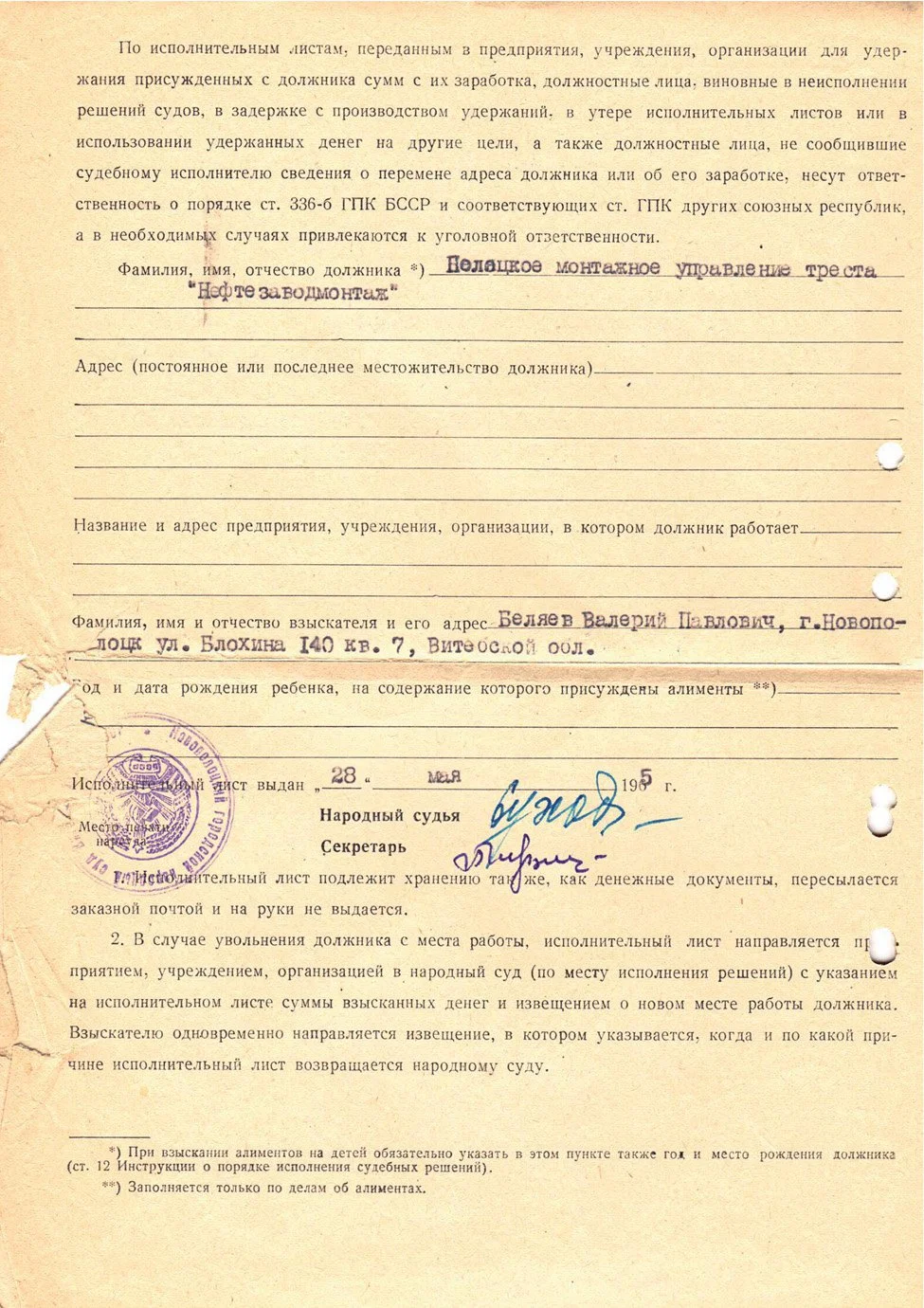
Writ of execution for recovery of state fees July 12, 1965 (photo 1)
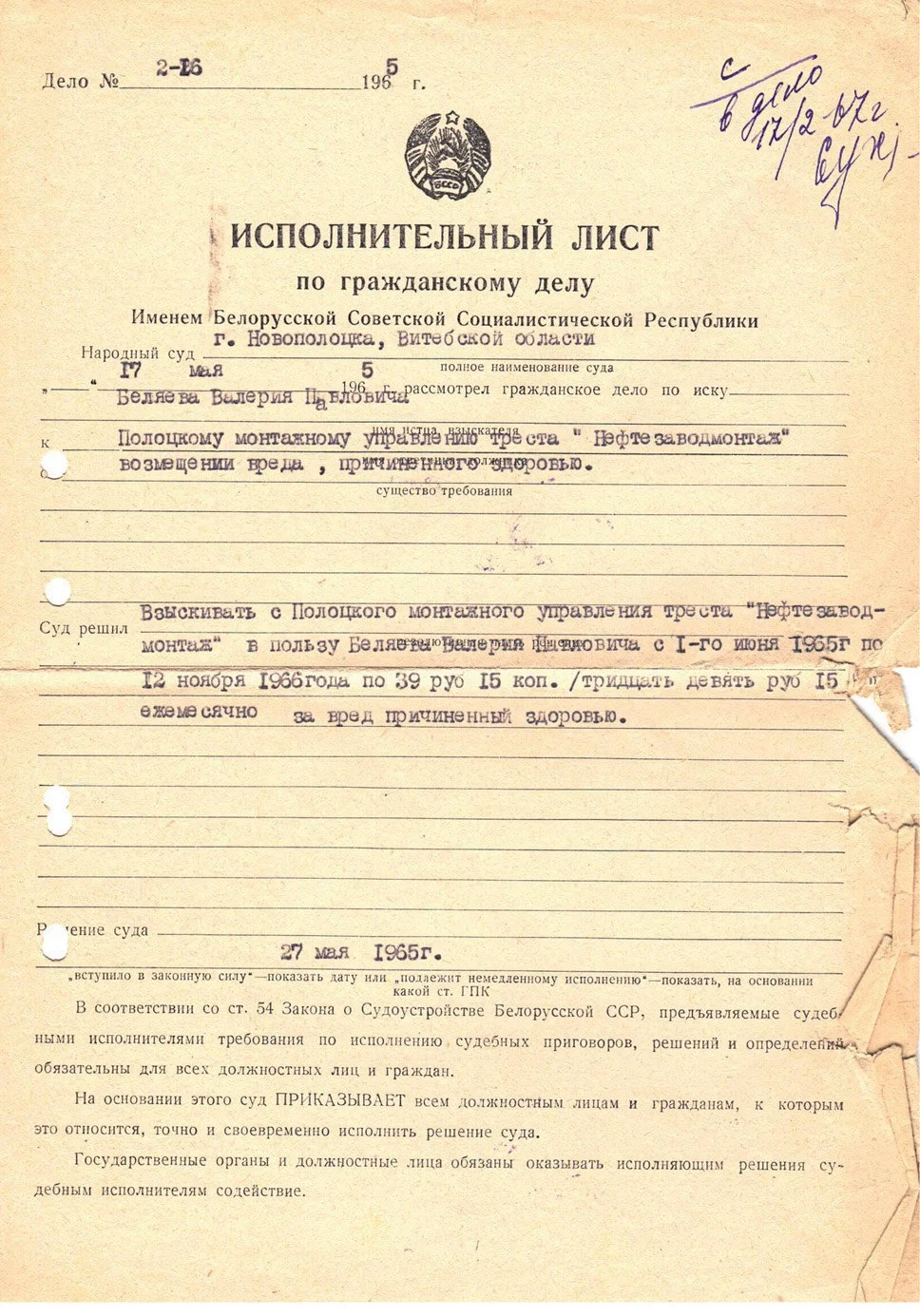
Writ of execution for compensation for harm caused to health May 17, 1965 (photo 2, 3)
Judicial Executor
of the Republic of Belarus //
1991-2014
Judicial Executor of the Republic of Belarus // 1991-2014
Until 1998, the execution of orders of all courts (general and economic) in the republic was carried out by judicial executors attached to district (city) courts, and their actions were regulated by the Civil Procedure Code in effect at that time, which subsequently had a number of amendments introduced.
From January 1, 1998, an independent structure — the Service of Judicial Executors of Economic Courts — was established within the structure of the economic courts of the Republic of Belarus.

Judicial Executor of the Republic of Belarus 1991-2014
At the same time, the tasks, goals, principles and procedure for enforcement remained the same and uniform for judicial executors of general and economic courts of the Republic of Belarus. Judicial executors attached to general courts ensured the execution of decisions, rulings and orders of courts in civil and administrative cases, sentences, orders and rulings of courts in criminal cases regarding property penalties, and other acts subject to execution.
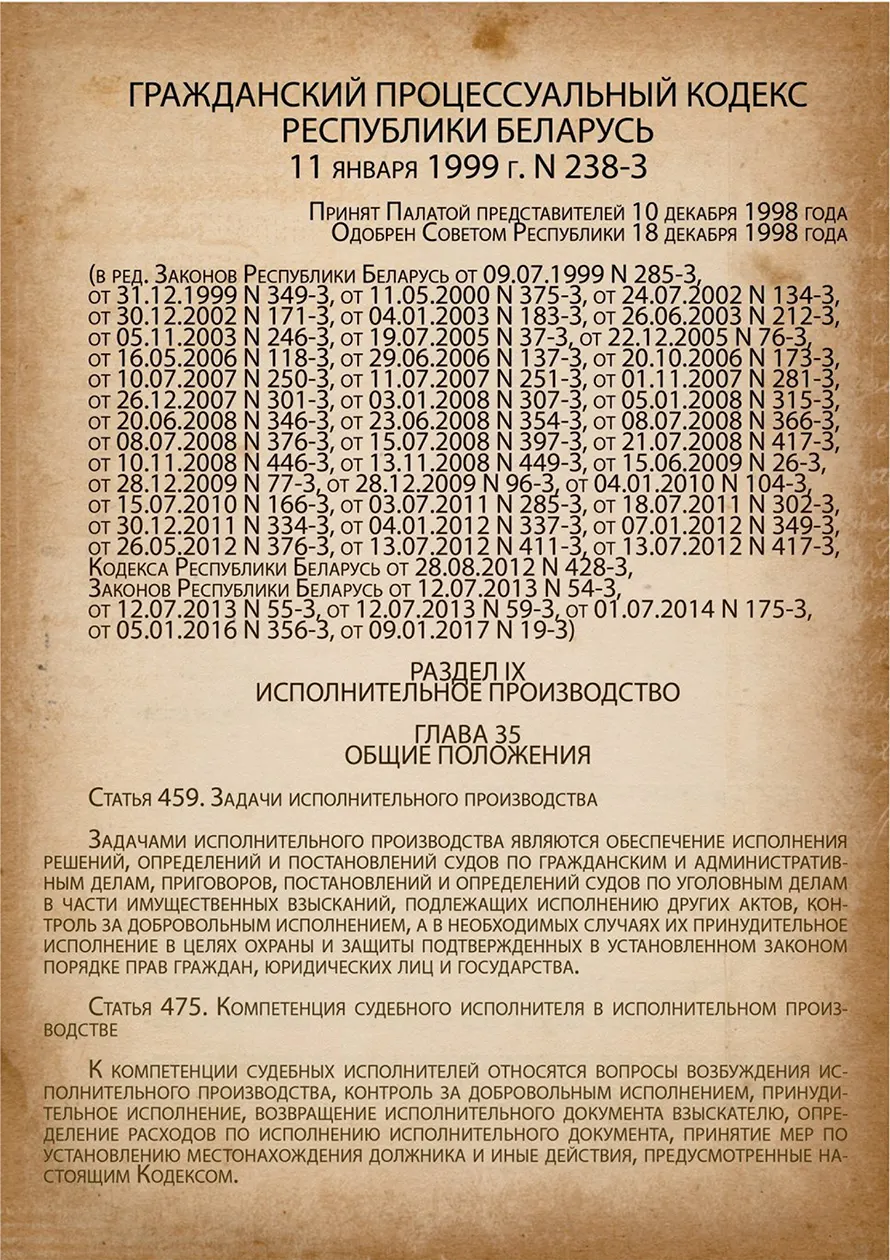
Civil Procedure Code of the Republic of Belarus January 11, 1999 No. 283-Z
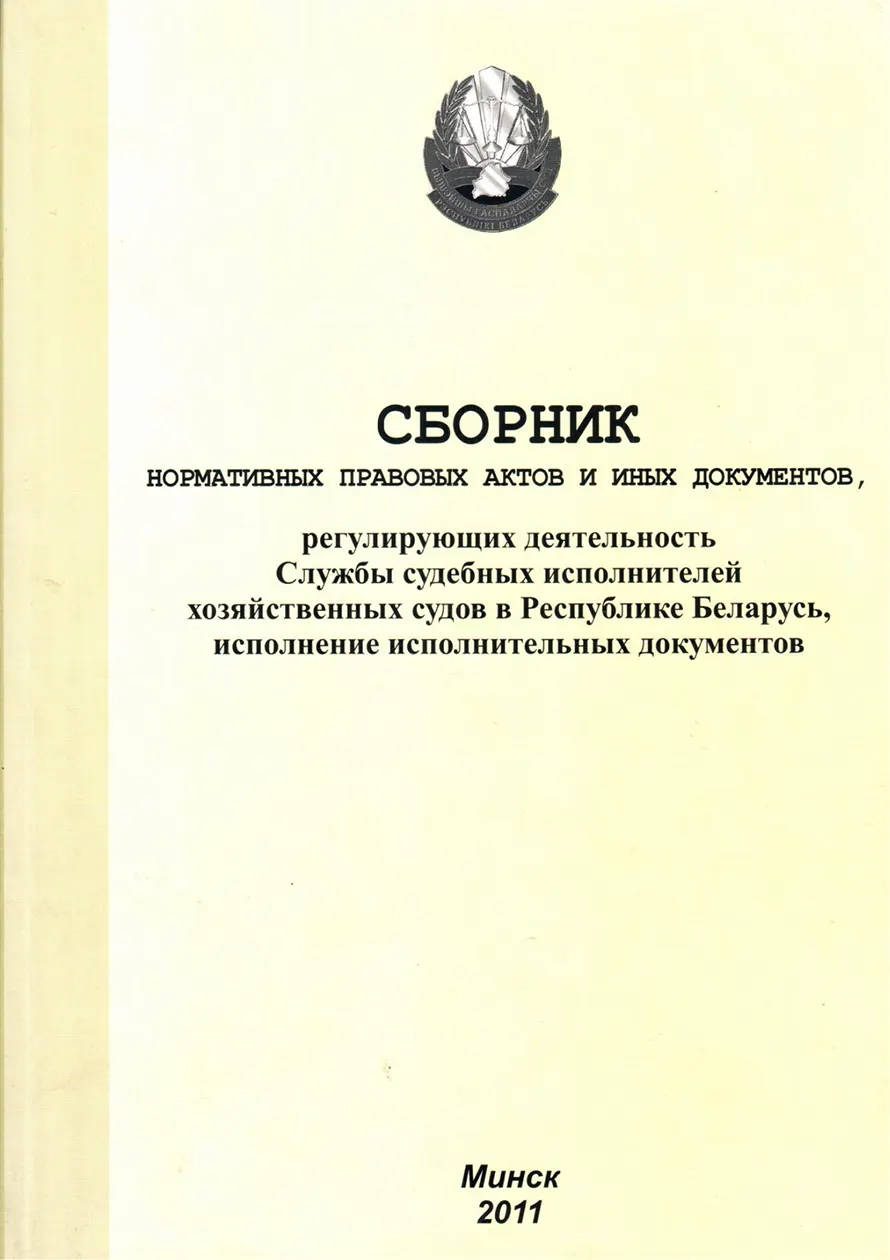
Collection of normative legal acts and other documents regulating the activities of the Service of Judicial Executors of Economic Courts in the Republic of Belarus, execution of executive documents
Enforcement proceedings represented the legally regulated activity of the court and the judicial executor for the compulsory execution of judicial acts and other jurisdictional bodies in order to ensure real protection of violated rights or legally protected interests of citizens or the state.
Correct and timely execution of court decisions and other bodies was primarily monitored by the judge and the chairman of the court to which the judicial executor was attached.
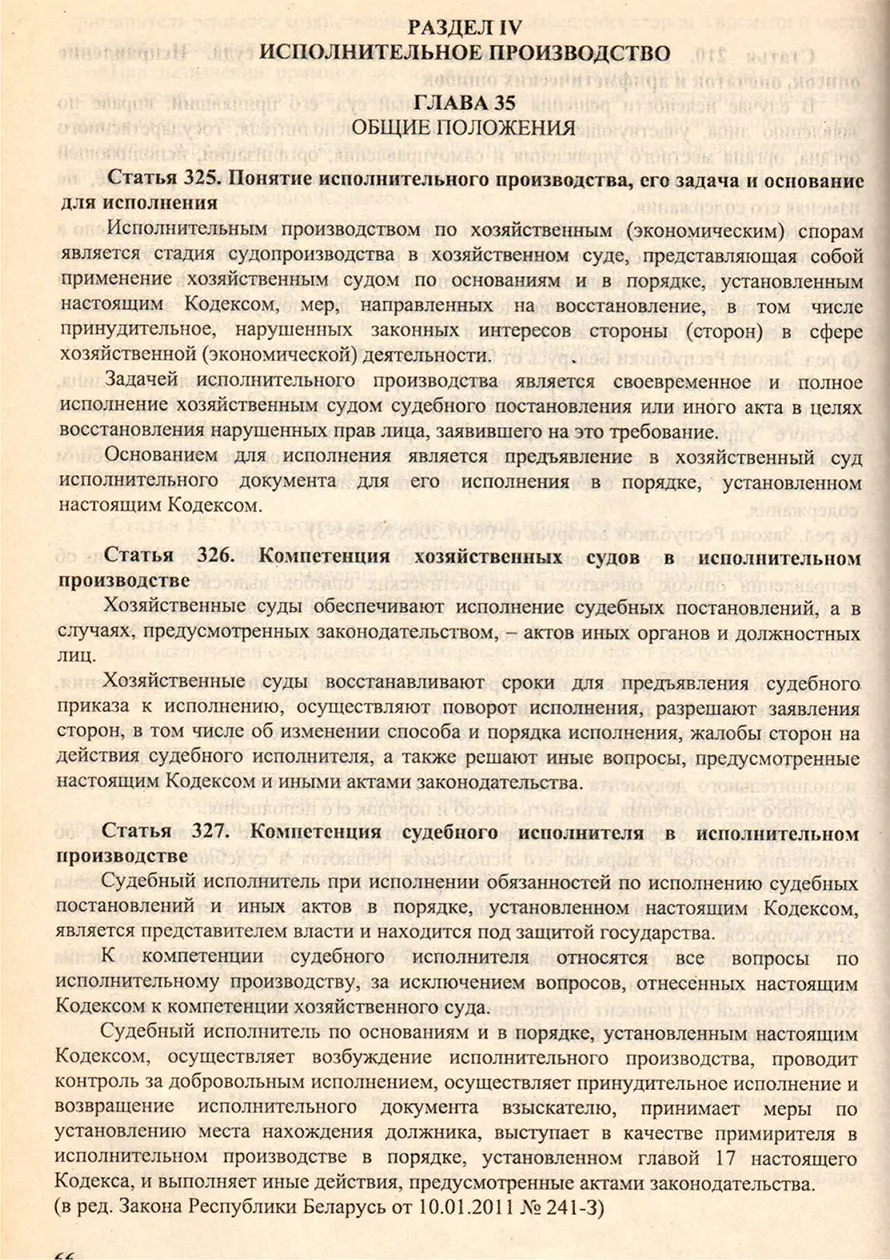
Enforcement proceedings in the Economic Procedure Code of the Republic of Belarus
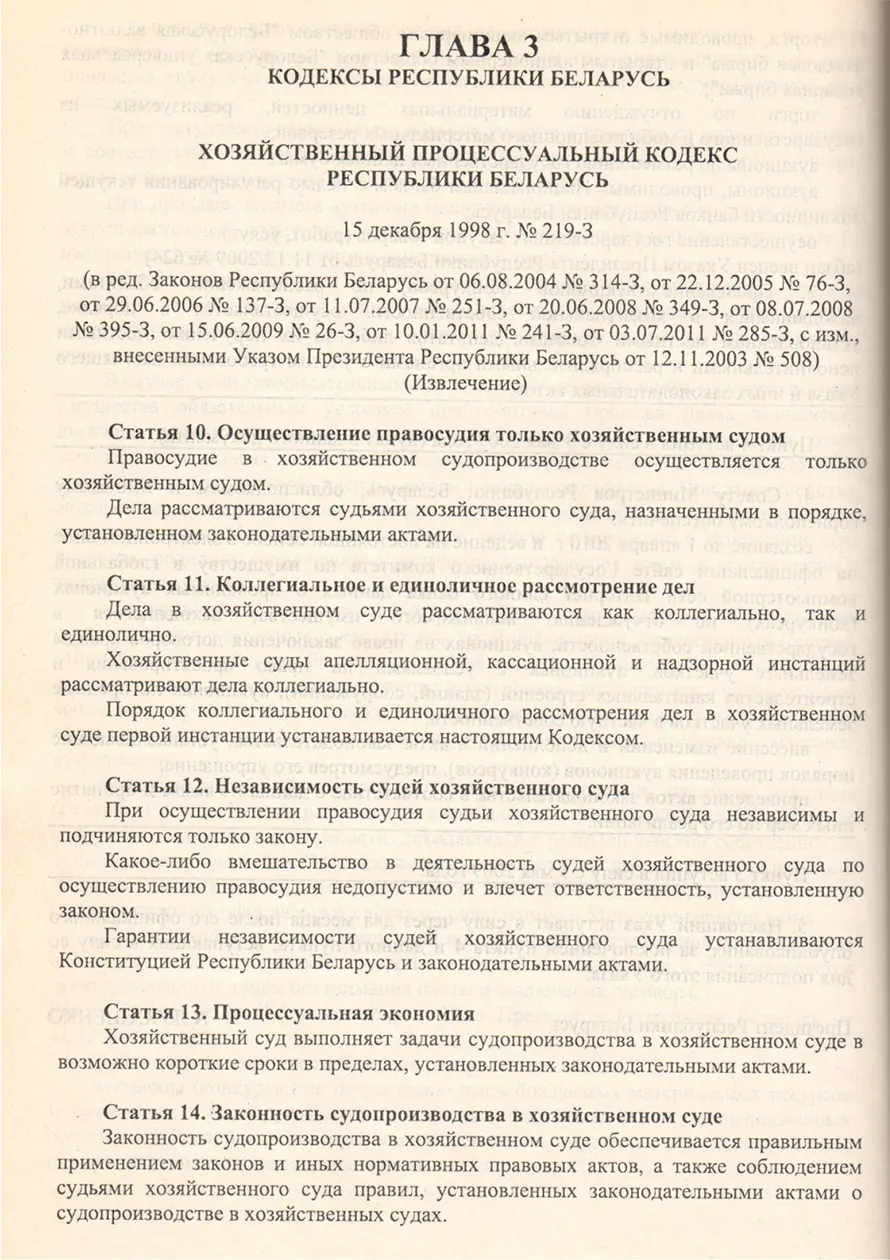
Chapter 3 of the Economic Procedure Code of the Republic of Belarus
In accordance with a resolution of the Council of Ministers of the Republic of Belarus, the appointment to the position of judicial executors of general courts was carried out by the Ministry of Justice of the Republic of Belarus, which also had the right to dismiss judicial executors of district (city) courts.
When carrying out duties related to the execution of executive documents, judicial executors were representatives of authority
The organization of the activities of judicial executors of general courts was entrusted to the Ministry of Justice and its local bodies — the justice departments of regional executive committees (Minsk City Executive Committee).

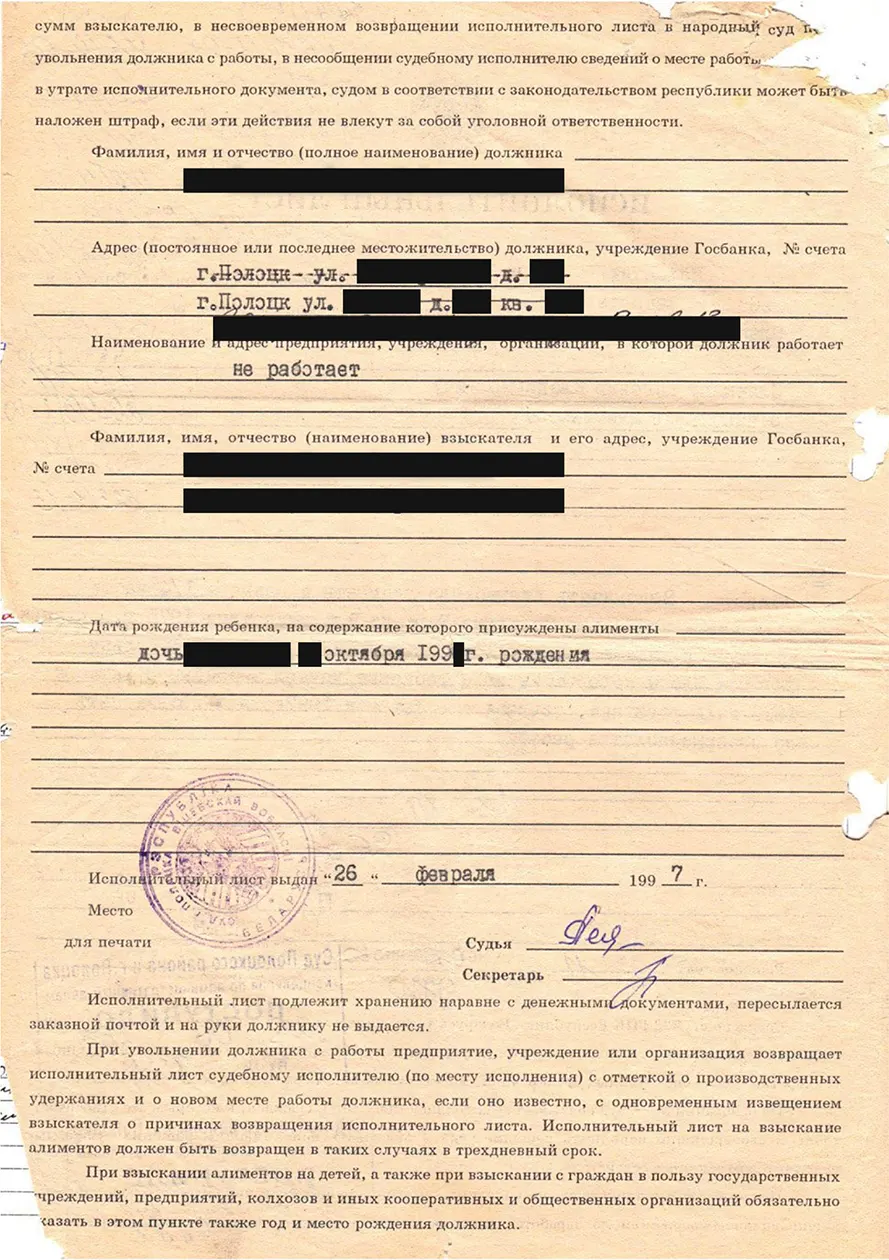
Writ of execution for recovery of alimony February 26, 1997
Judicial Executor
of the Republic of Belarus //
Present Time
Judicial Executor of the Republic of Belarus // Present Time
The reform of the judicial system and the creation of an independent service of judicial executors were carried out on the basis of a package of normative legal acts adopted by the President of the Republic of Belarus on November 29, 2013 — Decree of the President of the Republic of Belarus No. 6 of November 29, 2013 “On Improving the Judicial System of the Republic of Belarus” and the resulting Decree of the President of the Republic of Belarus No. 529 of November 29, 2013 “On Certain Issues of the Activities of Courts of the Republic of Belarus” and Decree of the President of the Republic of Belarus No. 530 of November 29, 2013 “On Certain Issues of Improving the Organization of Execution of Court Orders and Other Executive Documents”.

Modern judicial executor of the Republic of Belarus
Insignia of employees of compulsory enforcement bodies


Cockades, brooch, button emblem and stars of the Ministry of Justice (photo 1)
Sleeve patch. Breast badge (photo 2)
Head of the Main Department of Compulsory Enforcement of the Ministry of Justice.

Shoulder insignia of employees of compulsory enforcement bodies
Deputy Head of the Main Department of Compulsory Enforcement — Head of the Department of Organization and Control of Compulsory Enforcement of the Ministry of Justice.
Deputy Head of the Main Department of Compulsory Enforcement — Head of the Department of Legal Regulation of Enforcement Proceedings of the Ministry of Justice.

Shoulder insignia of employees of compulsory enforcement bodies
Deputy Head of the Department of Organization and Control of Compulsory Enforcement of the Main Department of Compulsory Enforcement of the Ministry of Justice.
Deputy Head of the Department of Legal Regulation of Enforcement Proceedings of the Main Department of Compulsory Enforcement of the Ministry of Justice.
Head of the Compulsory Enforcement Department of the Main Department of Compulsory Enforcement of the Ministry of Justice.
Head of the Compulsory Enforcement Department of the Main Department of Justice of the Regional (Minsk City) Executive Committee (hereinafter — MDJ of the region, Minsk).

Shoulder insignia of employees of compulsory enforcement bodies
Deputy Head of the Compulsory Enforcement Department of the Main Department of Compulsory Enforcement of the Ministry of Justice.
Consultant of the Department of Organization and Control of Compulsory Enforcement of the Main Department of Compulsory Enforcement of the Ministry of Justice.
Consultant of the Department of Legal Regulation of Enforcement Proceedings of the Main Department of Compulsory Enforcement of the Ministry of Justice.
Deputy Head of the Compulsory Enforcement Department of the MDJ of the region, Minsk — Head of the Department of Organization and Control of Compulsory Enforcement.
Deputy Head of the Compulsory Enforcement Department of the MDJ of the region, Minsk — Head of the Compulsory Enforcement Department.

Shoulder insignia of employees of compulsory enforcement bodies
Head of Sector of the Compulsory Enforcement Department of the Main Department of Compulsory Enforcement of the Ministry of Justice.
Chief Specialist of the Department of Organization and Control of Compulsory Enforcement of the Main Department of Compulsory Enforcement of the Ministry of Justice.
Chief Specialist of the Department of Legal Regulation of Enforcement Proceedings of the Main Department of Compulsory Enforcement of the Ministry of Justice.
Deputy Head of the Department of Organization and Control of Compulsory Enforcement of the Compulsory Enforcement Department of the MDJ of the region, Minsk.
Deputy Head of the Compulsory Enforcement Department of the Compulsory Enforcement Department of the MDJ of the region, Minsk.
Head of the District (Interdistrict), City, District within City Compulsory Enforcement Department.

Shoulder insignia of employees of compulsory enforcement bodies
Leading Specialist of the Department of Organization and Control of Compulsory Enforcement of the Main Department of Compulsory Enforcement of the Ministry of Justice.
Leading Specialist of the Department of Legal Regulation of Enforcement Proceedings of the Main Department of Compulsory Enforcement of the Ministry of Justice.
Judicial Executor of the Compulsory Enforcement Department of the Main Department of Compulsory Enforcement of the Ministry of Justice.
Head of Sector of the Compulsory Enforcement Department of the Compulsory Enforcement Department of the MDJ of the region, Minsk.
Chief Specialist of the Department of Organization and Control of Compulsory Enforcement of the Compulsory Enforcement Department of the MDJ of the region, Minsk.
Deputy Head of the District (Interdistrict), City, District within City Compulsory Enforcement Department.

Shoulder insignia of employees of compulsory enforcement bodies
Leading Specialist of the Department of Organization and Control of Compulsory Enforcement of the Compulsory Enforcement Department of the MDJ of the region, Minsk.
Judicial Executor of the Compulsory Enforcement Department of the Compulsory Enforcement Department of the MDJ of the region, Minsk.
Head of Sector of the District (Interdistrict), City, District within City Compulsory Enforcement Department.
Chief Specialist of the District (Interdistrict), City, District within City Compulsory Enforcement Department.

Shoulder insignia of employees of compulsory enforcement bodies
Leading Specialist of the District (Interdistrict), City, District within City Compulsory Enforcement Department.
Judicial Executor of the District (Interdistrict), City, District within City Compulsory Enforcement Department.