




Local environmental monitoring is conducted to provide an expert assessment of natural factors and anthropogenic impacts and to identify cyclical fluctuations in tree growth.
Main advantages:
- Ability to conduct a comprehensive study of climatic, heliophysical, land reclamation, anthropogenic, and other impacts on the variability of the condition of coniferous forest stands, including urban areas.
- Objectivity and timeliness in obtaining information.
- The use of developed tree-ring chronologies (dendroscales) as natural monitors allows for obtaining an integrated indicator of environmental and biogeocenosis health.
- Capability to assess the negative impact of various factors, including climate warming.
- Assessment of timber quality within the forest cutting fund.
- Ability to quantitatively assess forest stand productivity based on annual ring width.
- Capability to model forest management practices using developed dendrochronological databases.
Implementation status
This development has been deployed at the Grodno Forestry Association, within the "Braslav Lakes" National Park, and at the Belarusian Research Institute of Urban Planning (BelNIIGradostroitelstva) for use in the design and reconstruction of forest-park areas, among other applications.
Key parameters of dendrochronological scales
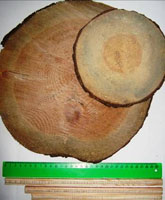
- Number of sample trees (cores) from various growing conditions included in the scale: over 25.
- Core sampling height: 1.3 m.
- Accuracy of annual ring width measurement using a binocular microscope: 0.01 mm.
- Method for deriving relative values (indices): moving average.
- Scale length: at least 100 years.
- Measurement object: annual ring width and its structure (earlywood and latewood).
Contacts:
Elena Degtyariova
Euphrosyne Polotskaya State University of Polotsk
29 Blokhin Street, Novopolotsk
211440
Belarus
Tel.: +375 29 215 63 99

