

Novopolotsk Polytechnic Institute (1968-1993)

Novopolotsk Polytechnic Institute (1968-1993)
Novopolotsk, a new large centre of the USSR petrochemical industry, was founded near Polotsk in 1958. Young and promising “Petroltown” wanted engineers, chemical engineers, mechanics of chemical manufacturing, as well as builders, machine-builders and other specialists with higher education. On July 14 of 1968, Novopolotsk branch of Belarusian Polytechnic Institute (BPI) was founded to solve the problem.
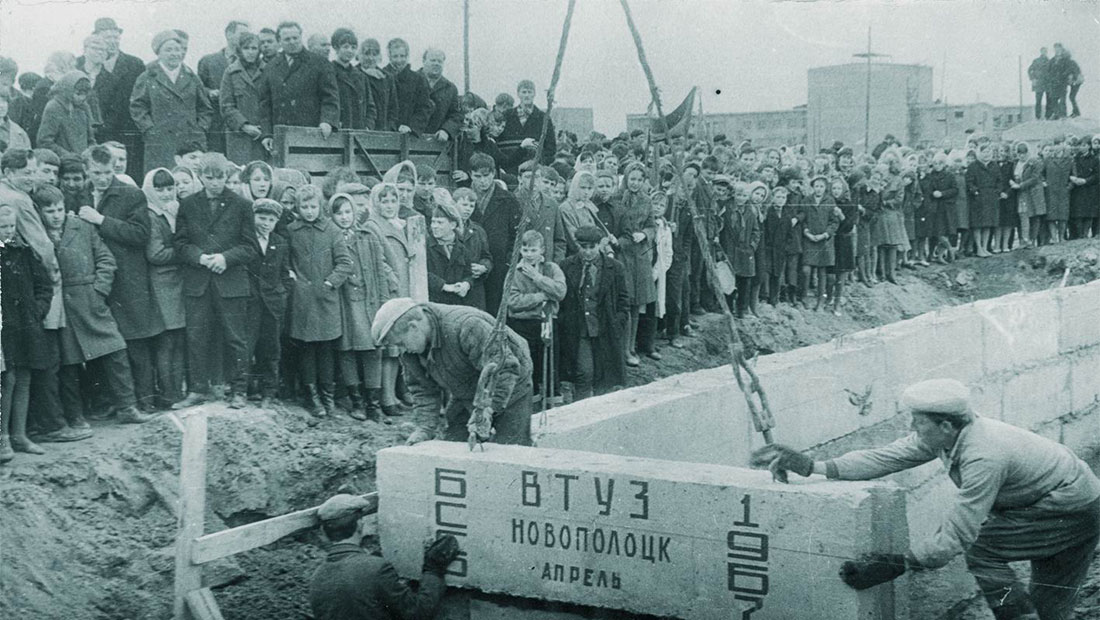
The Foundation Laying of the Main Building of NPI, 1967
Initially, only two forms of education were available at BPI: full-time and evening. The enrolment of students for the full-time form of education was carried out at "Machine-building" and "Industrial and Civil Engineering" specialities. The enrolment of students for the evening form of education was carried out at the faculties of: "Machines and Devices of Chemical Manufacturing", "Industrial and Civil Engineering", "Chemical Processing of Oil and Gas". Boris Egorovich Sokolov was appointed Director of the Novopolotsk branch of BPI. The first classes were held there on September 2 in 1968.
The following enrolment plan was established for the 1968/1969 academic year: 100 people for a full-time form of education and 125 people for a general technical evening form of education. Only 10 teachers were employed on a full-time basis at the Novopolotsk branch of BPI. The staff was not numerous either.
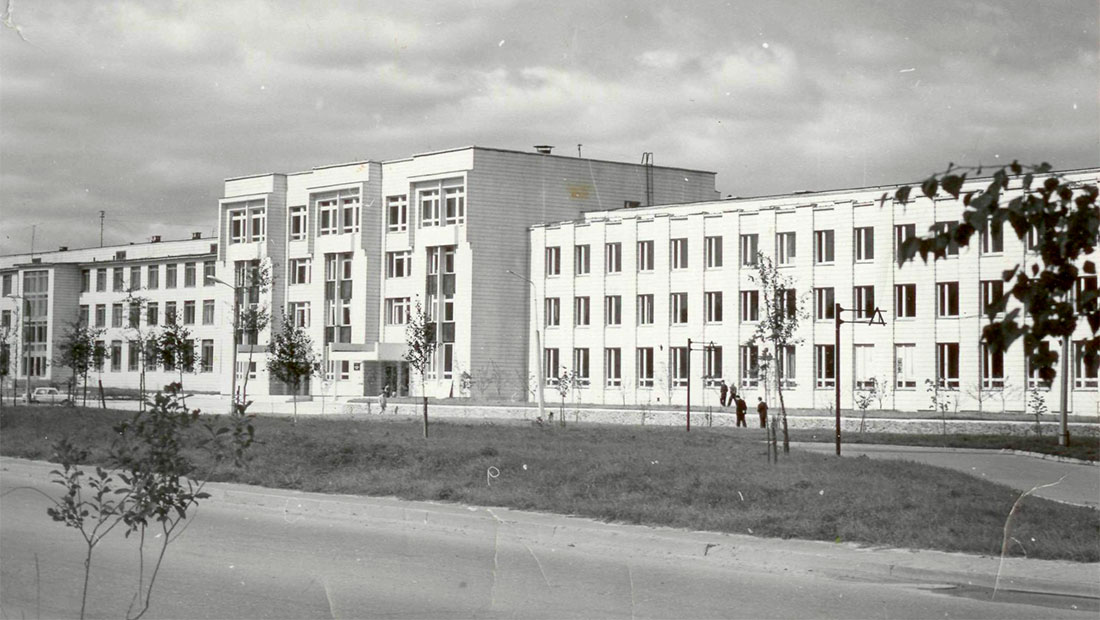
The Main Building of NPI, 1970s
In order to improve the quality of specialists training for the chemical industry and chemical engineering, on February 10, 1969, Novopolotsk branch of BPI was decided to transfer to Belarusian Technological Institute (BTI). A year later, on February 12 of 1970, Ernst Mikhailovich Babenko, Candidate of Technical Sciences, became the new director of the branch.
In 1969, two departments were opened at the Novopolotsk branch of BTI: the Department of Technical Disciplines and the Department of Physics and Chemistry. In 1971, the Faculties of Mechanics and Technology, the Faculty of Engineering and the evening Faculty were opened. By the end of 1973 two more Departments had appeared there: the Department of Higher Mathematics and Technical Mechanics and the Department of Marxism-Leninism. Besides, there were foreign language sections, descriptive geometry and drafting, physical education and sports sections.
The number of students increased rapidly. In the 1972/73 academic year, there were 801 students who studied at full-time and 483 students at the evening form of education. In 1973, the first graduates appeared at the specialties of "Industrial and Civil Engineering" and "Machines and Devices for Chemical Manufacturing".
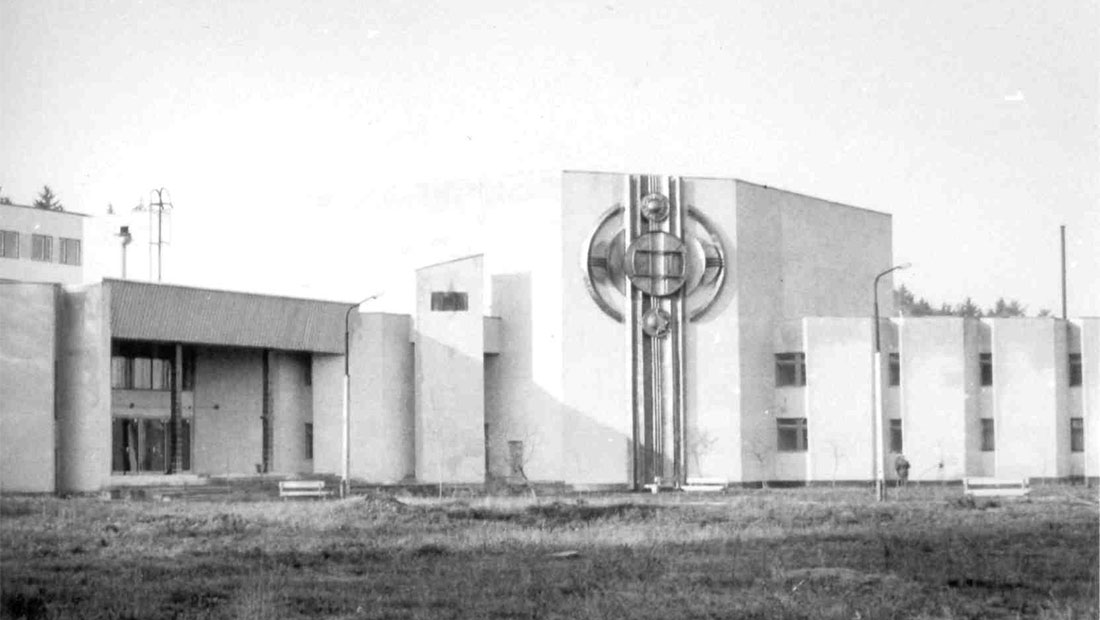
Educational Building № 3 with the Assembly Hall and Library, 1980's
A powerful material and technical base of the university was made mainly with the help of the branch ministries of the USSR and the republican and local authorities. Educational and laboratory buildings, apartments for teachers and halls of residence for students were being built actively.
Entire scientific schools were invited to the new university from such scientific and industrial centres of the Soviet Union as: Chelyabinsk, Volgograd, Saratov, Kaliningrad, Rostov. Talented teachers and professors at the same time S. I. Lugovsky, A. M. Levin, A. I. Semenov, Y. P. Oschepkov, B. P. Chemisov and others provided not only a successful scientific activity, but also laid the foundation for the scientific directions of the Departments. Moreover, large business agreements were completed with enterprises to develop new technologies for increasing the wear resistance of chemical equipment details, various machines and devices, the creation of ventilation and water purification systems, and the use of new building materials and structures.
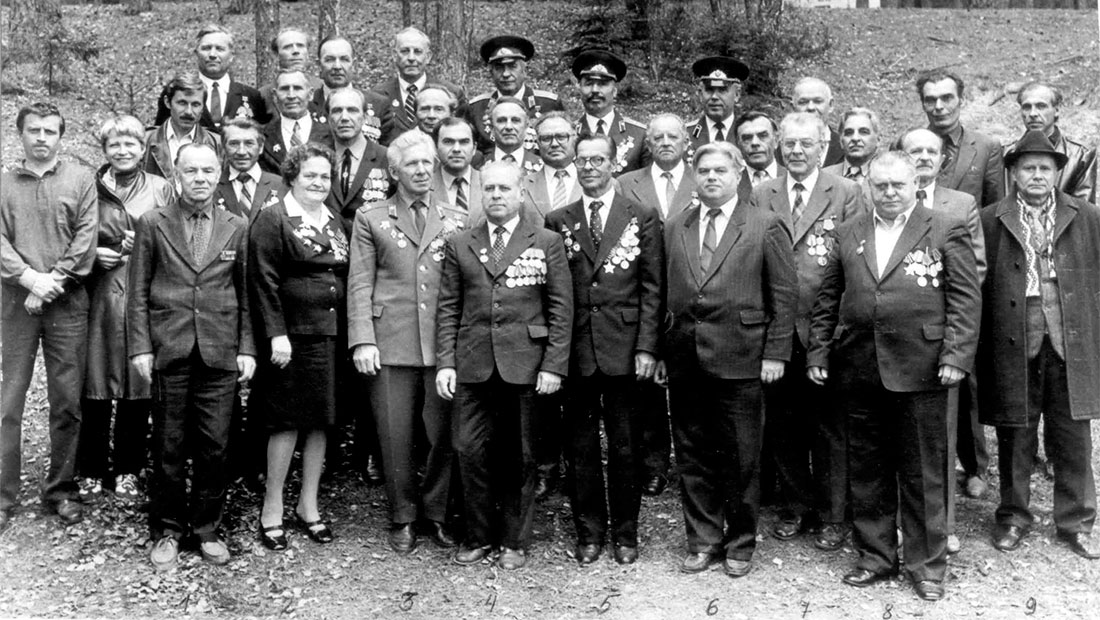
Great Patriotic War Veterans of the NPI celebrate Victory Day, 1985
Nevertheless, the rapid development of “Potroltown” demanded to turn NPI into a real higher educational institution. In accordance with the resolution of the Council of Ministers of the USSR № 413 of June 15, 1973, it was decided to establish a polytechnic institute on the basis of the Novopolotsk branch of BTI on January 1. E. M. Babenko, the former director of the Novopolotsk branch, was appointed Rector of Novopolotsk Polytechnic Institute.
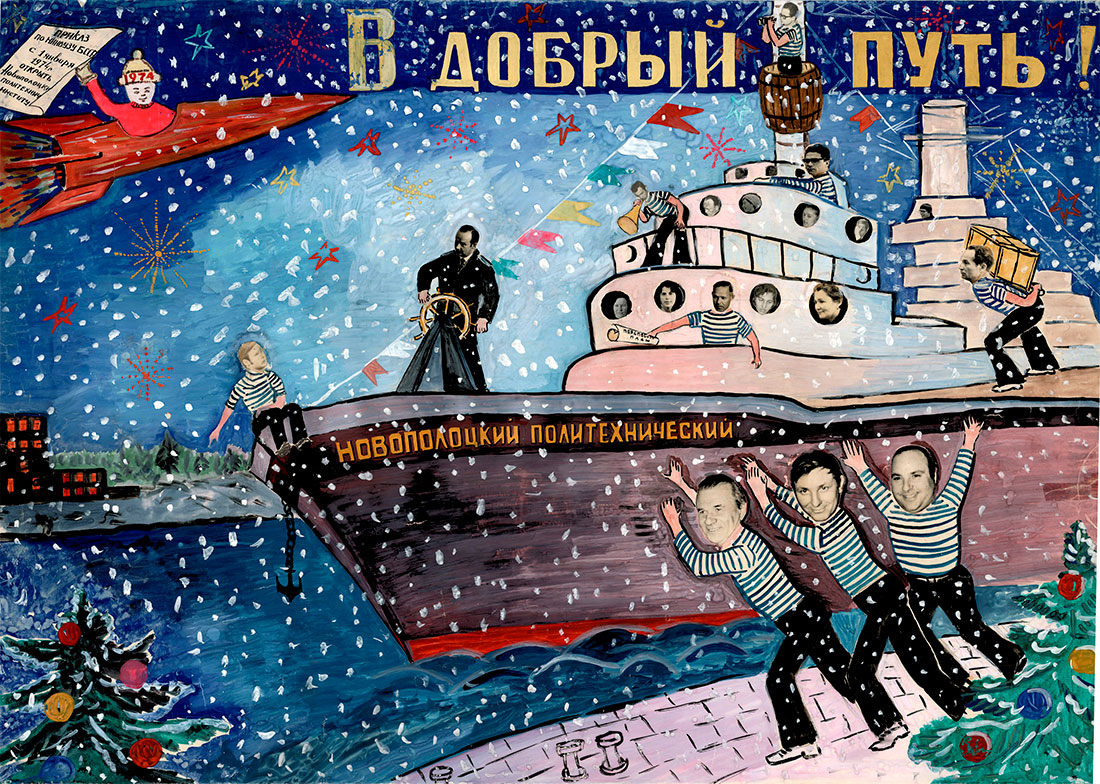
A Wall Newspaper Dedicated to the Opening of Novopolotsk Polytechnic Institute, 1974
The creation of NPI brought rapid qualitative changes. The contingent of Novopolotsk students had grown considerably. At the end of the 1974/1975 academic year, their number was already approaching 2 thousand people. Moreover, the organizational structure of NPI changed significantly: new faculties and departments appeared, the existing ones were reorganized. Thus, in 1976 Sanitary-Engineering Faculty and the Faculty of Machine-building were founded, the Faculty of Mechanics and Technology was renamed into the Faculty of Technology.
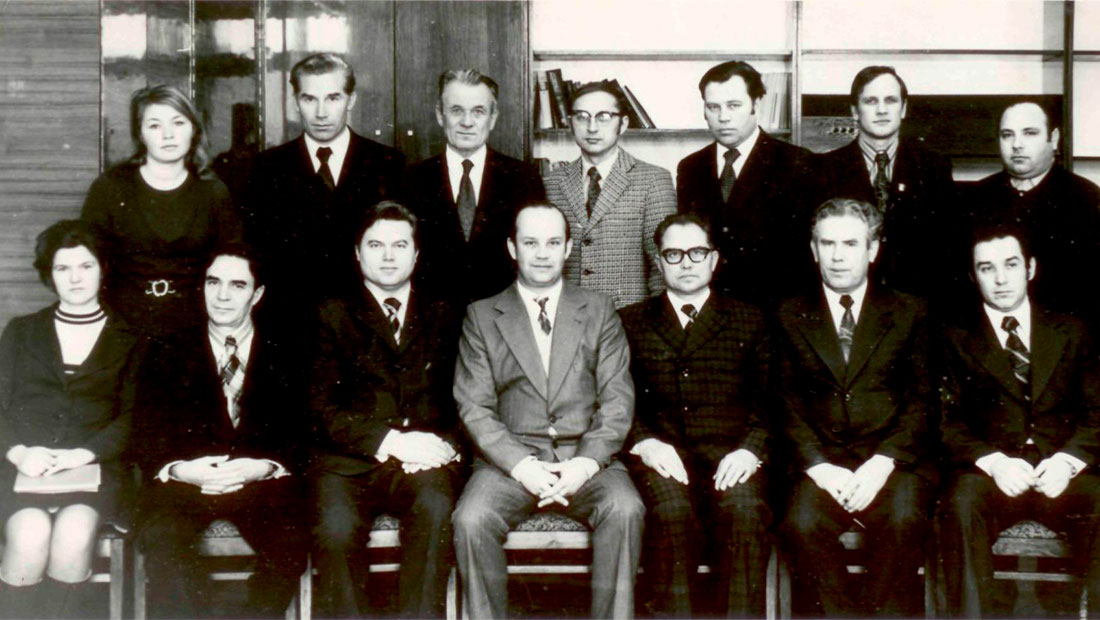
NPI Rectorate, 1975
In the 1975/1976 academic year, the enrolment for the specialty "Water Supply and Sanitation" began. In 1976, the Department of Geodesy was established and the first enrollment to the "Applied Geodesy" specialty was held. As a result of the successful development of this direction, the first and the only geodesic faculty in Belarus for quite a long time was opened at NPI in 1979.
In 1976 E. M. Babenko, a promising scientist and specialist in carbon materials, was transferred to Chelyabinsk to the post of director of the State Research and Development Institute of the Electrode Industry, and later, he was invited to Moscow to the post of Deputy of General Director of Science and New Technology of the All-Union Cooperation “Soyuzuglerod” (union+carbon). Therefore, from 1976 to 1987 the post of rector of NPI was held by P. I. Shved, a Ph.D., a senior lecturer, a laureate of the State Prize of the USSR, and a former vice-rector for scientific work.
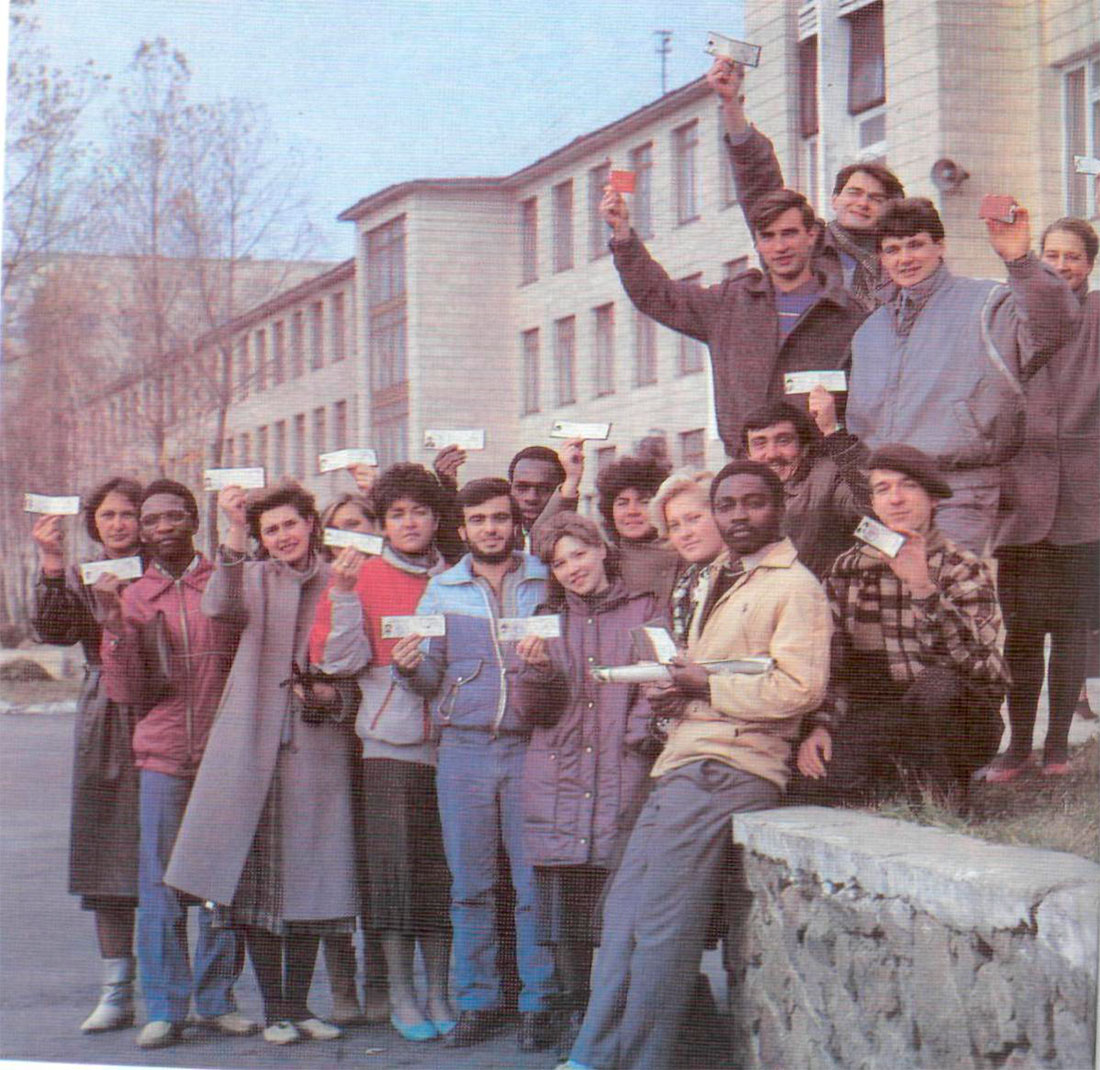
In 1982, NPI consisted of 6 faculties. They were the Sanitary-Engineering Faculty, the Faculty of Engineering, the Faculty of Technology, the Faculty of Machine-building, the Faculty of Geodesy and the evening one, 23 departments and the scientific-research sector. Later, in 1987, the Dean's Office for International Students was established at the institute. The achievements of the lecturers, employees and students of the university were highly appreciated: Novopolotsk Polytechnic Institute was given the name of the Leninist Komsomol of Belarus (according to the Resolution of the Council of Ministers of the BSSR № 333 of September 24, 1980).
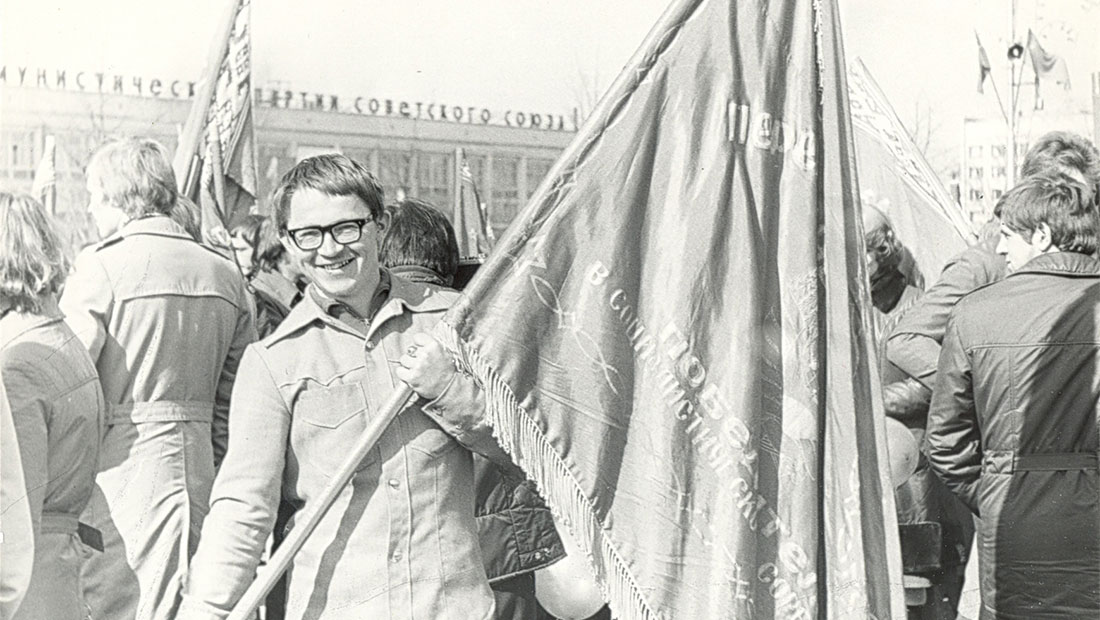
Vladimir Staheiko, a Student Construction Brigadier, with the Banner of the Socialist Competition Winners, 1978
The socio-political and socio-economic processes that took place in the USSR and, after its dissolution, in Belarus from the late 80's to early 90's of the XX century brought significant changes to NPI. Thus, in 1989 the Faculty of Radio Engineering was opened. In 1990, the Department of Chemical Technology of Fuel and Carbon Materials and the Department of Chemical Engineering were established on the basis of the Department of Chemical Engineering and of Oil and Gas Technology. The Department of Computer Science, Automation and Electrical Engineering was reorganized. Further, in 1990, the Departments of Automation of Production Processes and Programming were opened on its basis; as well as the Departments of Construction and Technology of Radioelectronic Facilities; and Radioelectronics. In 1992, some new faculties appeared at NPI: the Faculty of Finance and Economics and a separate faculty for the retraining of specialists with higher education (on the basis of the Faculty of Machine-building), soon converted to the Institute for Advanced Studies at NPI.