




Polotsk Cadet Corps (1835-1918)

Polotsk Cadet Corps (1835-1918)
The heritage, left by the Jesuits in Polotsk, opened the widest opportunities for the education development. On April 22, 1828, the decree of Nicholas I was given to the Senate. The decree said to find funds to establish Polotsk Theological Academy. On April 28 the decree about its opening was signed. Nevertheless, the problems in the rooms needed and the teaching staff required postponed the realization of the project for a year and then, after another gentry uprising (in 1830-1831), they didn’t return to the idea.
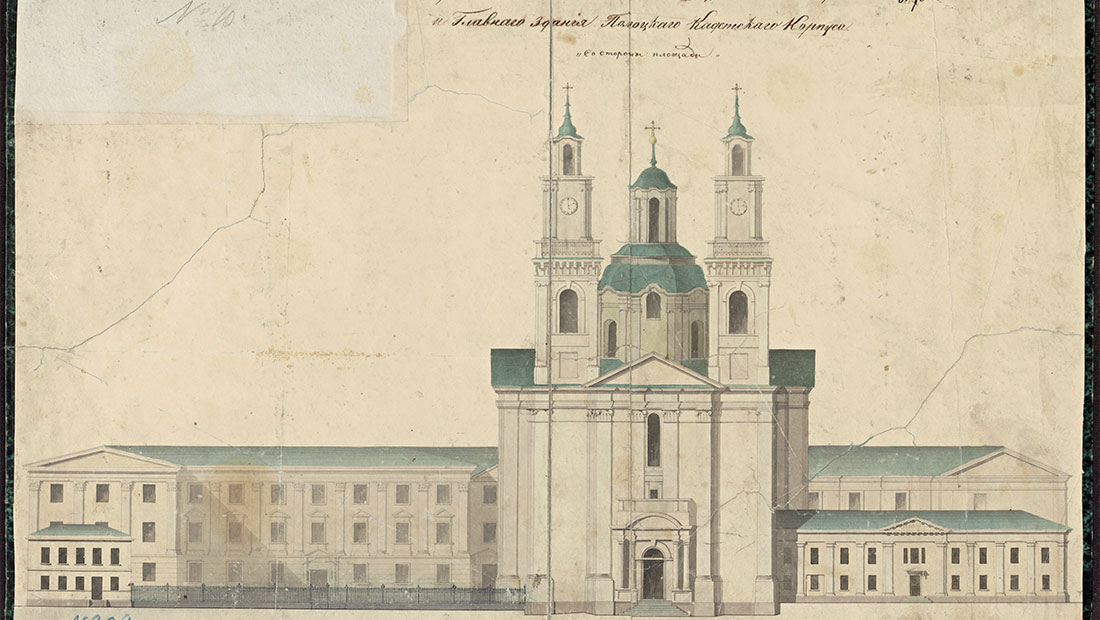
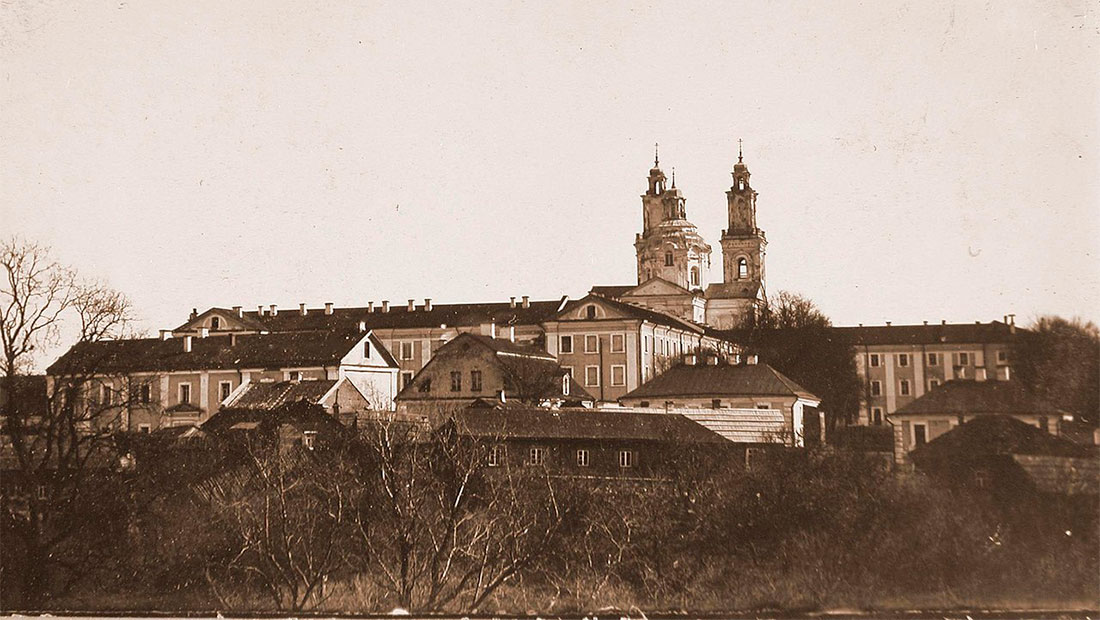
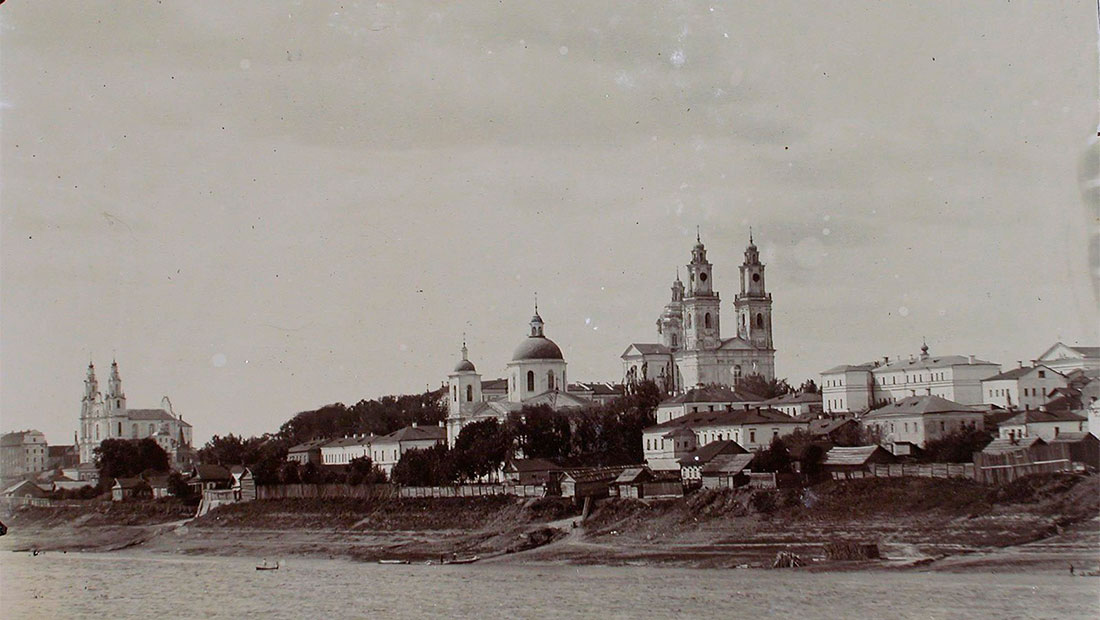
The Foreside of the St. Nicholas’ Church and the Main Building of Polotsk Cadet Corps from the Side of the Square
One of the principal directions of the education development on Belarusian land becomes the creation of military educational institutions of the closed type – the cadet corps. On February 1, 1830 the “Regulation of the Provincial Cadet Corps” was approved. The document ordered to create cadet corps in six cities of the Empire: Yelisavetgrad (now Kropyvnytskyi, Kirovohrad between 1939 and 2016), Novgorod, Poltava, Polotsk, Tambov and Tula. On April 26, 1830 tsarist government decided to found Polotsk Cadet Corps, designed for 400 cadets, at the place of Polotsk Piarist School aiming to "implement the ideas of Russian enlightenment, Russian patriotism and Russian affairs on the Western side".
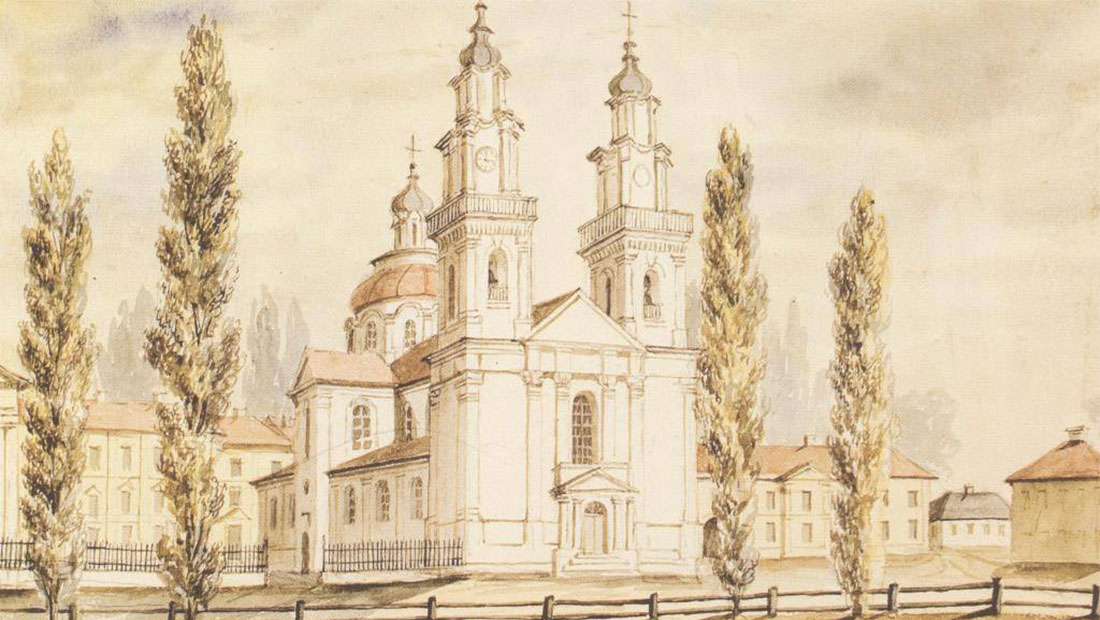
St. Nicholas' Church and Cadet Corps Buildings in the Picture by Napoleon Orda (1876)
The institution was established for the noblemen children of Vilna, Vitebsk, Grodno, Minsk, Mogilev, Smolensk provinces and the Bialystok region, as well as for the children of officers and military settlements officials of Vitebsk and Mogilev provinces. In addition to the general rules that concerned the Russian Empire, certain restrictions were introduced for the nobility of the Belarusian provinces. For example: Polotsk Cadet Corps did not accept the noble children whose fathers participated in the gentry uprising of 1830-1831. Those children were sent to educational institutions located in the Russian land.
On June 25, 1835 (the birthday of Emperor Nicholas I) after a long preparatory work, Polotsk Cadet Corps, primary military educational institution with a secondary education program, was inaugurated. Major-General P. K. Khvoshchinsky was appointed its first chief (director).
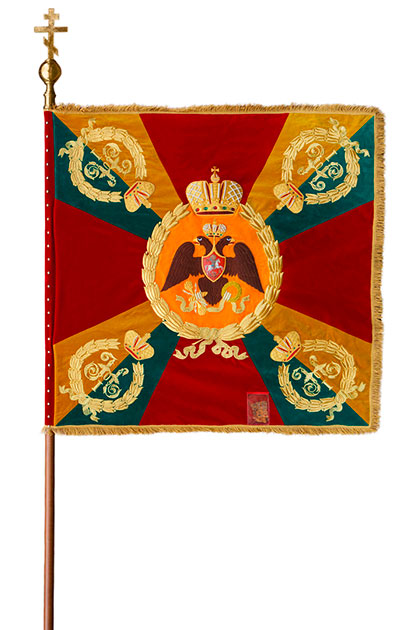
Polotsk Cadet Corps’ Flag
At first, the corps was designed for 400 cadets. It was planned to bring the number of students to a certain set within four years, taking 100 cadets every year. Only
54 people (young men aged 12 to 14 years) were admitted until the opening day, but in 1838 the corps was already fully staffed.
From 1835 to 1857 there were 2-years-long preparatory and 4-years-long general education courses. After ending the training cycle, the cadets were transferred to the capital's Nobility Regiment for the continuation of military education, or rather for obtaining a special (military) education. The successful development of the educational process in the corps encouraged administration to reorganize education. Since 1857 the term of study had been increased from 6 to 9 years. The cadets were to study 2 years at preparatory, 5 years at general education and 2 years at special education courses, at the termination of which the officer rank was given to the graduate. According to the troop list the cadets were divided into 4 companies: 3 ranked (one grenadier and two musketeer) and non-ranked, which comprised the battalion.
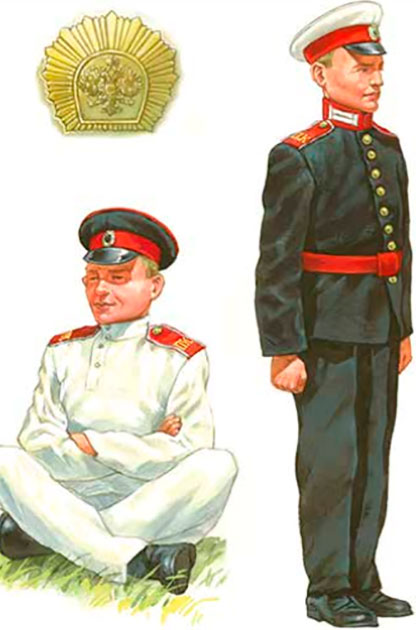
Polotsk Cadets’ Daily and Parade Uniform
A significant solemn event was held at Polotsk Cadet Corps in 1838. St. Nicholas' Church, which earlier was a Jesuit St. Stephen Church (from 1820 to 1830 belonged to the Piarists), was given to the Cadet Corps. The first parade with the flag (in the history of the Cadet Corps) took place in honour of this event. In 1875, when transferring the church to the city, it remained a corps church.
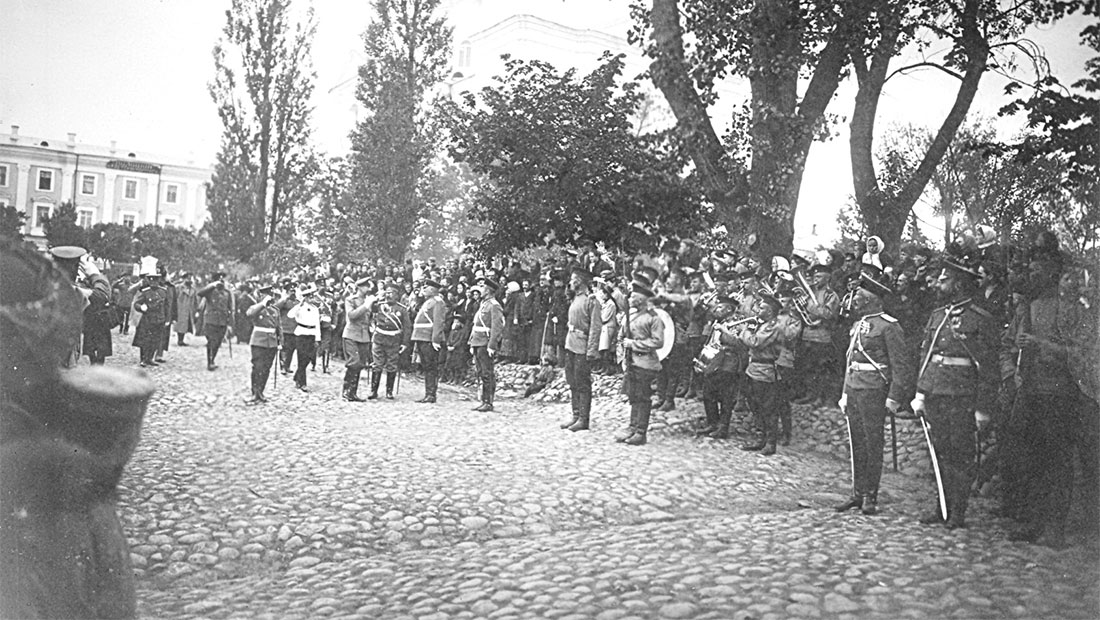
A Solemn Parade at Polotsk Cadet Corps
In 1845, the Emperor Nicholas I visited Polotsk Cadet Corps himself twice and was pleased with what he had seen and before leaving, he had ordered all employees to be given awards. Nicholas I awarded F. M. Ares, the director of Polotsk Cadet Corps, the signs of the St. Anne Order of the 1st degree and gave him 400 roubles in silver for distribution to the poorest inhabitants of Polotsk.
On August 26, 1850 the Cadets and the teachers of Polotsk Cadet Corps participated in one more important celebration. In Corpus Square (today - Freedom Square), in presence of Alexander Nikolayevich (since 1855 - Emperor Alexander II), the heir to the Russian throne, Basil (Luzhinsky), the Archbishop of Polotsk and Vitebsk, and a number of large state and military ranks, a monument to the heroes of the Patriotic War of 1812 was unveiled. (The event was dedicated to the 38th anniversary of the Battle of Borodino.) At the end of the commemorative event, the Cadet battalion marched a ceremonial march in front of the monument.
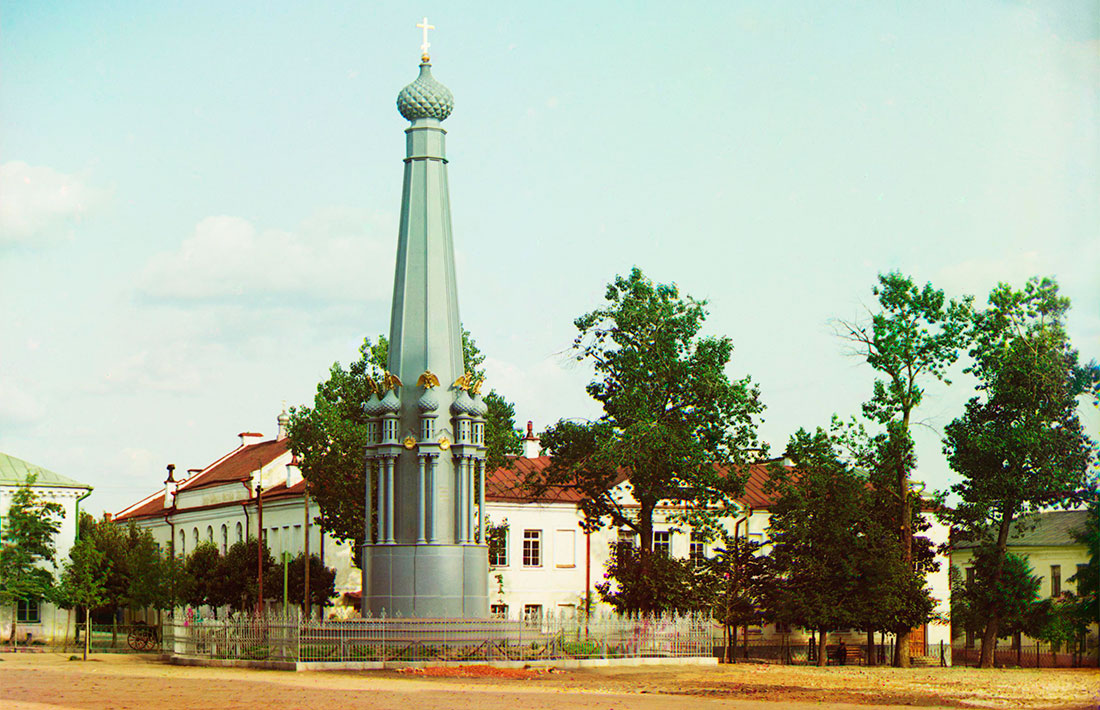
The Monument to the Heroes of the Patriotic War of 1812 in the Square Near St. Nicolas’ Cathedral (photo by SM Prokudin-Gorsky, 1912)
Nicholas’ I death, ascension to the throne of a young Alexander II, the defeat of Russia in the Crimean War forced the beginning of profound transformations in the empire. Thus, a progressive military reform affected the whole officers training system in the state. As a result, in 1862 Polotsk Military Gymnasium was opened at the place of Polotsk Cadet Corps. The Gymnasium resembled a real college in its educational content. The training course was designed for six years. The training was of an elementary character in the three junior classes. An age division of students (younger, middle, senior) was introduced instead of a company one. After graduating from the Gymnasium, most of the graduates were transferred to the military colleges of the empire.
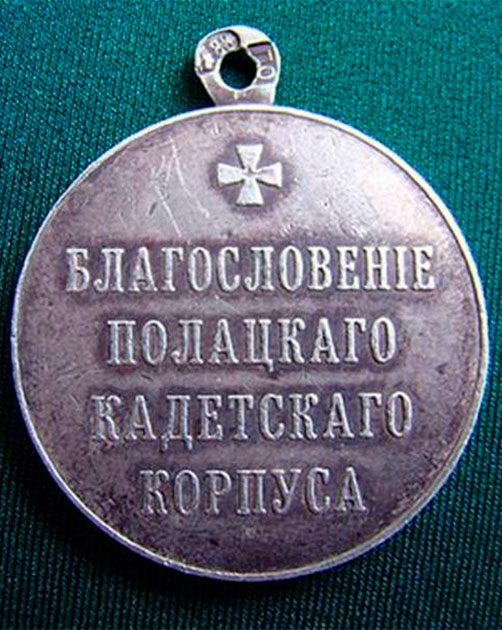
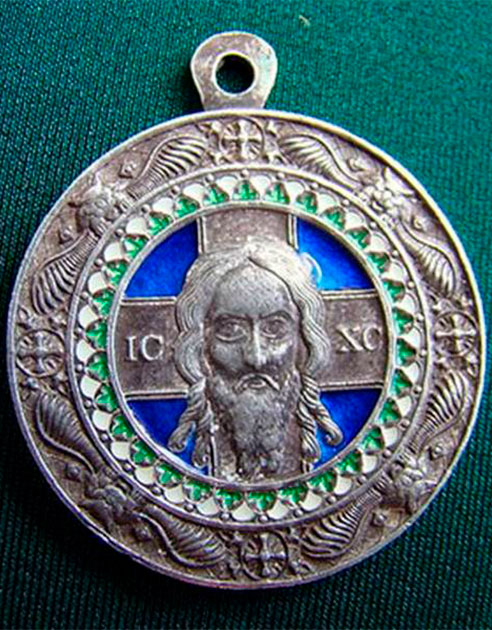
A Graduating Token of Polotsk Cadet Corps
However, after the assassination of Alexander II and the ascent to the throne of Alexander III (1881), a final retreat from the policy of bourgeois reforms happened. The state policy in the field of military education was changed as well. Because of its unsatisfactory state, it was decided to restore the cadet corps; while maintaining the general education course, they decided provide systematic military training and regime that would meet the objectives of institutions; the tutors were to be replaced by military officers only; they also decided to introduce the division into companies with the introduction of company commanders posts and an older company was to be called a drill company. On July 22 of 1882 Polotsk Cadet Corps was rebuilt as a 7-year secondary military establishment.
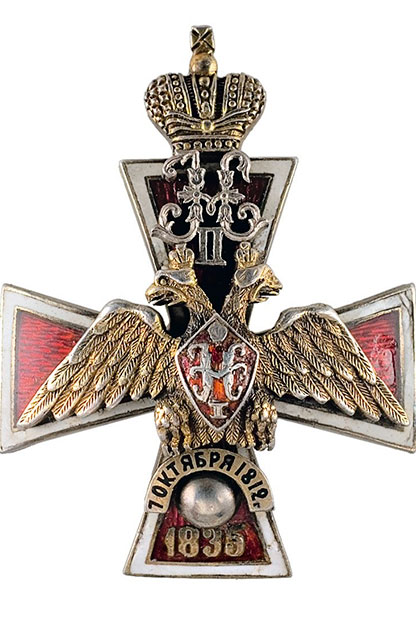
A Graduating Sign of Polotsk Cadet Corps
As required by the general orientation of the institution, the majority of the teachers were officers and natives of the central Russian provinces: physicist M. V. Popov from the Voronezh province, Colonel A. P. Argamakov from the Tula province and etc. Most of them were orthodox. In the course of time the graduates appeared among the teachers: Major-General G. P. Kuzmin-Karavaev (from 1864 to 1867 – the director of the military gymnasium), Colonel A. S. Chizh and his brother I. S. Chizh and others. Specialists from far abroad were drawn in teaching the cadets: I. Kudelko, a graduate of the Vienna Ballet School - a dance teacher, A. Zh. Marshal, a graduate of Brussels Conservatory.
The educational process organization remained practically the same: the academic year lasted from August 15 to June 5, the classes started at 8 a.m. and lasted until 3 p.m. The general educational disciplines included: God’s law, the Russian language, German and French, Russian and general history, geography, mathematics (including arithmetic, algebra, geometry, trigonometry, analytical geometry), physics, chemistry, legislation, drafting, mineralogy, physiology, botany, cosmography, drawing, music, singing and dancing. Special military subjects included tactics, artillery, military history and fortification. Much
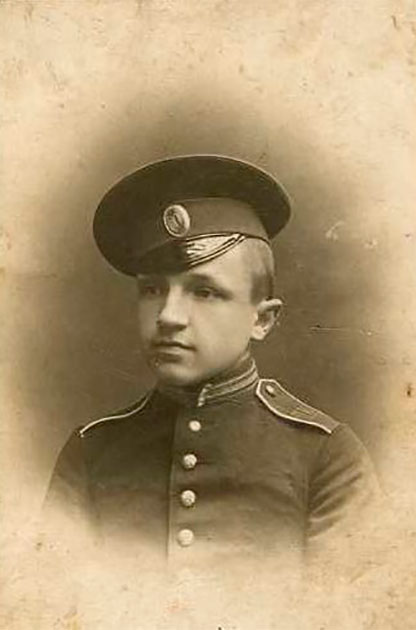
A Polotsk Cadet
The students received high claims. For example, in 1847/1848 academic year 30% of all cadets were underperformers. In the struggle for improving the quality education they couldn’t but improve the pedagogical skills of the teaching staff. Over some time, the efforts made delivered the deserved results. Thus, by the results of studies and discipline, in 1912 Polotsk Cadet Corps was recognized as the best one among all corps of the empire, including the most prestige – the Page Corps. The choice of Grand Duke Konstantin Konstantinovich, who sent his son Oleg to study at Polotsk Cadet Corps in 1907, can be explained by the high level of education there (Oleg died from a wound received in a battle during World War I; awarded the St. George Order of IV degree).
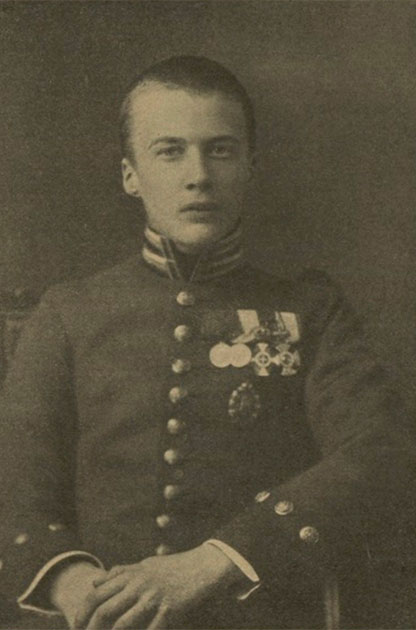
Prince Oleg Konstantinovich
It should be noted that despite the class type of the institution, more and more non-nobles were getting into the number of Polotsk cadets over time. For example, in 1915 from 403 students only 307 were from the privileged class, and 48 cadets came from townspeople, and 4 – from peasants.
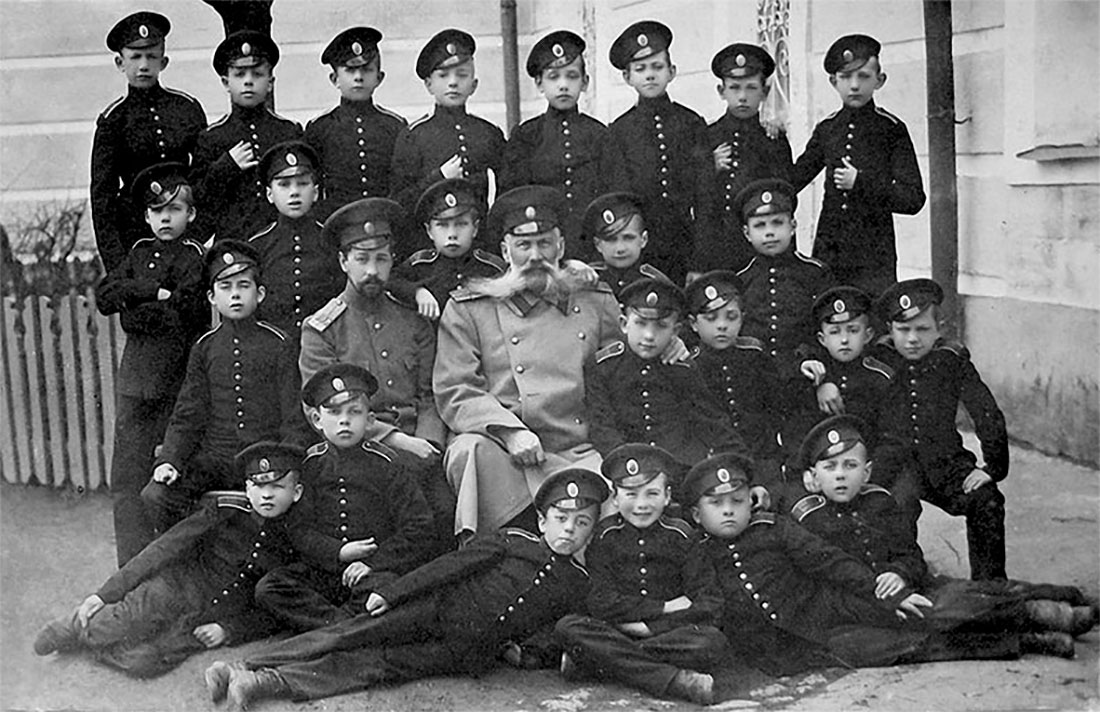
A Group of Polotsk Cadets Together with Teachers (1912)
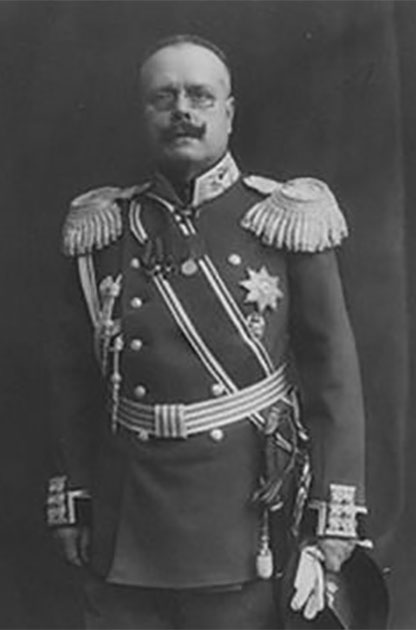
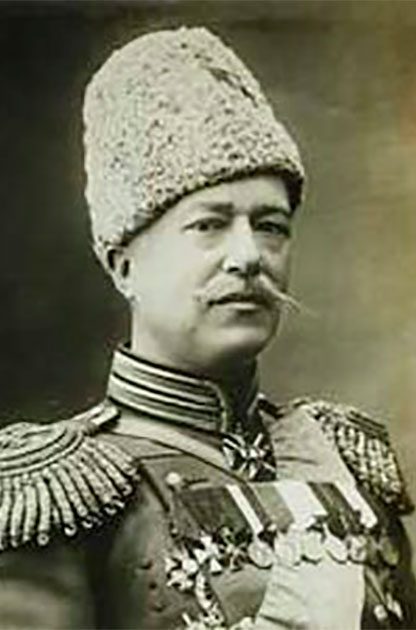
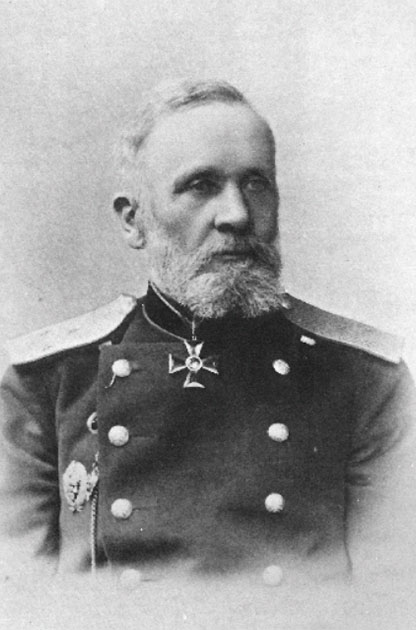
For the whole time of its existence, Polotsk Cadet Corps had trained over 3 thousand young men. Among its students are a lot of important military and state figures. Evgeniy Mikhailovich Subbotkin, an actual Privy Councillor (the civil position (class) in the Russian Empire, according to the Table of Ranks. The rank was equal to those of Lieutenant-General in the Army and Vice-Admiral in the Navy), held the posts of the Suwalki and Siedlce governors and was appointed senator later. Major Franz Albert Alexandrovich Seyn held office of the Grodno Governor and the Finland Governor-General and Lieutenant-General Alexander Konstantinovich Gaines was the governor of Kazan. Alexander Ivanovich Petrov held the post of the Minsk and Kharkov governors and then sat in the Senate. General Yevgeniy Konstantinovich Klimovich made an excellent career in the police. He headed the Moscow Security Department and the Police Department. Later he was appointed Senator.
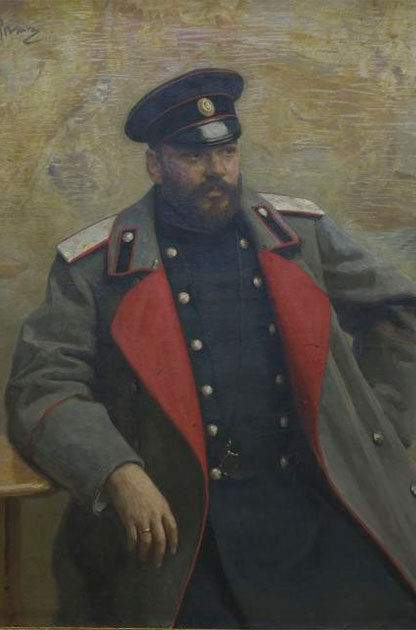
Alexander Konstantinovich Gaines (I. Y. Repin, 1896) (photo 1)
Franz Albert Alexandrovich Seyn (photo 2)
One of the most famous graduates from Polotsk Alma Mater is Lieutenant-General Roman Isidorovich Kondratenko, twice the holder of St. George Cross and the hero of the Russo-Japanese War (1904-1905) (died during the defence of
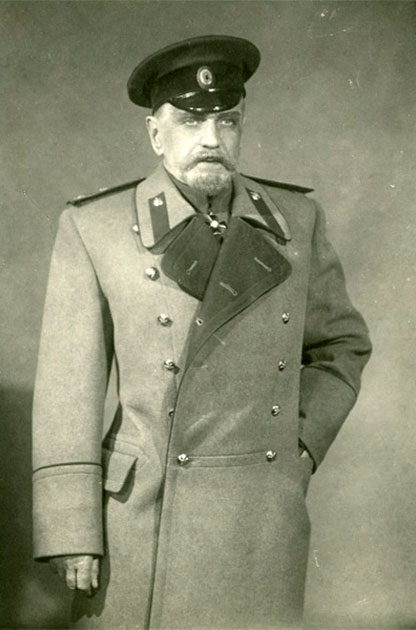
Roman Isidorovich Kondratenko
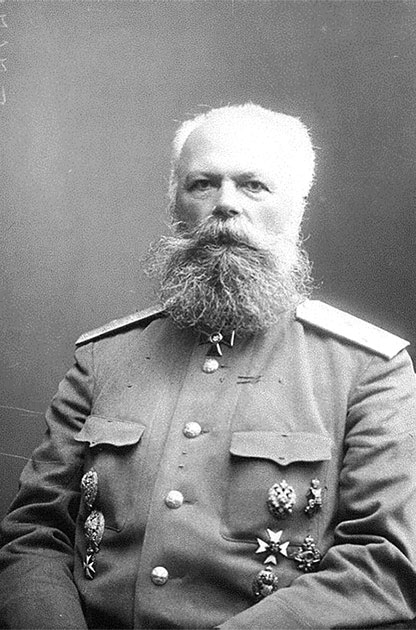
Quite a few graduates from Polotsk Cadet Corps became the holders of St. George Cross. Except Oleg Konstantinovich Romanov and Roman Isidorovich Kondratenko St. George Cross was also awarded to Lieutenant-Generals N. A. Brzozovski, N. M. Kisielewski, K. V. Levitsky, A. R. Meister, Nemiro, M. A. Pryaslov, I. D. Iouzefovitch, Major-Generals V. V. Golitsyn, P. M. Golovin, A. S. Grishinsky, Generals J. I. Mrozovsky, E. A. Radkevich, A. F. Ragoza, V. V. Smirnov, V. N. Tokarev, V. A. Yatskevich, Colonel A. N. Levikov.
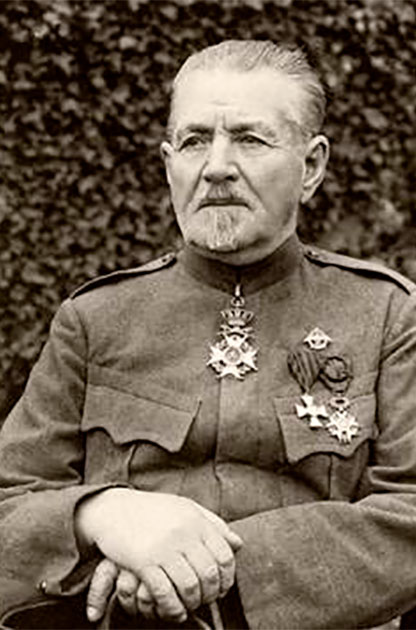
Nikolaj Alexandrovich Brzozowski (photo 1)
Joseph Ivanovich Mrozovsky (photo 2)
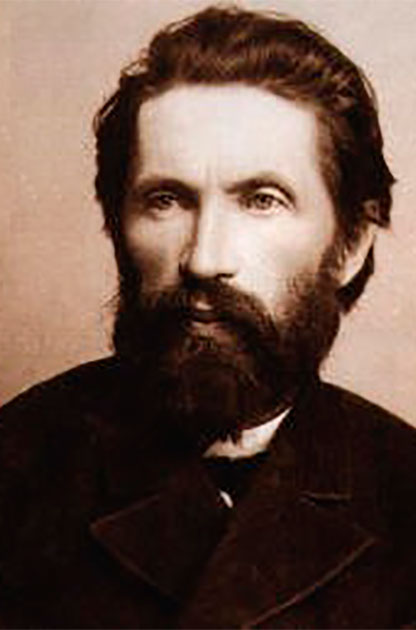
Some graduates were able to prove themselves both in soldiering and in science. Pavel Osipovich Bobrovsky, apart from having a successful military (in 1875-1897 he was a commandant of the Military Law Academy and became an infantry general) and state dignitary career (in 1897 was appointed senator), made a name in the field of ethnography and history. A group of General Staff officers led by P. O. Bobrovsky made “Materials for geography and statistics collected by General Staff officers. Grodno province”, an excellent source of information in household, education, ethnography, history and geography of the province. P. O. Bobrovsky studied the history of chronicles and the Uniate Church history at a high level. He is the author of more than a hundred works in history, jurisprudence, archeography, geography, biology, pedagogy, ethnography, statistics, economics, local lore.
Pavel Osipovich Bobrovsky
An honourable place among the Polotsk cadet corps inmates belongs to the Kirpichev brothers: Lev, Konstantine, Victor, Michael and Neil. Lieutenant-Generals Konstantin Lvovich and Neil Lvovich successfully combined military and scientific career as well and became professors of the Nikolayev Engineering Academy. Lev Lvovich worked his way up to the Major-General and a professor of the Academy of the General Staff. He was considered one of the largest military scientists of the second half of the XIX c. in the field of artillery. Mikhail Lvovich Kirpichov, a talented lecturer of the Mikhailovsky Artillery Academy, showed promises and took direct part in the experiments of D.I. Mendeleyev on the elasticity of gases. Unfortunately, his early death ended up his brilliant career.
Neil Lvovich Kirpichev
Victor Lvovich Kirpichev was an ideologist and the creator of higher technical education system in the Russian Empire, the founder and the first rector of Kharkov Institute of Technology and of Kiev Polytechnic Institute, chairman of the All-Russian Union of Engineers and Technicians, construction committee chairman, the "Best Lecturer" of St. Petersburg Polytechnic Institute and the founder of a scientific school of mechanics and engineering, many graduates of which are known worldwide.
Victor Lvovich Kirpichev
As well as V. L. Kirpichev, many of the Polotsk Cadet Corps graduates found themselves in peaceful activities. For example, Vitold Vladislavovich Novodvorskiy made a great career in science and pedagogy. He studied the history of the Polish-Lithuanian Commonwealth and Polish-Russian relations while working at the Universities of St. Petersburg, Kiev and Vilna and at Nezhinsky Institute of History and Philology. Vladimir Fyodorovich Chizh, a student of the famous scientists Wilhelm Wundt and Jean-Martin Charcot taught at St. Petersburg and Tartu Universities. He was one of the first doctors who used the experiment in his clinical and psychological studies and became one of the founders of the psychological theory of personality and individuality.
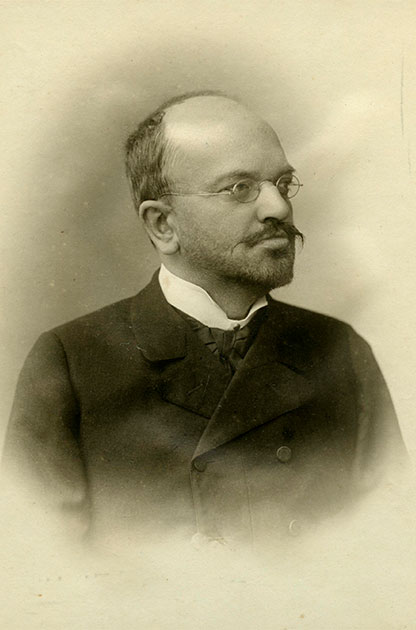
Vladimir Fyodorovich Chizh
Nikolay Grigoryevich Pisarevsky inspected state telegraph offices over the most of Russia, published an instruction about the installation of a telegraph line, learned about the telegraph business in Paris, London, supervised the process of cable laying from St. Petersburg to Kronstadt and from Baku to Kransnovodsk. Besides, he organized an awareness-raising publishing association "Public Benefit" and published the official military ministry newspaper "Russian invalid". Nevertheless, N. G. Pisarevsky became famous not only as a public figure and as an excellent engineer in the field of electrical communication means, photography and topography. In 1886 he founded and was appointed the first director of a special electrotechnical higher educational establishment - Electrotechnical Institute (nowadays it is Saint Petersburg Electrotechnical University "LETI")
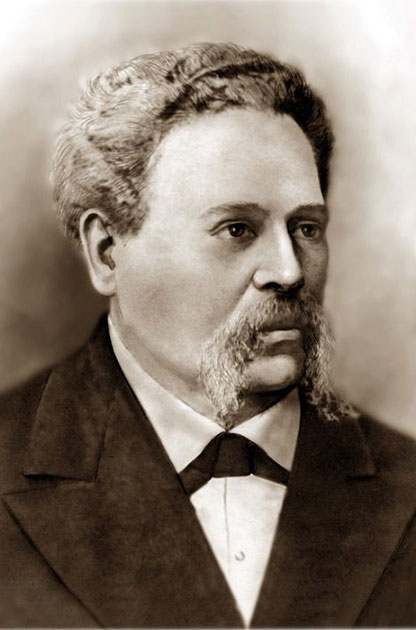
Nikolay Grigoryevich Pisarevsky
Dmitry Nikiforovich Kaygorodov became a remarkable biologist, ornithologist, scientific knowledge populariser, teacher and professor of St. Petersburg State Forest Technical University. He was called the father of Russian phenology - the science concerning seasonal phenomena of animate nature. D. N. Kaygorodov was the first in pre-revolutionary Russia who managed to create a phenological network of European part of Russia, which became the basis for its bioclimatic zoning.
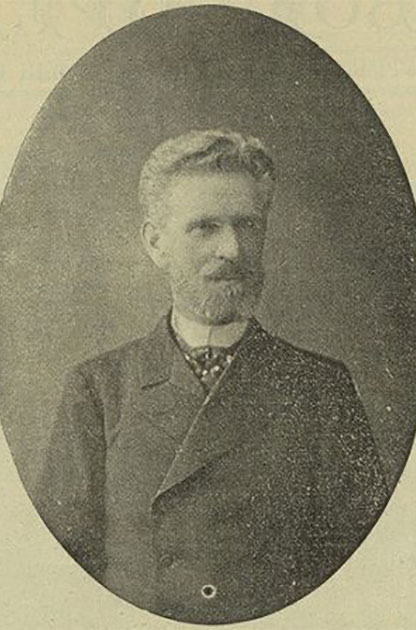
Dmitry Nikiforovich Kaygorodov
Alexander Nikolayevich Stepanov, a well-known Russian writer of the Soviet period, studied at Polotsk Cadet Corps for three years. After his father’s (who was an artillery officer) transfer to the Far East, A. N. Stepanov left Polotsk and witnessed the heroic Siege of Port Arthur. He took his childhood experience and memories, which he gathered from the participants of the Russo–Japanese War, as the basis for the historical novel “Port Arthur”. The novel gained widespread popularity among readers and in 1946 it was highly appreciated at the state level – A. N. Stepanov became a laureate of the State Stalin Prize of the first degree.
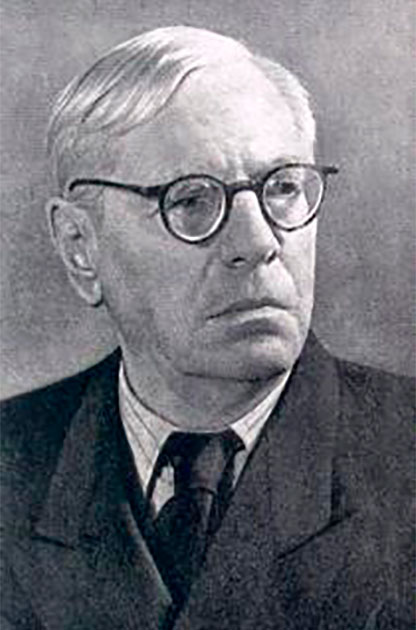
Alexander Nikolayevich Stepanov
Because of the beginning of the World War I in 1914, the front-line approximation and the need for large rooms in the front-line for the wounded, the corps was evacuated from Polotsk and a military hospital was arranged in its buildings. In August of 1917, Polotsk Cadet Corps was renamed into Polotsk Gymnasium of Military Department. Yet October Revolution and the coming to power of the Bolsheviks party left the educational establishment poor chances to survive. The year 1918 actually became the last year of its existence, for the new revolutionary regime finally refused to support the military department schools. Therefore, during the Civil War, many of the Polotsk Cadet Corps graduates joined the White Movement. Nevertheless, those who managed to stay alive, had to move abroad after the final victory of the Soviet power.
When Alexander II ascended to the throne (1855-1881) and hopes for reforms and fundamental changes of the Russian Empire were raised, both the public of the Belarusian-Lithuanian provinces and government discussed the possibility of creating a new higher educational institution. The closing down of the University of Vilna (1832) created a paradoxical situation: regardless long-standing traditions in the field of public education and a great necessity of highly qualified staff, Vilnius educational district remained the only one in the Empire with no University of its own.
At first, grass-roots initiative prevailed. Thus, in 1856 in Vitebsk the nobility addressed to the governor with a request “to establish a University in Polotsk or in any other place of the Vitebsk province”. In two years the whole nobility of the province prepared a petition to the government, which requested to establish a “Polish university” in Polotsk. Alexander II, however, categorically rejected the petition for the resolution, aimed at "preserving the imagined Polish nationality", was considered to be openly harmful since the authorities intended to return the “Russian face” to the North-West land.
Polotsk
At the same time the importance of the establishing an educational institution was understood by major state dignitaries too. Vilna governor-generals V. I. Nazimov and M. N. Muravyov supported the idea of setting up a University that would become a “centre of the Russian culture” in the province. Moreover, many considered Polotsk a potential town for a University. For example, I. S. Aksakov, one of the leaders of slavophilism, claimed “Universities should be established either in Polotsk, Vitebsk or Minsk, but not in Vilna. Russian professors there would have to fight against old university traditions with no support among foreign polonism-soaked society.” Count D. A. Tolstoy, the Minister of National Education, who was present at the opening of the teachers’ seminary in Polotsk (1872) during his monitoring trip of the north-western provinces, was sure that this “almost Russian town” had every chance of becoming a new University centre of the Empire. Among its indisputable advantages the minister pointed out that Polotsk disposes “an edifice, specially built for higher educational establishment: it was a Jesuit Academy earlier and it is a Military Gymnasium now.”
Alexander II supported count Tolstoy’s idea. It was intended that only two humanitarian faculties would appear in Polotsk first and it seemed that the elaboration of the statute was the only thing left to be done. Governor-general of Vilna A. L. Potapov, however, supposed that “the centre of freethinking” should be placed in an “easily accessible place” i.e. in a province town, Vitebsk or Vilna, where it would be easier to identify and, if it was necessary, put down revolts. Nevertheless, the worsening of the “Eastern Question” problem and the Russo-Turkish War of 1877–1878 postponed the realization of the plan for an unlimited period and Ignacy Hryniewiecki’s (a citizen of Belarus) murdering of Alexander II in 1881 completely buried it. Thus, Polish-Russian competition, one of the rings of which was Polotsk, ruined the perspectives of enlightening in the north-western province.
Polotsk
It seemed that cultural changes and urban industrial society, brought by the October Revolution would definitely put an end to Polotsk, a provincial town in all respects. Big cities, the largest administrative and industrial centres – Minsk, Vitebsk, Mogilev – drove Polotsk to a distant educational, scientific and cultural periphery. However, the founding of the largest petrochemical complex and Polytechnic Institute in Polotsk region gave hope for the revitalization of Polotsk and Polotsk land as an intellectual centre. After the beginning of mental and national revival, Polotsk returned its lost property: the university and the Jesuit buildings.

