

Polotsk Jesuit Academy (1812-1820)

Polotsk Jesuit Academy (1812-1820)
In July of 1810, J. de Maistre sent a short letter with the reasoning of the need to expand the Jesuit education network and establish an Academy to A. K. Razumovsky. In August of the same year, T. Brzozowski made the first request about establishing Polotsk Jesuit Academy. Already in October 1811, during a personal meeting with Alexander I, the Sardinian envoy obtained the Emperor’s consent for the implementation of the project. Shortly after, T. Brzozowski filed a corresponding official report to the name of Alexander I, and finally, on November 11 of 1811, the idea of creating a Jesuit Academy in Polotsk was approved by the Committee of Ministers of the Russian Empire.
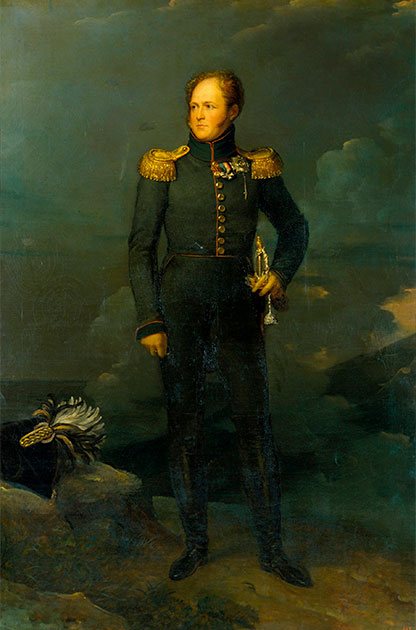
Alexander I of Russia (Francois Gerard, around 1817)
On January 12 of 1812, Alexander I proclaimed the opening of Polotsk Jesuit Academy by his decree to the Senate: “In respect of the entrusted to Us desire of the Belarusian nobility and the use of sciences, of the competition between several educational establishments of equal rank, we consider it useful to assign an academy grade to Polotsk Jesuit Collegium with the appropriation of the advantages given to universities". The establishment was to work on the basis of the main features listed in the document. The General of the Society of Jesus was to become the head of the Academy; all other Jesuit educational institutions were to obey the Academy; only the subjects specified by the government were allowed to be taught; concerning academic activities, the Academy was subordinated to the Ministry of Education and concerning the religion, the Academy subordinated to S. Bohusz Siestrzencewicz, the archbishop of the Roman Catholic Church. Since the Order’s funds were recognized as sufficient, the government refused to give any financial help to the Academy. By the decree, T. Brzozowski, the general of the Society of Jesus, was ordered to create the Academy Charter and submit it to the Ministry of Education.
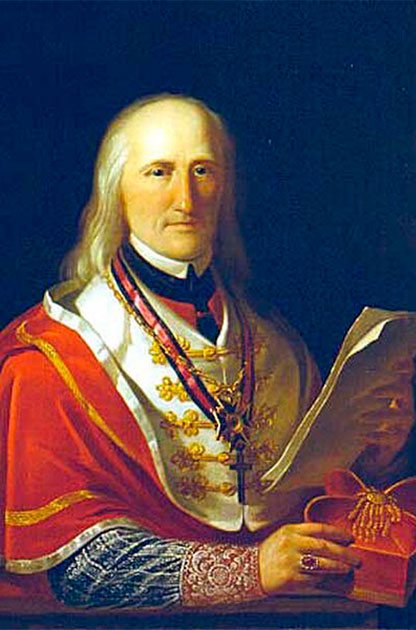
Stanisław Bohusz Siestrzencewicz (Jan Damel, 1820)
A new decree of March 1, 1842 made the status and structure of Polotsk Jesuit Academy even more exact.
Thus, Polotsk Jesuit Academy acquired the rights of the University with three faculties. They were the Faculty of Linguistics, the Faculty of Philosophy and Liberal Arts, the Faculty of Theology. The Academy not only got rid of the intrusive University of Vilna, but also actually became the centre of another regional education authority.
The main features of the Royal decree were deciphered and specified in the “Charter or General Orders of Polotsk Jesuit Academy”. Students of all classes and religions were accepted to the Academy and after finishing the education, they were given a 14th rank (of the college registrar) and scientific degrees. The study at the Faculty of Theology and at the Faculty of Philosophy and Liberal Arts was designed for four years. The training duration of students who studied languages was not exactly defined and could last “in proportion to the needs and achievements”.
The solemn opening of the Academy took place on June 10, 1812. Quite a lot of prominent people came to Polotsk on that occasion, including duke Alexander of Wurttemberg, Belarusian governor-general with his entourage.
A solemn procession of town’s corporations and students was a nice beginning of the festival event. The procession was decorated with 70 flags of: Polotsk, Polotsk Jesuit Academy, Vitebsk, Russian Empire, duke Wurttemberg and Russian provinces.
The main celebrations began in a big hall of Polotsk alma mater. The congratulations were read out and the Imperial Letter on the opening of the Academy was placed on a golden cushion in front of the bust of Alexander I there. Speeches in honour of the Emperor and important participants of the holiday were made in seven languages (including Belarusian). After this, all people who had participated in the procession went to the ornate St. Stephen’s Cathedral. The decree on the Polotsk collegium’s acquiring the rank of the Academy was read in Polish in the Cathedral. Moreover, the praise was delivered to the tsar and poems dedicated to this event were recited there as well. After the ceremony, the Jesuits gave a gorgeous dinner intended for a hundred people. Then the celebration proceeded to the town streets. From the town’s arbour fired fifty guns, a balloon floated in the sky and the Jesuits organized festive illuminations at night.
The celebration had just finished and “the great Napoleon army” entered the Russian Empire. The students departed and the professors “fled deep into Russia”. In 1812 the classes at the academy never began.
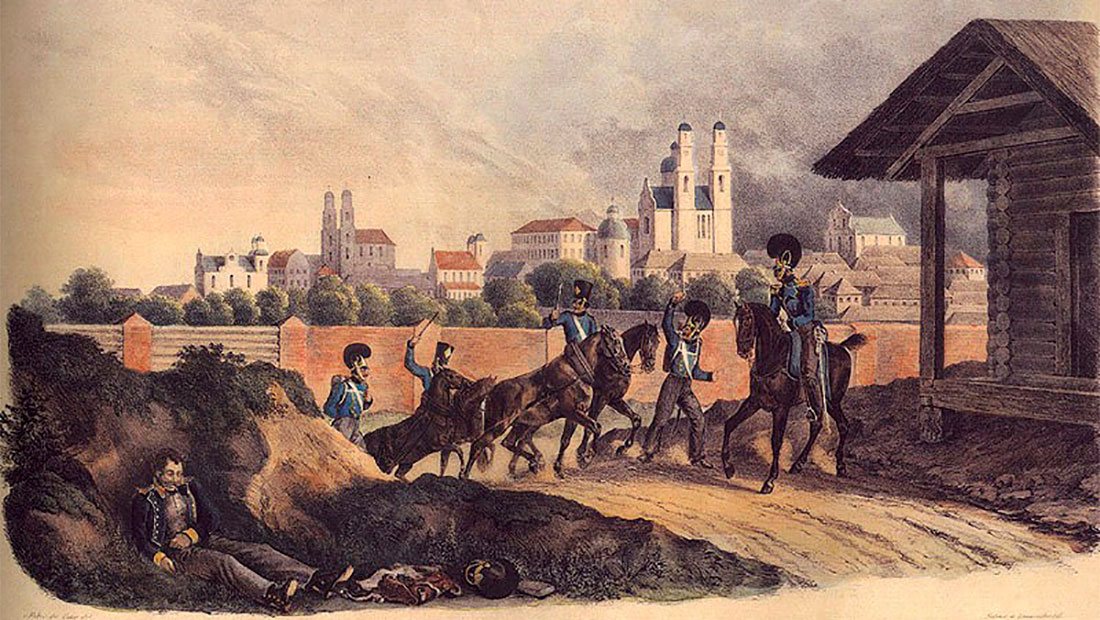
On the Way to Polotsk. July 25, 1812 (C. W. von Faber du Faur)
The Jesuits managed to demonstrate their loyalty to the authorities again (only few students were on the Napoleon’s side). On the contrary, the university professors and students in Vilna discredited themselves by open cooperation with the French because the patriotic circles of Belarus and Lithuania associated Napoleon with their aspirations for the restoration of the GDL. Jan Sniadetski, the rector of the University of Vilna, for example, was a member of the Provisional Government Commission, which was under control of the French military authorities and served as the supreme body of the civil administration in Vilna, Grodno and Minsk provinces and in Bialystok Region.
In St. Petersburg there were still a lot of influential people, who wished to put an end to Vilna University, the spreader of freethinking and hostile “polish-likeness”. Exactly at that time a plan of transferring the university to Polotsk and its merge with the Academy appeared at the Provisional Government Commission. It was planned to leave only the Faculty of Medicine in Vilna. The new educational establishment, however, would certainly appear in the Jesuits’ hands. But with the efforts of A. Czartoryski’s, a close Emperor’s friend and an old patron of Vilna University, that project wasn’t carried out.
Napoleon’s expulsion from the Russian Empire gave rise to a new wave of Jesuit activity in Polotsk. On January 8, 1813 a solemn ceremony was held, which was usually followed by the beginning of the academic year. Because of the small number of students, however, the study began only in March, and only on November 3, 1813 the first average academic year started at Polotsk Jesuit Academy. The difficulties couldn’t but have an effect on the number of Polotsk students in the first years after the war: only 84 people started studying
at the Academy. From the following academic year, the educational process started normalizing. The classes began on September 15, 1814 and lasted till July 15, 1815 (that time of the beginning and ending of the academic year stayed the same till the end of the Academy’s existence). Then the total number of the Academy students reached the maximum number of 136 people.
Besides, a number of other educational establishments, directly subordinated to the Academy, operated in Polotsk. The most important one was a five-grades Collegium (also called Gymnasium) the activities of which were carried out on the basis of the "Charter or general decrees of Polotsk Jesuit Academy and institutions, boarding schools, seminaries, bursas and other colleges belonging to it" as well. There were about ten Jesuit teachers and a few secular teachers. Its popularity was evidenced by the growing number of the students: in the academic year 1813/1814 there were 197 boys in the Collegium and then, in the 1816/1817 academic year, there were 376 students.
Since 1801 there had appeared a gentry pension or a boarding house designed for 70 people. It was located in a separate building and was adjoined on one side to the church, and on the other – to the educational building, very close to the dining room. The institution was intended for gentry children, whose parents paid a fee for this (100 roubles in silver per year and since 1818 – 150 roubles). It was led by the regent, assisted by five Jesuit teachers. The pupils of the boarding house attended the Academy or the Collegium according to their education. In 1817, 62 students used the pension’s service.
Polotsk Jesuits had their own parochial school designed for the poorest children. A monk-Jesuit taught there. Moreover, a seminary was designed for a low-income group of students of gentry estate. A monk-Jesuit and two assistants taught there. In 1817, for example, 33 boys studied there. Besides studying, the seminarians were to serve during worship, clean the church and etc. The majority of students were provided with a uniform by the Jesuits.
The number of the students studying at Jesuit Polotsk bursa continued increasing. About two dozen boys studied there. In 1818 Polotsk bursitis had 28 musical instruments, which had appeared there either thanks to the financial assistance of the guardians of the institution, or were bought for the Jesuits’ money. In addition, the students had a rich music library. For example, there were 548 music works of secular character, not counting any other works.
Besides Polotsk educational institutions, the collegiums in Vitebsk, Mogilev, Orsha, Mstislavl, Chechersk, Klimovichi, Petersburg (existed until 1815), Riga, Odessa, Astrakhan, Saratov, and Romanov (in Volhynia) were subordinated to the Academy.
The total number of Academy students and its subordinated institutions was increasing steadily: in 1818 it already exceeded 500 people, and in 1820, on the eve of the expulsion of the Jesuits, it was already approaching 700 people.
The Academy was headed by the Jesuits with a great experience in organizational and pedagogical activity. Its first rector was a professor of Theology A. Lustig (1812-1814). Since 1814 till 1817 A. Lyandes performed the leading functions, and since 1817 till 1820
the position of rector was occupied by R. Brzozowski, an outstanding theologian and writer.
Teaching at the Academy was carried out by experienced scholars, by only those professors, who could honour many other educational institutions and not only within the Russian Empire. A kind of a union of purposeful youth ("youth" according to the academic standards of that time, of course) and famous coryphaeus was formed. For known reasons, many foreigners taught there: Cornelius Everbrock, Antonio Calebotta, Ignazio Pietroboni, Mateo Molinari, Cajetanus Angiolini, Aloizo Rusnati, Jacob Kondrau, Peter Lange, Desiderius Richardot, Jacques Jourdan, Francois Gavot and many others. There were many Jesuits, who were born in Belarus: Francis Dzierozynski, Vincent Buchinsky, Kazimir Rogoza, Samuel Glasco, Joseph Tsytovich, Jehoshaphat Zalessky, and others.
The availability of funds allowed the Jesuits to stimulate the scientific and literary activity of its teachers and students. A significant role was played by the first magazine on the territory of modern Belarus – “Miesicznik Polocki” (Polotsk Monthly), which consisted of six sections: literature and liberal arts, moral-philosophical, physical-mathematical, historical, criticism and literary news. The magazine was published during the period of 1818–1820. 14 issues of the magazine were published in total for the time of its existence. They were combined into four volumes.
Very soon, however, the situation started to change for the worth for the Jesuits. On August 17 of 1814, Pope Pious VII published a Papal Brief “Solicitudo omnium ecclessiarum” ("The Care of All Churches") about the legalization of the Jesuit Order and the restoration of all its former privileges. It meant that Russian autocracy, in essence, was losing their sole control of the Jesuits and thus started to doubt if it was necessary to tolerate this vanguard of Catholicism on their territory. Alarmed by the success of the Order (even Prince Dmitry Golitsyn, the hereditary Russian aristocrat, became a Jesuit missionary) and frightened by the prospects of its further spreading, Orthodox hierarchs and part of the state dignitaries managed to convince Alexander I in the need of taking steps against the Jesuits. It did not come to the total ban of the Society of Jesus, but on December 20, 1815 the Jesuits were removed from both Russian capitals: St. Petersburg and Moscow, according to the imperial decree. Moreover, it was banned to accept Orthodox children for training on the territory of Belarus.
On March 13, 1820 Alexander I ordered: “1) The Jesuits, who have forgotten the sacred duty not only of gratitude, but also of loyalty to the oath, and therefore unworthy to enjoy the patronage of Russian laws, to send beyond the state limits under the supervision of the police and henceforth not allow to enter Russia under any name and in any form; 2) To abolish Polotsk Jesuit Academy and its subordinate colleges.”
For the short time of its existence, Polotsk Jesuit Academy prepared quite a few qualified specialists. Various academic degrees were awarded to 123 graduates. For example, 17 people became Doctors of Theology and Canon Law, 43 people – of the Civil Law. 10 graduates gained the degree of Master in Philosophy, 13 – Master in Theology, 2 – Master in Liberal Arts. Moreover, Polotsk Jesuit Academy prepared many well-educated people: artists, clergymen, officials and common people.
Many teachers and graduates of Polotsk alma mater took a worthy place in history. After leaving the Russian Empire, Francis Dzierozynski, a former professor of theology at Polotsk Jesuit Academy (1779 – 1850), was sent to the USA by the Holy Papal See. He continued his pedagogical activity in the New World (taught at Georgetown University), he was engaged in active organizational work to create a system of Catholic education in the country and, finally, he headed the local unit of the Society of Jesus.
After 1820, Vincent Buchinsky, a professor of philosophy at Polotsk Academy (1789 – 1853), taught philosophy and theology at the Austrian Catholic schools of Ternopil, Graz, Linz, Innsbruck, and then at the University of Louvain, where he moved by the invitation of the King of Belgium. V. Buchinsky is the author of the original work "Philosophical Reflections" in three-volumes, which is rightly considered by researchers the top of the Neosholastics Polotsk School.
Jan Roothaan, a Dutchman, studied philosophy and theology at Polotsk Jesuit Academy (1785 – 1853). After the forced expulsion from the Russian Empire, the talented Jesuit managed to make a successful career in the Society of Jesus.
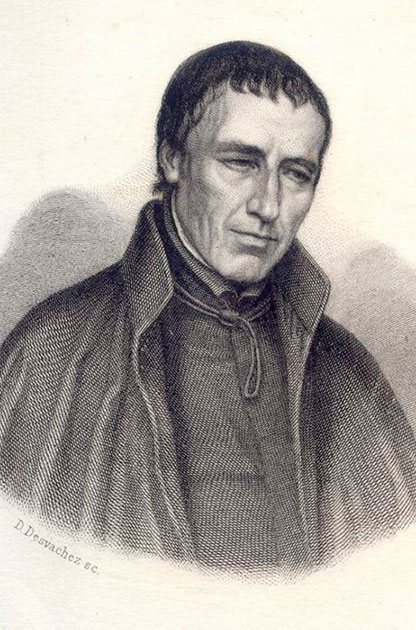
Jan Roothaan (engraving, XIX c.)
First, he was appointed the rector of the newly opened Jesuit Collegium in Turin, and then a vice-provincial of the Order in Italy. On July 9, 1829, Jan Roothaan was elected a general of the Society of Jesus. His more than twenty years long activity in this high post had greatly contributed to the rapid restoration of the significant influence of the Society of Jesus. During this time, the number of members in the Order grew up to 5 thousand people, and the number of higher Jesuit educational institutions had almost doubled (from 55 to 100).
Maximillian Stanislav Ryllo (1802-1848), a philosopher, archaeologist, orientalist, Catholic missionary in the Middle East and North Africa, became widely known in the world.
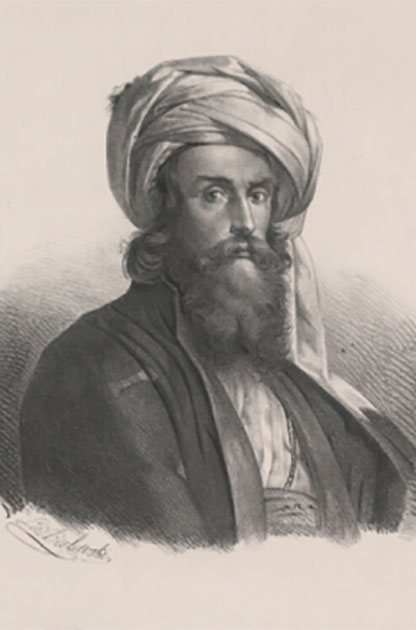
Maximillian Ryllo in Oriental Clothes (the middle of the XIX c.)
After graduating from Polotsk Jesuit Academy with a degree of Master in Philosophy, he headed to study at Vilna University. The young man desired to commit to the Society of Jesus. Its expulsion from the Russian Empire, however, forced M. S. Ryllo to continue his education at the Gregorian University in Rome, where he entered the Jesuit Order and received the title of professor of philosophy. Later on, M. S. Ryllo was engaged in activity of scientific and missionary work in the Middle East. In 1836 – 1837, he was one of the first people, who surveyed the ancient Babylon ruins and then donated a rich collection of archaeological finds to the Vatican Museum. In 1837 Ryllo was accepted to the Pontifical Academy of Archaeology and Oriental Society in France. Asian Collegium was founded in Beirut with Maximillian’s help, after his coming back to the Middle East. The collegium was reformed into Saint Joseph University, which is active nowadays. In 1844 – 1846, M. S. Ryllo held a responsible position of a Pontifical Urban College in Rome, the leading Jesuit educational institution for the preparation of priests for missionary work. The last days of life M. S. Ryllo spent in North Africa where he led a Jesuit mission in the Nile Valley as an apostolic vicar.
Polotsk Jesuit educational establishments prepared not only active servants of the Catholic Church. Among the graduates of the Academy, there were figures that left a deep imprint in the history of the Uniate and Orthodox churches. Thus, Polotsk Jesuit Academy prepared Vasily Luzhinsky (1791-1879), a Uniate with a PhD degree.
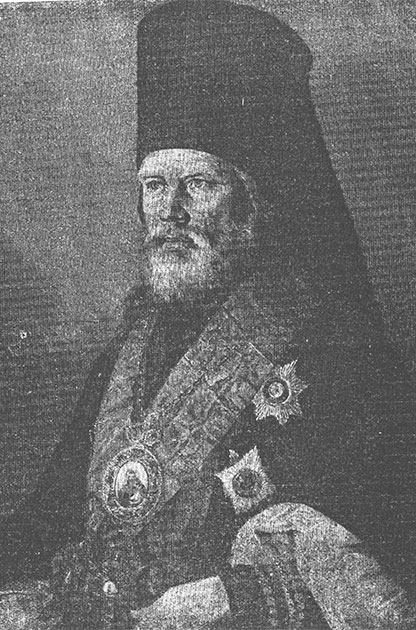
Vasily Luzhinsky, Archbishop of Polotsk and Vitebsk (XIX c., second half)
After continuing his education at the Main Catholic seminary at the University of Vilna (where he gained a Doctor of Theology degree) V. Luzhinsky held responsible posts at Uniate Church. In 1833, he became a bishop of Orsha, a vicar of the archdiocese of Belarusian Uniates, and in 1838 Luzhinsky became a governing pontiff of the archdiocese of Belarusian Uniates. Being a convinced supporter of joining the Uniates to the Orthodox Church from the very beginning of his activity, V. Luzhinsky played one of the central roles in organizing and leading the Polotsk Church meeting. On February 12, 1839 during the joint service with the Uniate bishops Joseph (Semashko) and Anthony Zubko, V. Luzhinsky accepted the act of joining the Uniate Church to the Orthodox Church. In 1841 he was elevated to the rank of the archbishop of Polotsk and Vitebsk. After the liberation from the diocese leadership, he was appointed a member of the Most Holy Synod (1866), the supreme governing body of the Russian Orthodox Church. Vasily (Luzhinsky), the Archbishop of Polotsk and Vitebsk, was awarded the Order of St. Vladimir of the 2nd (1845) and 1st (1866) degrees, the Order of St. Alexander Nevsky (1851) and the Order of St. Anne (1838) for his services to the Russian Empire.
Not only one pupil of Polotsk Jesuits was present at Polotsk Church meeting in 1839. Anthony Zubko (1797 – 1884), who was already mentioned above, made a career similar to V. Luzhinsky’s. In 1818, Anthony graduated from Polotsk Jesuit Academy with a PhD degree and then studied in Vilna, where he got the Doctor of Theology degree.
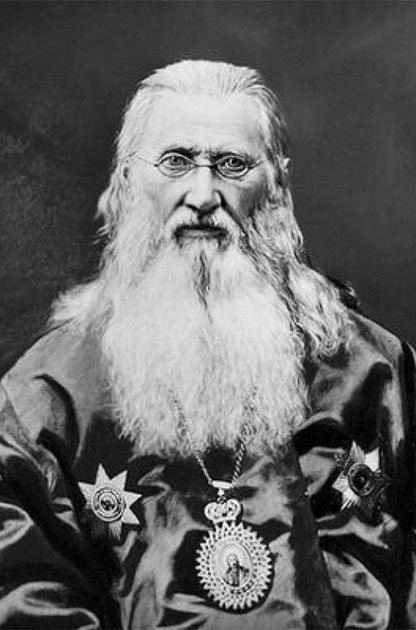
Anthony Zubko, Archbishop of Minsk and Bobruisk
In 1827, Anthony Zubko was directed to Zhyrovichy to open a Lithuanian Theological Seminary. Soon he was appointed its first rector. In 1834 he became a Bishop of Brest, a vicar of the Uniate Diocese of Lithuania. After the abolition of the Uniate church in 1841, A. Zubko was elevated to the rank of the Archbishop of Minsk and Bobruisk. The last years of his life he spent in saying his prayers in the silence of a cloister.
Pedagogical and artistic talent of G. Gruber had a strong influence on the creative development of Count Fyodor Petrovich Tolstoy (1783 – 1873), a medalist, sculptor, painter, engraver and one of the most influential figures of Russian art of the XIX century.
In spite of aristocratic origin and high state position of his father, who served as the head of the Kriegs Commissariat, the institution that was responsible for providing the army, nine-year-old Fyodor was sent to Polotsk Jesuit Collegium, where he began to paint professionally under the guidance of G. Gruber. Family circumstances made the boy leave Polotsk in a few years. His father, however, did not consider painting as an occupation worthy of a high society representative. Nevertheless, neither studying at the Naval Cadet Corps nor the military service, nor his father’s objections, could change a creative Tolstoy’s nature. He attended the Academy of Arts in St. Petersburg as a non-matriculated student, left the army and, deprived of the family support, devoted himself entirely to fine arts.
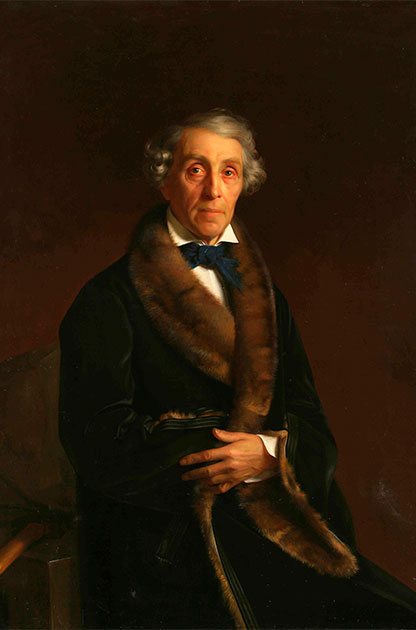
Fyodor Petrovich Tolstoy (by S. K. Zaryanko, 1850)
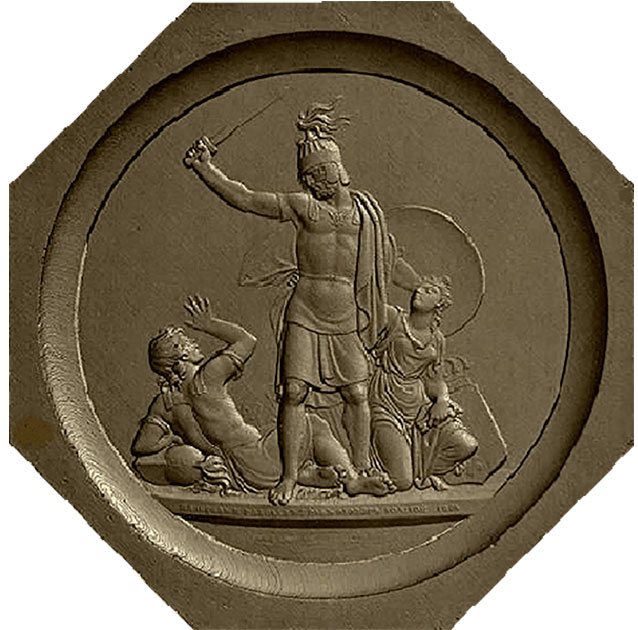
In 1810 – 1828, F. P. Tolstoy worked at St. Petersburg Mint as a medallist and in 1828, after receiving the rank of State Councilor, he was appointed a vice-president of the Academy of Arts. F. P. Tolstoy received world-wide recognition after he had worked for more than 20 years over his own medallions series. The series was dedicated to the events of the war of 1812. Almost all European art academies elected F. P. Tolstoy as their honourable member. Since 1846 till 1851 the artist had been performing the royal order for the design of the Moscow Cathedral of Christ the Savior. Tolstoy created four main and eight side doors with ornaments and etc. In 1849 F. P. Tolstoy became a professor of the Academy of Arts for his great merits in the field of sculpture art. In 1849 he was awarded the title of Professor of Sculpture. Moreover, F. P. Tolstoy is famous for his watercolors, which are genuine masterpieces of this type of painting.
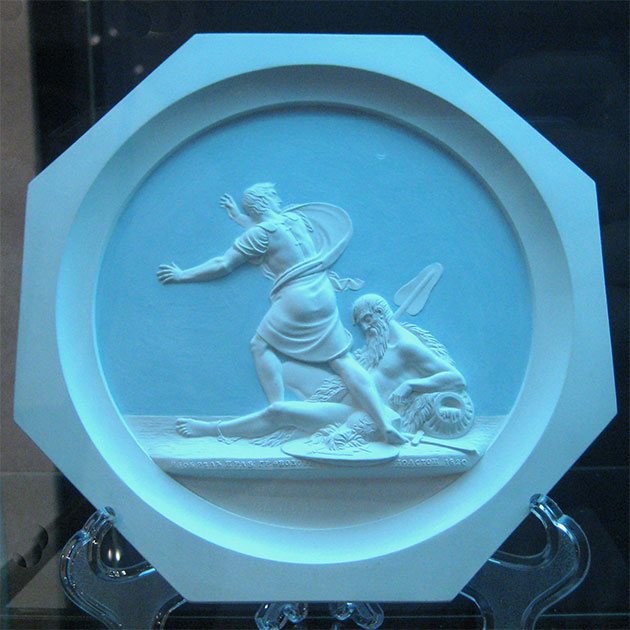
Tolstoy’s medallion “Napoleon’s Escape Over the Niemen” (photo 1)
Tolstoy’s medallion “The Liberation of Amsterdam” (photo 2)
Count F. P. Tolstoy occupies a special place in the history of Russian art not only as a versatile artist, generously gifted with talent, but also as a man who elevated the value of the artistic profession in the eyes of society through his conversion from an aristocrat to an artist. Furthermore, he contributed to the development of young artists, working selflessly in the position of vice-president of the Academy of Arts.
Walenty Wankowicz (1800-1842), another pupil of Polotsk Jesuits, became an excellent painter as well.
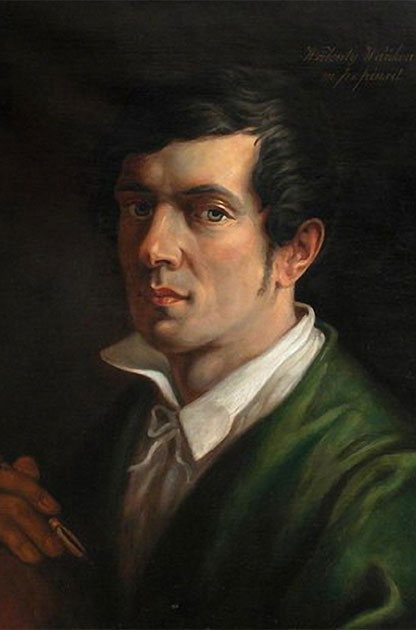
Walenty Wankowicz. Self-portrait (around 1840)
After the expulsion of the Jesuits, he continued his artistic education in Vilna. Having graduated from the university, he was sent to St. Petersburg Art Academy for a state account because of his art achievements, where he became one of the three graduates awarded with a gold medal. The artist became especially famous for his portrait paintings. His painting "Mickiewicz on Ayu-Dag Cliff" (1828) gain so much popularity that Wankowicz had to paint some more copies of this work, including one requested by Mickiewicz himself. Thanks to the image of Adam Mickiewicz, Walenty Wankowicz earned an honourable place as a classic in Polish, Lithuanian and Belarusian art. His works are kept in the collections of Vilnius, Petersburg, Warsaw, Krakow, Paris, and they are also represented in the State Art Museum of the Republic of Belarus.
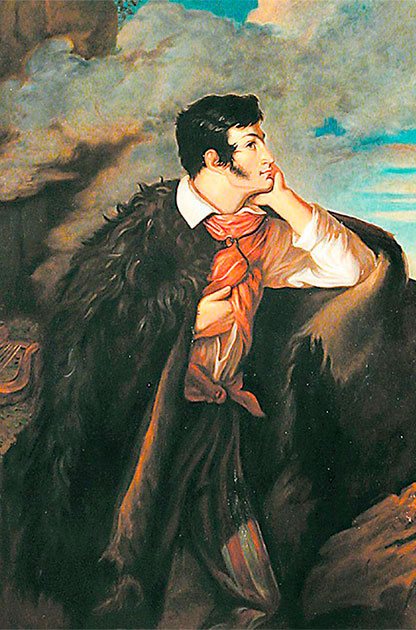
Walenty Wankowicz. Adam Mickiewicz on the Ayu-Dag Сliff (1828)
Jan Barszczewski (Barscheuski) (middle of the 1790s–1851) was a Polish- and Belarusian-speaking writer. He is one of the founders of the new Belarusian literature, a publisher, Belarusian antiquity lover and a collector of Belarusian folklore.
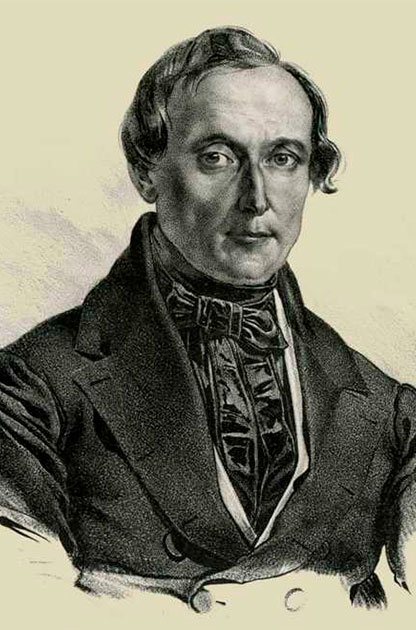
Jan Barszczewski (Karol Zhukovsky, 1840th)
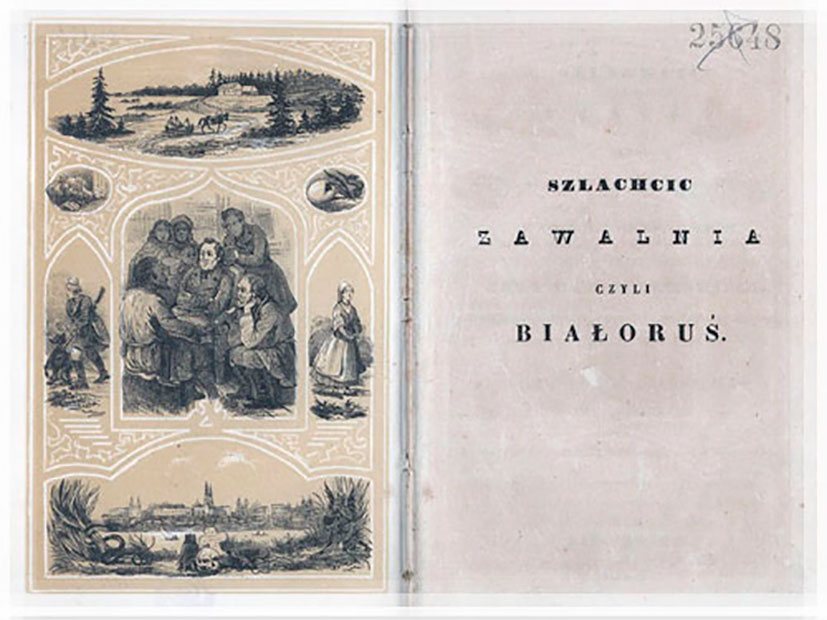
His collection "Szlachcic (= a nobleman) Zawalnia, czyli Białoruś w fantastycznych opowiadaniach" is a wonderful example of romanticism in literature, much similar to Gogol's "Little Russian" prose (for example, "Evenings on a Farm near Dikanka"). "Szlachcic Zawalnia” holds a special place in the history of Belarusian literature (the author inserts large pieces of text written in Belarusian into the texts, written in Polish). Moreover, the collection represents one of the valuable sources on the ethnography of the Belarusians of the first half of the 19th century. (The publisher of the first three volumes of J. Barszczewski’s works was Jan Einerling, another pupil of Polotsk Jesuit Academy).