




Polotsk Jesuit College in 1648-1772

Polotsk Jesuit College in 1648-1772
From the middle of the 17th century, domestic and foreign policy conditions for the development of the Polish-Lithuanian Commonwealth, especially of the GDL, had worsened. The Belarusian and Lithuanian lands suffered human and material losses because of the armed and bloody conflicts, the Cossack and Peasant War of 1648-1651 (by the way Bohdan Khmelnytsky, the pupil of Lviv Jesuit Collegium, headed anti-government forces) and the Russo-Polish War of 1654–1667. Polotsk and Polotsk powiat were particularly affected by the events. The losses of the household, one of the main units for taxation, were 93.2% and 74.8% respectively. It is reasonable that Polotsk College had not been functioning during the war (1654–1667): its buildings were burned down or destroyed and the property of Jesuits was almost completely plundered.
Right after the end of the war Polotsk Jesuit College continued developing and working, though not fully yet. In the 1667/1668 academic year, the courses were held in the classes of “infima” and “grammar”, and since the 1672/1673 academic year, the teaching of poesy and rhetoric had been held again. The classes in the higher school (with training in logic) started in the 1675/1676 academic year. Physics and mathematics were taught there starting from the following academic year. Professor of mathematics, as an individual staff unit, appeared in Polotsk Jesuit College in the 1690/1691 academic year. It was almost a unique phenomenon in Order’s establishments of the type in the Lithuanian province. The teaching staff became more stable. Moreover, all the teachers had academic ranks of Professors.
In the middle of the XVII c., the reduction of requirements for fulfillment of the Ratio studiorum’s prescriptions became one more important problem. The problem was common for the whole system of education in the Lithuanian province. The teaching of the Greek language and literature was of special concern. These disciplines together with Latin were still the core of the humanitarian education in Jesuit schools on papers. Nevertheless, the low level of usage among the gentry led to the classics teaching decrease at Belarusian-Lithuanian institutions of the Order. Greek literature, for example, was relevant only in the context of the ancient mythology.
In 1655, Giovanni Paolo Oliva, the General of the Society of Jesus, ordered: “It is necessary to make the teaching of the Greek language in schools obligatory. And it is necessary to punish those who did not follow the rule or publicly said that this discipline was not necessary”. However, the beginning of the war suspended this initiative realization. The Greek language came back for a short period in the 1676/1677 academic year together with Maxim Voitekhovich, a master of it. Then it vanished again until the 1683/1684 academic year. In the following years, the teaching of Greek was repeatedly interrupted. The main cause was the lack of profile teachers in the Lithuanian province. Professors who combined Greek and mathematics or Greek and logic taught the Greek language in Polotsk (and other Belarusian-Lithuanian institutions of Jesuits). Undoubtedly, the language was not their profile discipline.

General of the Society of Jesus Giovanni Paolo Oliva (engraving XVII c.)
The Great Northern War (1700–1721), events of which influenced the GDL lands, brought death and destruction again. This couldn’t but have a negative impact on both Polotsk town and Polotsk Jesuit Collegium.
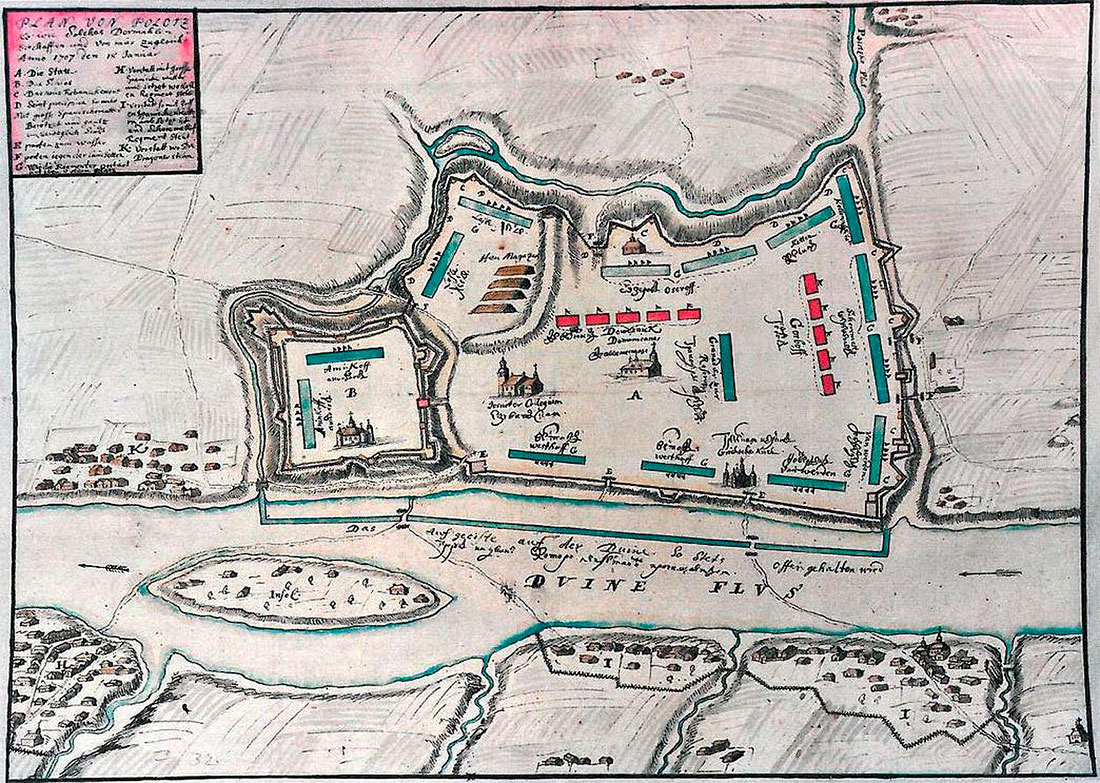
Plan of Polotsk in 1707
From the 1740s, an active phase in the educational activity of the Society of Jesus in the GDL began and the ideas of the European enlightenment penetrated there. The changes affected almost all the spheres of social and cultural life. One of the most characteristic traces of that time was the GDL intellectual elite desire to make their local education correspond to a high European level.
Stanislaw Kornarski (1700-1773), a brilliant innovative teacher and a professional politician, played the main role in the process. He established a new type of a school – a Piarist College nobelium in Warsaw. Unlike Jesuit educational program, prescribed by “Ratio studiorum”, Piarist institution focused on teaching the disciplines, which were of current interest for the government and its social elite. German and French, as highly demanded languages, were paid considerable attention. The Bible and Polish history, the basis of local civil and international law, politics, and etc. occupied the central position in the Piarist educational system. Mathematics and natural sciences courses were expanded due to the requirements of that time. The teachers were to use only the new books created by Piarists. They tried their best to develop a feeling of citizenship among the students. Besides, physical punishment was forbidden. Thus, Piarist institutions provided its students with the education, which could contribute to the rapid growth of their political and diplomatic career in the near future. The expansion of the Piarists educational network (Piarists College in Vitebsk was opened in 1751) and the popularity growth among the gentry worried the leadership of the Society of Jesus, which was losing its monopoly in the sphere of education. Jesuits even managed to close Piarist collegiums in Vilna, Geranenakh and in Voronov. Nevertheless, they wanted to borrow the competitors’ experience when possible.
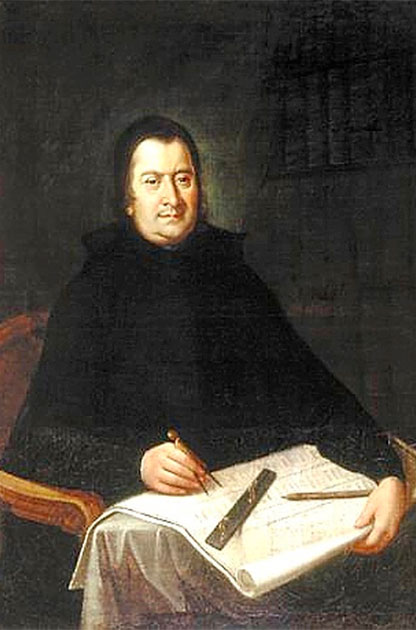
Stanislaw Konarski (author unknown, XVIII c.)
In this way, the Society of Jesus began practicing overseas internships for their students according to S. Kornarski’s recommendations concerning the qualified staff training. The educational and methodological base updating began. For example in 1749, a new textbook for teaching Latin was created by a collective of Jesuit authors. Polish and even French translations were provided to Latin texts in new dictionaries and manuals. These novelties soon appeared at Polotsk Jesuit Collegium.
The foreign languages introduction to Jesuit educational system was one more important tendency in its modernization. The University of Vilna was the leading one in this sphere. The teaching of French began in Polotsk in the 1756/1757 academic year.
Approximately in that time, history as a discipline was introduced to the educational process. Jesuits taught the basis of geographical knowledge within this discipline. Franciszek Paprotski (1723-1805), a historian and one of the well-known specialists in the geography field of the Commonwealth, started his successful career in the Society of Jesus in Polotsk. He prepared and published several historical-geographical and geographical textbooks, for example, "Polish Local Data of the Grand Duchy of Lithuania" (1752). The students learned the basis of the political and physical geography of the motherland and the state political system. In the manual “Europe - the best part of the world” (1754), F. Paprotski described geographical location, natural conditions, socio-economic and political system, the population structure, the spiritual culture of European peoples.
Increasing competition made Jesuits start strengthening the material base. A stone Jesuit temple building started at the end of the XVII c. In 1738, St. Stephen's Cathedral was almost ready. It was consecrated in 1745, but the decoration of the temple interior lasted until 1766. About 1750, at the place of the destroyed wood collegium, Jesuits started building a new enormous stone complex, which formed a single architectural ensemble of more than 7.000 m2. Tiled stoves were one of the building’s decorations.
Initially, an E-formed two-story building was built. Its main facade with a front door was turned to the south, towards the Dvina River. Moreover, there was a garden planted on the terrace in front of the main facade. A dining room was on the ground floor in the middle (smaller) bulk of the collegium, where the Front Hall was situated. The main room of the Jesuit library was on the first floor. The height of this one-story part of the building was the same as of the other two-story parts of the building. 105 monastic cells were located in the side bulks of the collegium. The corridor of the right bulk of the building was joined with the altar part of the church. There ceilings were vaulted. Fireplaces and stoves were hardly ever used, and their function was performed by heating channels laid under the floors of brick and tile.
Polotsk Jesuit College was the second educational institution after Vilna University, where the Society of Jesus made an attempt to train specialists in the field of architecture. Gabriel Lenkevich (1722-1798), a citizen of Polotsk, was destined to be the main figure in the idea realization. After studying architecture at Vilna University, he continued self-improving and the administration decided to send him to the main educational establishment of the Order – the Roman College (nowadays “Pontifical Gregorian University”). On coming back, he started conducting a course of architecture in Polotsk from the 1768/1769 academic year. G. Lenkevich served as the head of construction works in the Jesuit College complex until 1773.
In the middle of the XVIII c., Polotsk Jesuit College received quite a lot of honored science and cultural figures of the Age of Enlightenment, and Marcin Odlanicki Poczobutt (1728–1810) was one of the most prominent ones. After studying at the Jesuit establishments in Grodno, Vilna and Slutsk, he was sent to Polotsk in 1749 as a teacher of “infims” (the first year of studying). While teaching, a young and talented Jesuit studied theology and philosophy (1749-1752).
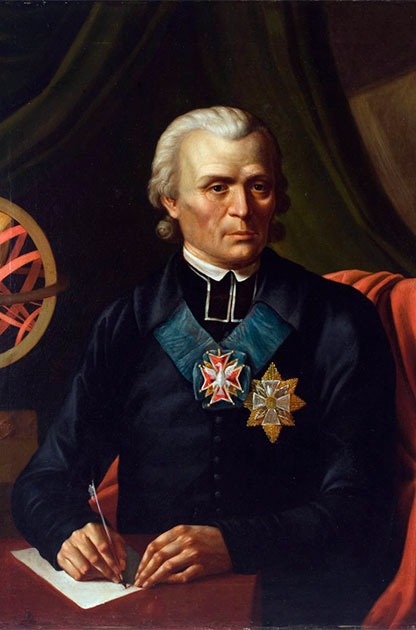
Marcin Odlanicki Poczobutt (Oleszkiewicz, 1810)
Having continued his studies at Vilna University and having completed an internship in Prague, Marseilles, Avignon and Naples, M. Odlanicki Poczobutt became a recognized headman of Russian astronomy. Not without reason the last King of the Commonwealth Stanislaw August Poniatowski awarded him a title of Astronomer Royal, and Vilna Astronomical Observatory, founded by the scientist, was awarded Royal status in 1767.
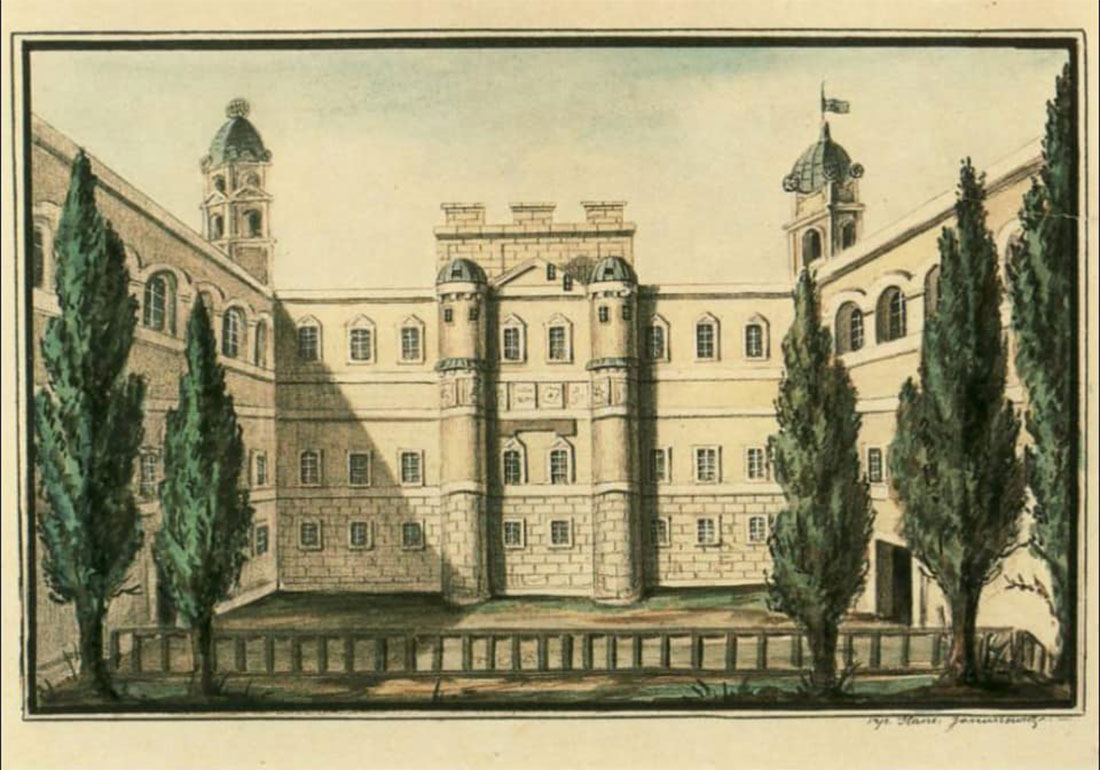
Vilnius University Astronomical Observatory (Janushevich, XIX c.)
He gained recognition not only in his homeland, but also in the European scientific community. M. Odlanicki Poczobutt was appointed a member of London Royal Society (Academy of Sciences) and Paris Academy of Sciences. Moreover, he headed the reorganization of Vilna University into a completely secular educational institution, the main school of the Grand Dutchy of Lithuania. Furthermore, he was its rector during the whole period of its existence (1780-1810).

