




Polotsk Jesuit College in 1773-1812

Polotsk Jesuit College in 1773-1812
Jesuits in the Polish-Lithuanian Commonwealth found mutual understanding with the authorities and competed successfully in the educational field, i.e. coped with the demands of the time. But in Western Europe from late 50-ies of the 18th century, their positions shattered greatly. Success in the spreading of a new scientific world picture, based on the discoveries of N. Copernicus, G. Galilei, I. Newton and etc., the educational ideology influence growth and the need for state and society modernization made the Society of Jesus not just an out-of-date (and therefore unnecessary), but also a hostile to the innovations institution. Besides, Order’s impressive wealth caused envy all over Europe. Even Roman Popes did not want to put up with wilfulness and excessive influence of their creation.
After the expulsion from the main Catholic countries (Portugal, Spain, France) the abolishment of the Society of Jesus became a question of wait and see. On July 21, 1773, the Jesuit Order was to cease its existence after publishing a brief of Pope Clement XIV “Dominus ac redemptor noster” (“Our Lord and Saviour”). Jesuits were ordered to move to other Orders or to obey the local Catholic authorities and head to a certain place to perform pastoral duties according to the Bishop’s order.
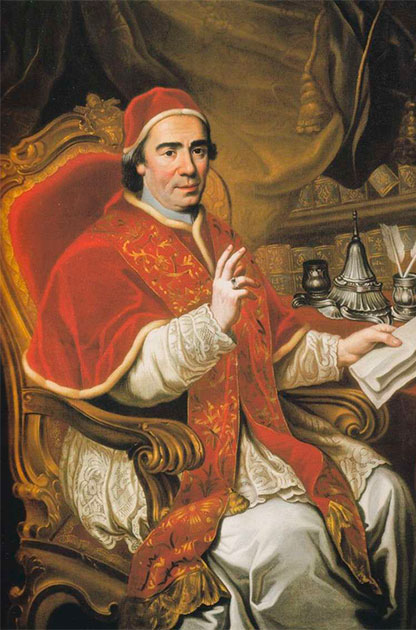
Roman Pope Clement XIV (author unknown, 1773)
This event was so unexpected, that many people did not believe that the Order had ceased its existence even when they saw the papal brief with their own eyes. They supposed that it would be just a dead letter. The following day after the “Dominus ac redemptor noster” had been published, a Spanish messenger came to Clement XIV and called in for a favour: “Your Holiness, you have published this brief as a Pope, but give me your precious word that you will execute it as an honest man”.
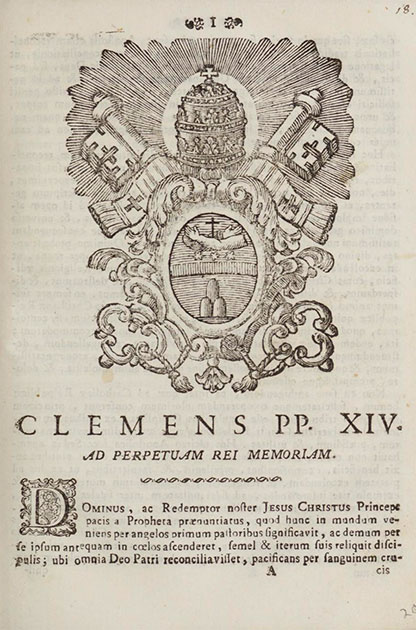
A page with a printed text of the papal brief “Dominus ac redemptor noster”
The destiny of Belarusian and Lithuanian Jesuits was predetermined by other events. On August 5, 1772 Austria, Prussia and Russia signed a tripartite agreement concerning the First Partition of the Commonwealth. North-eastern part of modern Belarus and some respective territories came under the rule of Russian Empress Catherine II. As a result, four Jesuit Colleges (in Polotsk, Dinaburg (now - Daugavpils), Orsha and Vitebsk) and two Jesuit residences (in Mogilev and Mstislav), many missions with 201 Jesuit came under the Russian jurisdiction.
At first, Catherine II treated her new Jesuit subjects with great concern. The governors of the attached provinces were ordered to make a special census of cloisters, schools, colleges and watch them as the most insidious of all other Latin orders. But the dedication of the Society of Jesus local leadership solved the case in favour of the Jesuits.
Thus, in October 1772 the "The sermon on the anniversary of the fortunate coronation of her Highness Catherine II - the monarch of all Russia" was preached in Polotsk cathedral of St. Stephen. In this sermon, all Polotsk citizens and Society of Jesus members were encouraged to absolutely obey the Russian administration. In that way, Jesuits were the first of all Catholic Orders to recognize the new governance. In November 1772, by order of rector of the Polotsk College Stanislaus Czerniewicz, all the Jesuits in Russian Empire gathered in Polotsk on the occasion of the Empress’s Angel Day to take the oath of allegiance to Catherine ІІ.
The Russian government could not wait for more from one of the richest and the most influential organizations in the attached land. That is why Catherine ІІ just banned the papal brief’s announcement when it appeared. Thus, Belarusian Jesuits had an opportunity to continue their activity. After the official dissolution of the Society of Jesus, Kazimir Sobolsky, a provincial of the Belarusian-Lithuanian Jesuits, as a citizen of Poland, where the papal brief was announced, submitted his resignation. As a result, S. Czerniewicz, vice-provincial and rector of Polotsk Jesuit College, disobeyed the pope and headed the Jesuits. In fact, Polotsk, the centre of Russian Jesuits, turned into a worldwide Jesuit capital. In November 1773, the Order’s delegation (S. Czerniewicz, G. Lenkevich, J. Katenbring) visited St. Petersburg. In a few months the Empress freed the Jesuits from all taxes, and the papal brief was banned not only to be announced, but also to be brought to the empire. So the Society of Jesus remained in Russia!
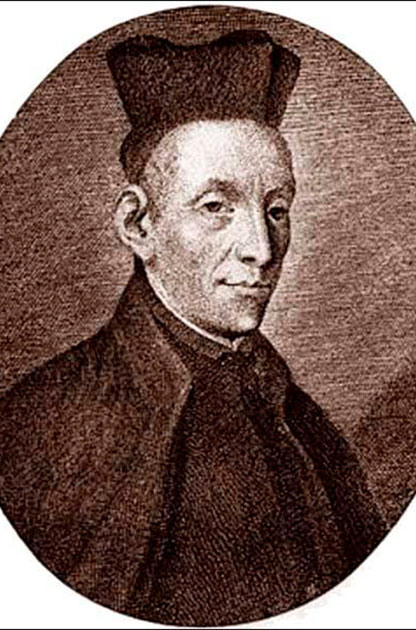
Stanislaus Czerniewicz (engraving of the beginning of the XIX c.)
In June 1775, Bishop Stanisław Bohusz Siestrzeńcewicz, head of the Catholic Diocese and of all Catholics, issued a legislative act which allowed the Order to establish a novitiate – a special institute for the preliminary training of the Order’s members, i.e. a means of increasing of the Order’s members in number. It became a prominent event for their high status maintaining.
This permission was given in violation of canon law and, what is more important, could not be fulfilled dispense with the consent of the royal government. For this reason, in 1776, Polotsk Jesuits led by S. Czerniewicz began negotiations with the Russian authorities concerning the novitiate establishment. This appeal to the government was to verify the Jesuit's obedience once again and, possibly, contained a
hint at receiving financial support from them. In 1777, the request was granted. Count Z. G. Chernyshev and Prince G. A. Potemkin, leading government officials, took over the institution management. The grand opening of the novitiate took place on February 2, 1780 with the building of the intended educational premises completed.
In May 1780, Catherine II visited Jesuits during her three-day trip to Polotsk. Numerous welcoming events in honour of the Empress were organized in Polotsk, and Jesuits couldn’t but take their chance to show the loyalty of the new authority. They arranged festive illumination that stood out for its grandiose scale. A special throne was installed for Catherine II in St. Stephen church, and S. Czerniewicz, Provincial of the Order, made a solemn speech in her honour. Then, the novices of the recently established novitiate were introduced to the Empress and the College students’ works were shown to her. Catherine II paid attention to drawings of church, civil and military architecture and even ordered to take some of them with her. The dining room of the Jesuit College was honoured a special praise. "I doubt if my fathers' dinners were as magnificent as their dining room," admitted Catherine II. During the receptions and other celebrations, the Empress showed her interest in cooperation with the Order once again. Later, Pavel Petrovich, the son of the Empress and heir to the throne, and his wife Maria Fyodorovna visited Polotsk.
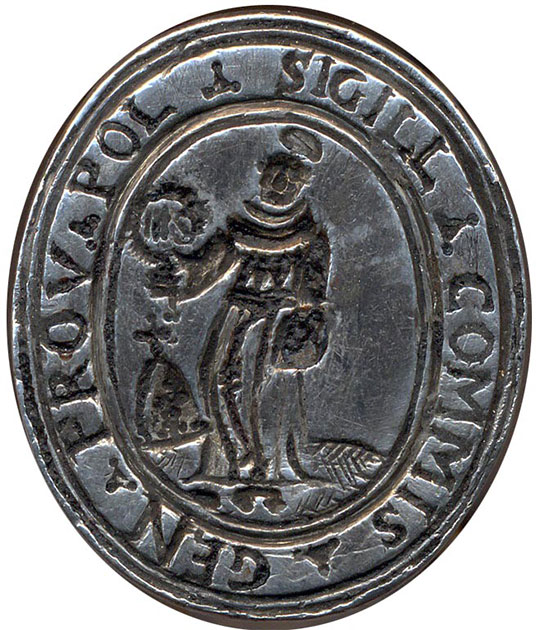
General’s seal of the Society of Jesus of Polotsk period (the last quarter of the 18th c – beginning of the 19th c.)
Mutual understanding between the Society of Jesus and Russian authorities showed European Jesuits that they should move to Polotsk. S. Czerniewicz received a letter from Rome saying the following: “…There are a lot of our young Spaniards and industrious Jesuits who beg to let them go to Belarus”. Ex-Jesuits from Germany, Switzerland, Spain, Italy, Poland and some other countries started moving in to Polotsk. Stanisław Szantyr, a pupil of Polotsk Jesuit College, recalled that many of them, even outstanding experts in some fields, were denied in movement because of the lack of room.
The acquisition of such a significant intellectual potential couldn’t but influence the quality of Jesuit education. In particular, a large number of innovations of the last ten years were put into regular practice. The French and German languages were already taught at the College in 1783. Architecture teaching continued in Polotsk. It remained the only place in Belarus where the architects training was provided. Further institutional strengthening of the Society of Jesus in Russia contributed to further development of Jesuit education. On October 17 of 1782, the first Polotsk congregation consisting of 30 high-ranking Jesuits elected the head - vice-general S. Czerniewicz. On
March 12, 1783 Pope Pius VI endorsed the existence of the Society of Jesus in the Russian Empire.
At the end of the XVIII c. one of the most prominent figures of Polotsk Jesuit College was Gabriel Gruber (1740-1805), a native of Vienna. G. Gruber, a man with a truly encyclopaedic knowledge, was educated at the College of Graz and the University of Vienna and then taught at Ljubljana College. After the disestablishment of the Society of Jesus, he was invited to become a court physicist of Austrian emperor Joseph II Habsburg. G. Gruber served as an engineer at the shipyards of Trieste. He designed civil buildings (the National Archives of Slovenia in Ljubljana is situated in one of them today), headed marsh drainage and etc. After moving to Polotsk in 1784, G. Gruber designed a special museum building and then took an active part in the creation of the museum. It was opened in 1788, when a new two-story College building was finished.
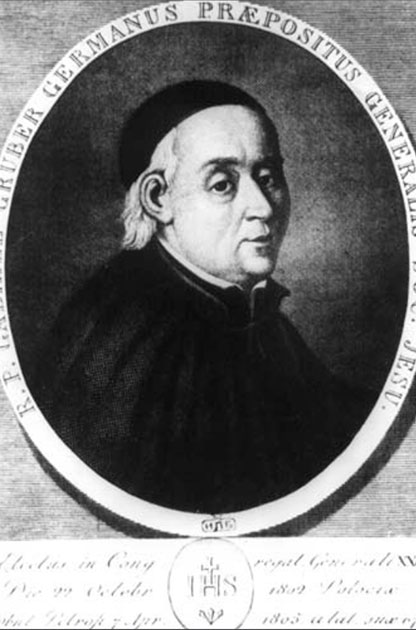
Gabriel Gruber (engraving, the beginning of the XIXc.)
Laboratories with utility space and a natural history cabinet were on the ground floor of the museum building and a physical-mechanical cabinet occupied the whole first floor. Jars with alcohol containing bodily anomalies of humans and animals were in the cabinet of natural history (natural science). Stuffed animals and birds were also exhibited there. In course of time, Jesuits conducted a study of soils in the precinct of Polotsk, developed its classification and presented the corresponding watercolour images in the museum. "Various earth metals", rare and precious stones as well as other stones and fossils, which were found near Polotsk, were exhibited in the cabinet. Already in 1835, A. Morel, a professor of Polotsk Cadet corps, noted that there were 2 diamonds, 6 rubies, 20 emeralds, 5 sapphires, more than 100 pieces of zircon, 40 pieces of garnet, 24 topazes and 20 amethysts. Moreover, one could find various species of wood (387 plate-samples), herbarium (518 plants) and fossil oils (57 cans) in the cabinet. On the “physical” floor of the museum there were electrical machines and apparatus, mechanical, optical and astronomical instruments and equipment. Besides, diverse operating models were presented there as well. Thus, during the course on mechanics, students had an opportunity to study the device and operation of the machine for piling the piles. The visitors and guests of the museum were especially impressed by the fact that most of the mechanisms were made in Polotsk, and many of them by G. Gruber himself or under his direct supervision.
Among the works of a talented engineer and scientist, the "Mechanical Head" occupied a special place. It was a head of an old man with moving eyes and long grey hair. The Jesuit who accompanied the museum visitors, invited them to ask any questions in any language. The "Mechanical Head" answered clearly, loudly, logically, with full knowledge of the circumstances and the situation. This unusual mechanism did not
possess supernatural properties but delighted the visitors, horrified them and provided quivering curiosity. That was the effect that the Jesuits needed. (In 2015 on occasion of PSU birthday celebration, the "Mechanical Head" reconstruction, an exact copy of G. Gruber's creation but using modern technologies and materials, was opened in Polotsk.)
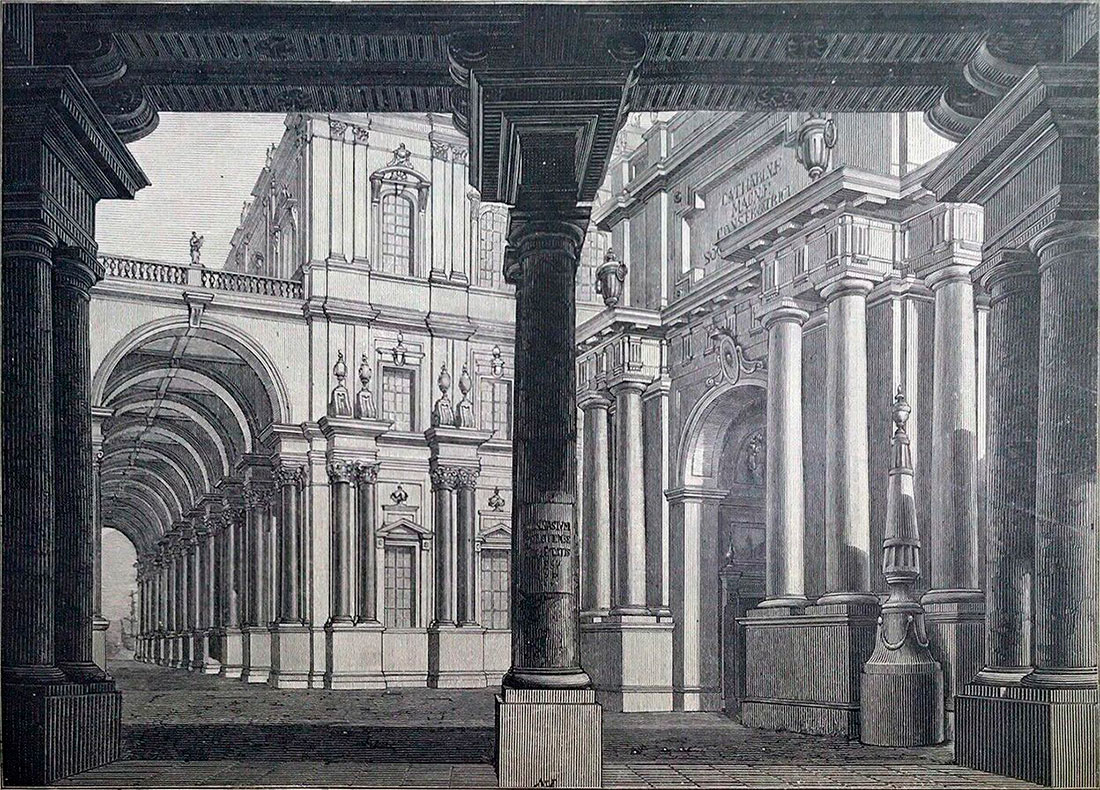
The project of the architectural solution of the Jesuit College complex by G. Gruber (the end of XVIII c.)
Gruber also participated in the artistic design of the museum building interior of the College. The walls of the building were covered with his frescoes. Moreover, a room for drawing, painting and architecture lessons was set up. It contained a large number of books, drawings and engravings, models of all architectural styles with patterns of masonry and roofs, models of bridges and a model of a ship. The museum gallery contained four mosaic works, various items from amber and many other artistic values and remarkable picturesque works, which, according to contemporaries’ words, could become an ornament of any European museum.
The works of the Italian painter Salvatore Rosa (1615-1673) stood out among the exhibited canvases. Pictures of this worthy pupil of the famous Spaniard Jusepe de Ribera still adorn the best museums in the world, the Louvre in Paris, the gallery of Palazzo Pitti in Florence, the Imperial Hermitage in St. Petersburg, and others. Besides, there was a rich collection of copies of works by great artists: Raphael, Titian, Rubens.
G. Gruber’s activity was approved of by the Empress Catherine II and her heir Paul I, whom Gruber got acquainted with in 1797 during the Emperor’s visit to Polotsk. In 1799 G. Gruber moved to St. Petersburg and had a strong influence on Paul I. He founded a College for the capital's nobility children and became its first rector. Referring to the need of fighting the French Revolution spirit, Gabriel Gruber together with General of the Society of Jesus Franciszek Kareu persuaded the emperor to send a letter to the Pope with a request to recognize officially the Jesuit Order in the Russian Empire. In reply to the request Pope Pius VII published a brief “Catholicae fidei” («Catholic faith») in 1801. In that brief the Holy See recognized the canonicity of the Jesuit structures in Russia and gave its consent that the general vicar of the Society of Jesus in the Russian Empire and his successors could bear the title "General of the Order in Russia". It is not surprising that after F. Kareu died in October 1802, G. Gruber was appointed the general of the Order.
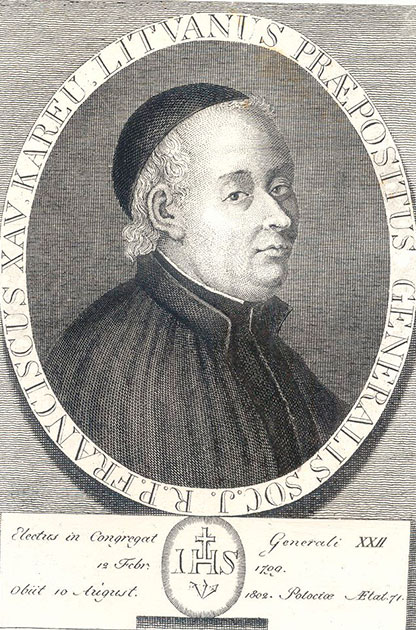
Franciszek Kareu (engraving, the beginning if the XIX c.)
Socio-economic and political situation in the Russian Empire in the beginning of the XIX c. made the government face the need to carry out reforms. The complication of state administration, the growth of trade and industry demanded the educated people.
Improvement of the whole education system becomes an objective requirement to make further development of the country possible.
That is why in 1803 the new Russian emperor Alexander I issued an order to start a school reform. The country was divided into educational districts. In accordance with the document Belarusian-Lithuanian provinces (Vilnius, Vitebsk, Grodno, Mogilev and Minsk provinces) became part of the Vilnius Academic District. Imperial University of Vilna (founded in 1803), which was under the rule of the Ministry of Public Education, governed these provinces. Direct supervision of the study district was carried out by the curator appointed by the tsar.
In 1804, the university charter was issued, which gave considerable autonomy to universities: they could elect the rector and professors, their own court, they were given non-interference of the higher administration in their affairs, the right to appoint teachers in the gymnasiums and schools of their district. All secular schools submitted willingly to the new governing body but the church authorities’ reaction to their new patron was quite ambivalent. The majority of the schools of monastic orders declared their loyalty to the University of Vilna. But the Society of Jesus continued dreaming of dominance in the educational sphere and met the news of the transfer of total control over the education to the University of Vilna with great concern, because the Order thought of the University as of a secular and freethinking one. The Jesuit Order flatly refused the offer of Vilnius Academic District to conform all religious educational institutions to unified programs and rules of education and to reform them in accordance with their charter.
When in 1807 Count L. Plater visited the Jesuit institutions at ministers of public education request, Plater noted in his report that “everything is as it has been before” at the Jesuit establishments and that “they do not think about carrying out university orders in the least”. Actually, the Jesuits carried out only those university requirements that did not contradict the Charter of the Society of Jesus.
Jan Śniadecki, Rector of the University of Vilna (since 1807), an outstanding scientist and teacher, actively advocated the subjection of the Society of Jesus’ educational establishments to the University of Vilna. In the beginning of 1808, he sent a letter to Tadeusz Brzozowski, the General of the Jesuit Order, in which J. Śniadecki demanded “uniformity of sciences and ways of teaching, the usage of the same textbooks”, created by professors of the university and full subordination to the University of Vilna.
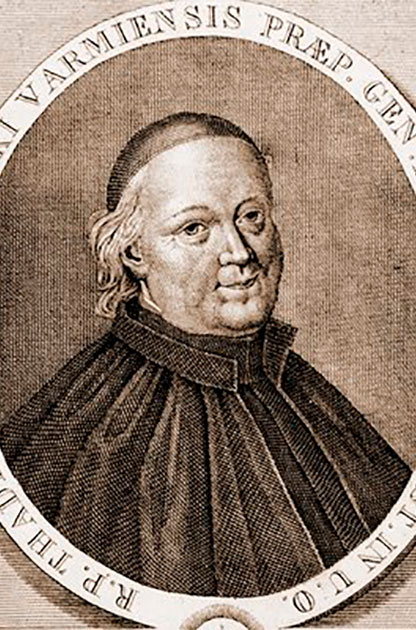
Tadeusz Brzozowski (engraving, the beginning of the XIX c.)
Confrontation of the University of Vilna with the leadership of the Vilnius Academic District had little effect on Polotsk Jesuit College activities. All Vilna's attempts to
convince the Order’s General of the necessity of subordination did not bring success. It was obvious that there were powerful capital patrons behind the Order. Count A. K. Razumovsky, who replaced the liberal P. V. Zavadovsky in the post of Minister of Education in 1810, launched a public invitation for the University of Vilnius not to interfere in the affairs of Jesuit educational establishments.
Russian state dignitaries adhered to such a position not without a reason. The General of the Society of Jesus T. Brzozowski maintained active correspondence with the most influential Russian politicians and managed to create an image of inflexible fighters with such a rebellion. T. Brzozowski, in his activity for the benefit of the Jesuit order, found an ally. It was Joseph de Maistre (1753-1821), an envoy of the Sardinian kingdom at the imperial court. Joseph de Maistre had a very strong influence on the public opinion. Moreover, he was described as the most famous European thinker of his era, one of the founding fathers of the conservatism ideology, literary talent and the "soul" of any secular company. One of his contemporaries wrote that “monsieur de Maistre was the most outstanding character of St. Petersburg in the time of Alexander I”. The King trusted the Sardinian completely. Once, Maistre received an unusual proposal from Alexander I: to choose the design of the monument to Minin and Pozharsky in Moscow. It was Maistre’s choice that was approved by the emperor.
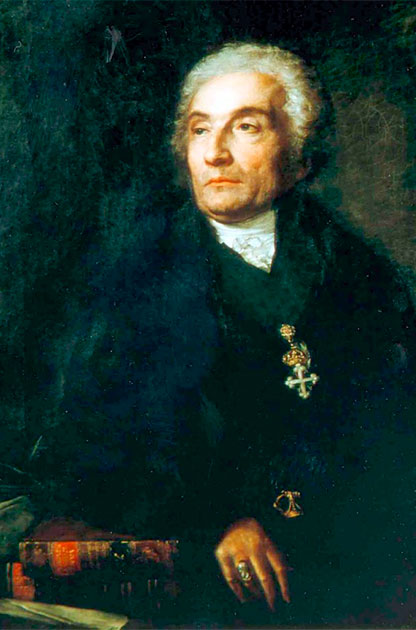
Joseph de Maistre (Carl Christian Vogel von Vogelstein, 1810)
Feeling the power of their influence on the part of the capital elite, which was increasingly inclining to a conservative tendency, T. Brzozowski and J. de Maistre not only sought to convince the authorities of the good intentions of the Society of Jesus and its benefits for Russia, but also began the struggle for the opening of a higher Jesuit establishment.

