




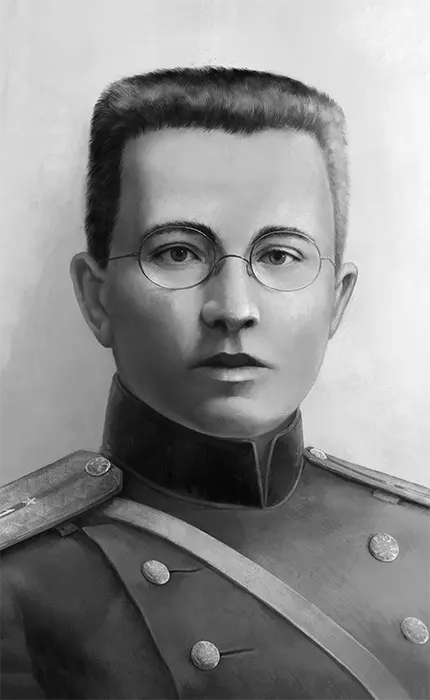
Gleb Alekhnovich
Graduate of the Polotsk Cadet Corps (1904)
Gleb Alekhnovich
Staff Captain – a pioneer of Russian aviation and holder of multiple national flying records.
Education
After graduating from the Polotsk Cadet Corps in 1904, Alekhnovich continued his studies at the Konstantinovsky Artillery School in Saint Petersburg.
Military service and aviation achievements
In the summer of 1910 Artillery Lieutenant Gleb Alekhnovich learned to fly a glider. By late October he had completed initial flight training at the Sevastopol Aero Club. When Russia opened its first officer aviation schools, Alekhnovich’s attempts to enroll met a frustrating obstacle: his myopia. Both Sevastopol and Gatchina rejected him for poor eyesight. Only with difficulty did he persuade the Gatchina instructors to let him remain as an observer pupil; he was forbidden to touch the controls, although he had already mastered—often better than many trainee pilots—theory of flight and aircraft engines.
Fortune intervened. At the Gatchina airfield Alekhnovich became friends with engineer Ya. M. Gakkel, who was testing his own designs there. In July 1911 Gakkel allowed him a trial on the Gakkel‑VI. To everyone’s surprise, Alekhnovich took off successfully on his first attempt, completed a circuit, and landed safely. Three days later the All‑Russian Aero Club awarded the self‑taught pilot a pilot’s diploma. He later became known as the only Russian pilot to fly wearing glasses.
A month after receiving his diploma, in August 1911, Alekhnovich won aviation competitions. His flights from Gatchina to Tsarskoye Selo, onward to Krasnoye Selo, and back were the first intercity flights in Russia. In September he flew Gakkel’s biplane five times between Saint Petersburg and Gatchina, covering about 200 kilometres in total.
Following the 2nd International Aeronautical Exhibition in Moscow in May 1912, Alekhnovich set a new Russian altitude record by climbing to 1,350 metres in the Gakkel‑VIII. That year he also astonished Muscovites by making an exceptional night flight, navigating by the light of petrol burned on the airfield.
Test pilot work
At the end of 1912 Alekhnovich resigned his commission in the Imperial Russian Army and joined the Russo‑Baltic Wagon Factory’s aviation department as a test pilot. He trialled the S‑5a and S‑10 “Hydro” seaplanes and was among the first pilots to fly the heavy multi‑engine aircraft Russky Vityaz and Ilya Muromets.
In May 1913 he outperformed competitors flying foreign seaplanes while piloting a floatplane designed by the factory and received a prize from the Naval Ministry. In June, flying a domestic biplane, he climbed to 3,400 metres in 24 minutes and again became the national height champion. That record, widely reported in Russian and foreign newspapers, placed Alekhnovich among the world’s leading aviators.
At a military contest in autumn 1913 he secured first place for the Russo‑Baltic biplane. In April 1914, on that same biplane, he set a national endurance record—4 hours, 56 minutes and 12.6 seconds—covering about 500 kilometres. In May he set a Russian altitude record for a flight with a passenger, reaching 2,100 metres.
Energetic and restless, Alekhnovich campaigned for professional organization of Russian pilots, speaking at the III All‑Russian Aeronautical Congress and helping to form a pilots’ union. He founded a student aviation club at the Petersburg Polytechnic Institute and taught there; staged public demonstration flights across Smolensk, Vyazma and other cities to promote aviation; and helped inventor G. E. Kotelnikov obtain military backing to manufacture the world’s first backpack parachute RK‑1. While preparing to enter the mechanical faculty of the Saint Petersburg Polytechnic Institute, he nonetheless continued test‑flying and, within two to three months as a student, passed ten examinations including higher mathematics, theoretical mechanics, physics and chemistry.
First World War and death
At the start of World War I Alekhnovich was recalled to service and appointed commander of the Ilya Muromets‑V, flying over 100 sorties with the Muromets squadron. He established workshops within the squadron to develop small arms and bombing equipment and converted his aircraft into a flying laboratory. Together with gunner‑artilleryman A. N. Zhuravchenko, he developed effective spherical defensive fire systems that protected the Ilya Muromets from enemy aircraft, so intimidating that opposing pilots often retreated.
Alekhnovich flew demanding reconnaissance and deep‑strike bombing missions and also trained other pilots at the Flight School of the Airship Squadron. For "distinction in actions against the enemy" and for personal courage and flying skill he received the Orders of St. Anna 3rd class with swords and bow and St. Anna 2nd class with swords in 1915; earlier he had been awarded the Order of St. Stanislaus 3rd class, and in 1916 the Order of St. Stanislaus 2nd class with swords. He also received the Order of St. George 4th class.
In 1917 he set a payload record by lifting 180 poods (2,948.4 kg) on his Ilya Muromets.
After the October Revolution he sided with Soviet authorities and in March 1918 voluntarily joined the Red Army. He organized assembly of Muromets aircraft at the Russo‑Baltic Wagon Factory and trained crews on them, taking part directly in military operations.
In autumn 1918, while several Ilya Muromets were based near Ertil station under Lipetsk, one aircraft piloted by Alekhnovich crashed during an urgent transfer conducted in extremely poor weather; the accident was attributed to the fault of a crew member. Thus ended the life of a distinguished ace and an early leader in Russian aviation and industry.
His comrades brought Staff Captain Gleb Alekhnovich’s body to Petrograd. He was buried in the Nikolskoe Cemetery of the Alexander Nevsky Lavra, near the graves of the first Russian aviators.

