




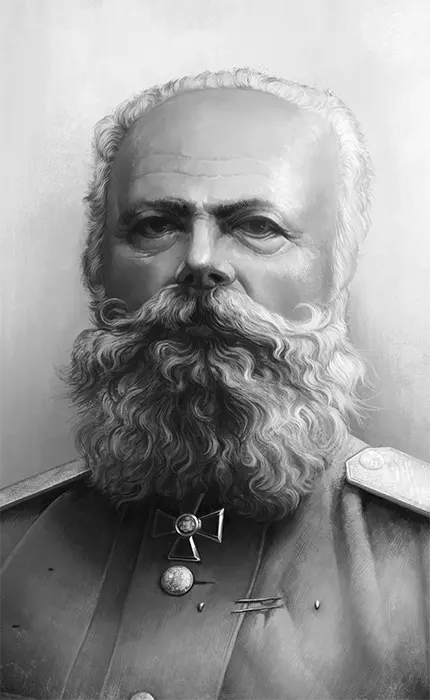
Nil Kirpichev
Graduate of the Polotsk Cadet Corps (1866)
Nil Kirpichev
Theorist of structural mechanics, honored professor at the Nikolaev Engineering Academy; first chairman of the Aeronautical Committee under the Main Engineering Directorate of the Imperial Russian Army; later manager of the Engineering Committee under the Main Military Engineering Directorate of the Red Army.
Education
Upon graduating from the Polotsk Cadet Corps (1866) and the Mikhailovsky Artillery School (1869), he began his military service in the fortress artillery of Kronstadt. In 1871, he entered the Nikolaev Engineering Academy, completing his studies in the first rank with his name inscribed on the marble plaque in the academy's conference hall.
Teaching and scientific career
Due to his academic success, Nil Kirpichev was first retained in the position of tutor, then as an instructor. In 1885, he received the rank of colonel. In 1889, he was appointed adjunct professor of structural mechanics and theoretical mechanics at the Nikolaev Engineering Academy, and the following year, he simultaneously became inspector of classes at the Page Corps. From 1890, he served as an extraordinary professor at the academy; in 1894, he was appointed a permanent member of the Engineering and Electrotechnical Committees of the Main Engineering Directorate. In 1895, he was granted the rank of major general.
For many years, Nil Lvovich taught mechanics at the Electrotechnical Institute and the Pyrotechnic Artillery School, while also instructing fortification at the Academy of the General Staff. He conducted extensive scientific and practical work. He was the author of scientific works on theoretical and structural mechanics, as well as analytical geometry. He was engaged in the development of telegraphy for military needs and participated in the preparation of projects and construction of the Okhtensky, Troitsky, and Palace bridges across the Neva in St. Petersburg, as well as a bridge across the Syr Darya, hydraulic structures, ship backwaters on the Amur, and the Ladoga water pipeline.
Great significance was attached to Kirpichev's works, which provided theoretical generalizations of the famous Berezan experiments of 1912 for determining the destructive impact of new types of shells on fortifications. He developed a calculation method and a formula for determining the destructive effect of new types of artillery shells, as well as design load standards for various types of bridges.
Nil Kirpichev played an enormous role in the establishment and development of aeronautics and aviation in Russia. In the 1880s–1890s, he was engaged in verifying calculations and reviewing designs for balloons and airships. He was directly involved in the design and construction of Russia's first airship “Krechet”, which was adopted by the Russian army and marked the beginning of Russia's air fleet. On January 7, 1911, Nil Lvovich received the Imperial Favor. That same year, he was appointed the first chairman of the Aeronautics Committee under the Main Engineering Directorate.
During the First World War, Nil Kirpichev served as a permanent member of the Engineering Committee under the Main Military-Technical Directorate and later became the head of affairs for the same committee. In 1917, he was promoted to the rank of Engineer-General. In 1918–1920, he headed the Engineering Committee under the Main Military-Engineering Directorate of the Red Army.
Final years
In his final years, he taught at the V.V. Kuibyshev Military Engineering Academy. Nil Kirpichev died in 1927.

