




Polotsk Jesuit College during 1581-1640

Polotsk Jesuit College during 1581-1640
During XV–XVI cc. the richest cultural heritage of the antique era was returned, the printing machine was invented, the ways to America were discovered and lots of other changes happened in the cultural field. All these things raised a great interest to knowledge in Europe; dozens of university centers appeared, science flourished, the amount of students increased.
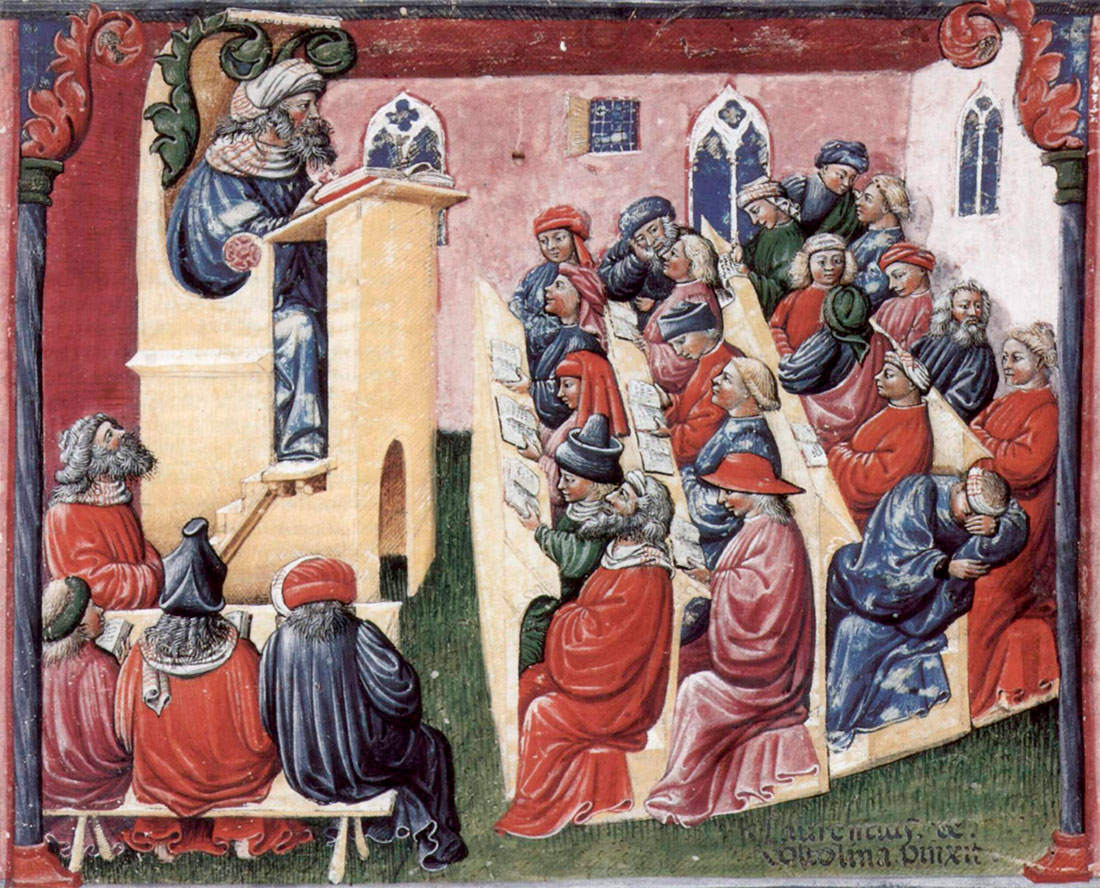
Henry Alemannic’s lecture at Bologna University (the illustration from a manuscript, the 2nd half of the XIV c.)
The Grand Duchy of Lithuania did its part as well. But as it did not dispose its own research and education sources for a long time, the GDL made use of what Western and Сentral Europe could offer. In 1397 the Czech King Wenceslaus IV fulfilled the request of the Polish Queen Jadwiga to buy a house in Prague for the Lithuanian students of theology in order to spread Christianity in Lithuania. Jadwiga, the wife of the Lithuanian King Jagiello, knew perfectly the problems of that land where Christianization of the population, modeled upon the Catholic pattern, started recently after concluding the union of Krevo in 1385. However the Queen’s death in 1399 and the resumption of the activity of Crakow University (Jadwiga had bequeathed her personal property to the university) couldn’t but slow down the realization of the Queen’s request. The house was bought only in 1411. Nevertheless a dozen of students from the GDL studied in Prague at the end of the XIVth - the first decade of the XVth century dispense with the support of the government.
Yet Crakow University gradually became the major education center for the students from the GDL. By XVI c. Crakow alma mater had trained around 700 students from the GDL! Moreover Lithuanian people studied at universities of Siena, Padua, Bologna, Tubingen, Erfurt, Wittenberg, Leipzig, Königsberg and others. Soon the government and the society of the GDL felt the necessity of introducing European education and science to their own system.
The aggravation of the religious confrontation in the GDL between the reformation movement and the renewed powers of the Roman Catholic Church (especially its vanguard - the Society of Jesus, better known as the Jesuits order) forced the progress in this sphere. Religious tolerance, which was a unique phenomenon in Europe of that time, predominated among the society of the GDL and created conditions for the settlement of disputes through open discussions and educational system competitions but not through wars.
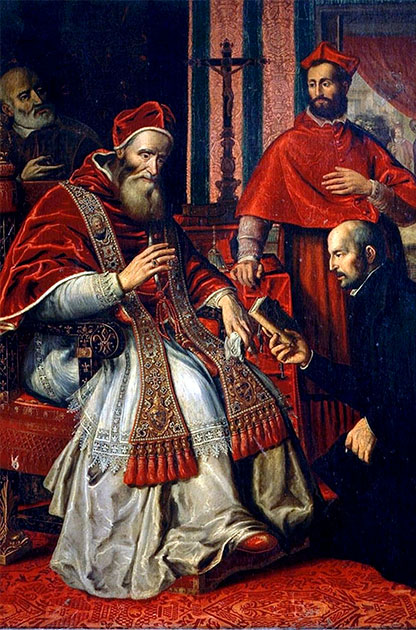
On September 3 in 1539 pope Paul III gives his verbal consent to Ignasio Loyola to create the Society of Jesus (author unknown, XVII c.)
In 1565 Jesuits offered a plan of establishing a college in Vilnius. That was several years before their appearance in the GDL. The Jesuits order was a monastic order of a new type. The participation in the life of the Catholic church, missionary outreach, publishing and educational work were its main objectives. The principles and the atmosphere in the Order were focused on the activation of the inner individual potential on the one hand, and on involving a person into a rigidly organized structure on the other hand.
The creation of an educational establishment net for the priesthood and the congregation was one of the most important measures of a church life reorganization. In 1551 a Spanish nobleman Ignasio Loyola, the founder of the Society of Jesus, sent a letter to the Order brethren in which he suggested building of the colleges throughout Europe. Jesuits opened 33 educational establishments for people of high society during the period from 1548, when the first college of that kind started working in Messina (Italy), till 1556, the year of Loyola’s death. Besides, they got a permission to build 6 more colleges.
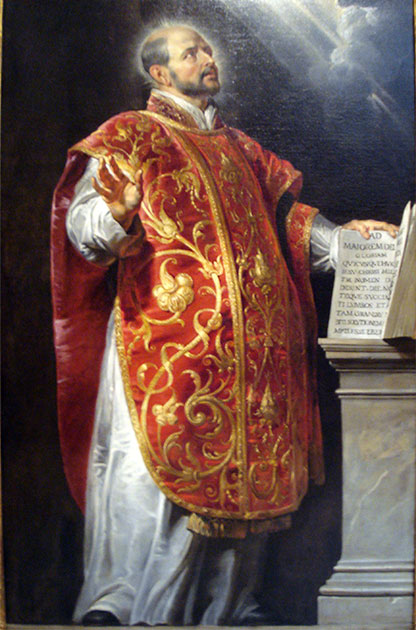
Saint Ignasio de Loyola (Peter Paul Rubens, the beginning of the XVII c.)
Jesuits did not stint themselves of these pedagogical measures only. They followed the Order’s system of upbringing and education. It consisted of the experienced preachers, polemicists and teachers’ training on the one hand and of educational establishments building for training catholic priests and missionaries on the other one. Assisting the reunification of the “schismatic-orthodox” with Catholic Rome under the papal system was a significant point in the plans of the Society of Jesus.
In 1569, after concluding the Union of Lublin between the Kingdom of Poland and the Grand Duchy of Lithuania and, thus, creating the Polish-Lithuanian Commonwealth, the first Jesuits appeared on the territory of the GDL and started the realization of the plan. The college was opened in Vilno in 1570. The hurry in the realization of the plan was explained by the desire of the Protestants, the main Jesuits adversaries, to create their own establishment of the same kind. According to the last will of Nicholas Radziwill “the Black”, the greatest representative of the reformation in Belarus and Lithuania and one of the richest magnates of the Duchy, considerable funds were invested in the Calvinist educational establishment building. His cousin, Nicholas Radziwill “the Red”, a new leader of the Protestants, supported the plan ardently. Moreover he was the major military and government figure of that time. Nicholas Radziwill “the Red” was a hetman and a waywode of Trox, and after 1566 he was appointed chancellor of the GDL and waywode of Vilno.
From the very beginning Jesuits regarded the college of Vilno as a transformation base to turn it into a university. But financial and staff difficulties brought doubts for some time if the idea would be soon realized. After establishing an independent polish Order province, with its provincial in the head, on the territory of the whole Polish-Lithuanian Commonwealth by the leader of the Society of Jesus in 1574, the future of the University of Vilno seemed to have clarified. However, the escape of King Henry Valois back to France and the beginning of another period of interregnum disturbed the stability of the commonwealth. The election of Stephen Bathory, the monarch of Protestant Transylvania, the King and the Duke of the commonwealth, which happened with the determinate support of Protestants, prejudiced the future of both Polish province and Jesuit University.
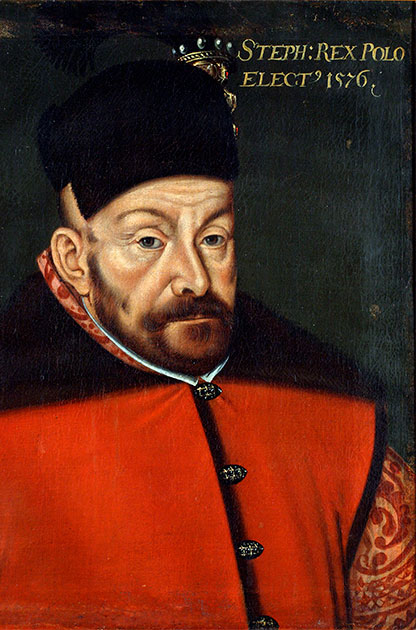
Stephen Bathory (Voytekh Stefanovsky (Stefanovich), 1576)
Quite unexpectedly, Jesuits found a true ally in Stephen Bathory. Firstly, the new King used the Latin language to rule the Polish-Lithuanian Commonwealth because he did not know the languages of his subjects being Transylvanian Hungarian by origin. For the realization of the transformations in the country, Stephen Bathory needed well-educated, fluent in the Latin language people both in the center and in the provinces. Secondly, the King was quite an educated person for his time and his high government position. He studied at University of Padua, the third of the oldest Universities in Europe, (founded in 1222). Such famous scientists as Leon Battista Alberti, an Italian writer-humanist, one of the founders of the new European architecture and the leading theoretician of Renaissance art, Nicholas Kuzansky, the greatest German thinker, philosopher and theologian of the XV c., Nicolaus Copernicus, a polish astronomer and mathematician, creator of the heliocentric system, graduated from that University. An interesting fact is that Francis Skoryna took his doctor’s degree in medicine exactly at the University of Padua.
Stephen Bathory couldn’t but understand that only an efficient system of education could provide the government with educated people. As the King was a pragmatic Catholic he supported the educational initiatives of other confessions, in particular brotherly schools in Lviv and Vilno. Their programs included not only Russian and Greek but also Latin and Polish languages. Nevertheless, the Jesuits school managed to prepare such people sooner than others. There were no worthy competitors to Jesuit educational establishments over the whole Europe. That’s why Francis Bacon, a famous English philosopher and politician, claimed “One should take the Jesuits school as an example to follow, because nothing better can be created”.
In 1577 Pope Gregory ХІІІ with King and great Duke Stephen Bathory agreed on the establishing of the University in Vilno. In 1579 the head of the government approved a legislative act of establishing an academy in Vilno. The Papal Bull assigned the status of higher education establishment to the academy in Vilno and to the University of the Society of Jesus. The academy in Vilno was a worthy competitor to the University of Krakow in the field of higher education in the country.
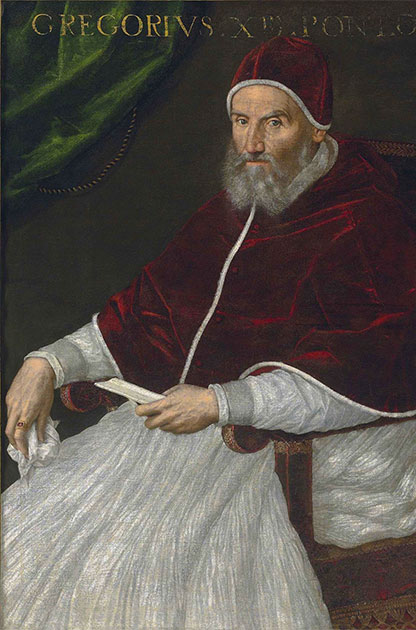
Pope Gregory ХІІІ (Lavinia Fontana, the end of the XVI c.)
The creation of Jesuit academy in Vilno served as a basis for further expansion of the Society of Jesus influence over the GDL territory. The next expansion objects should have become Polotsk and Nesvizh, the major reformation movement and Orthodox centers in the country.
At the time of establishing the University in Vilno, Polotsk was under the rule of a Moscow King Ivan the Terrible. But when Stephen Bathory, the King of the Polish-Lithuanian Commonwealth, ascended to the throne in 1576, the course of the Livonian War started changing in favor of the “Republic of the Two Nations”. In summer 1579 a united army of the Kingdom of Poland and the GDL headed to Polotsk. They had to storm the town in adverse conditions. It was raining constantly and Stephen Bathory’s army failed to set on fire the castle fortifications. Then the king and the great duke asked the Jesuit monks accompanying him to pray the God to relent and grant them the victory over Moscow. And if it is a success, Stephen Bathory promised to present the Jesuits with considerable ownership in the conquered town and the right to establish their cloister there. On August 30, 1579 Moscow garrison in Polotsk laid down the arms.
To prove his words, on the day of the conquest Stephen Bathory sent a letter to Piotr Skarga, one of the founders of the University of Vilno and its first rector, with a request to arrive to the liberated town together with other monks of the Society of Jesus.
Piotr Skarga (1536-1612) was educated in Krakow, Vienna and Rome. After becoming a member of the Jesuit Order he joined the struggle against the Reformation movement on the territory of the GDL and proved himself to be a profound theological scholar, a brilliant polemicist and an ardent preacher. In his letter King Stephen Bathory appealed Skarga not to feel jealous of Spanish and Portuguese Jesuits, who spread the Catholicism all over the world, and promised that Skarga will find here India [i.e. America] and Japan among Russian people and residents of Polotsk, who are still ignorant of the God’s work. On October 4, 1579 Stephen Bathory agreed on the financial support of the new college with Skarga and Francisco Sunier, a provincial of the Society of Jesus. On January 20, 1580 the legislative act was signed by the King, the senators and other officials of the GDL.
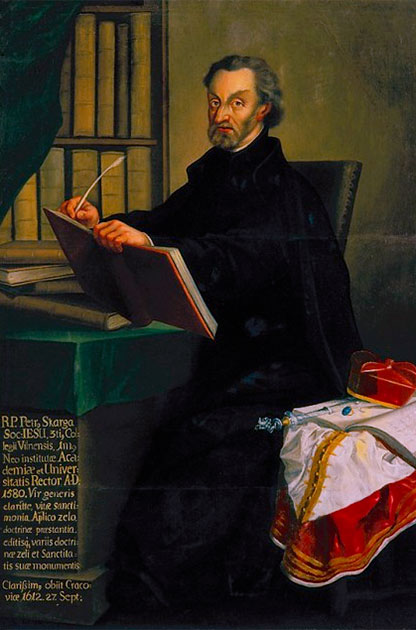
Piotr Skarga as a rector of the Vilno Academy (author unknown, before 1612)
The first Jesuits came to Polotsk in 1580. Piotr Skarga, who decided to get acquainted with the situation in the town himself, was accompanied by Stanislav Lenchinsky, Jan Aland and Wojciech Ginzius. Regardless the open opposition from the side of orthodox citizens and the waywode of Polotsk and ex-Calvinist Nicolaus Monvid Dorohostajsky in particular, the Jesuits managed to take a foothold in the town. Stephen Bathory visited Polotsk himself in 1580 and in 1581 and made effort to provide them with all the necessary assistance. Thus, during the patronage of the King, Polotsk Jesuit College, a five-grade educational institution of philological and theological profile, started its work since 1581. Moreover, a seminary was established in the town in 1582. It aimed at the education of poor gentry children.
After a long-term dispute between the Orthodox and Protestant ambassadors, in 1585 the Commonwealth Sejm upheld the Royal decision to let the Jesuits the right to establish their college in Polotsk. As a result, the Jesuit Order possessed 82 villages and farmsteads and also orthodox cloisters and churches in Polotsk except St. Sophia Cathedral, a watermill under the Upper Castle and the passage over the Dvina River. Soon the Order got the island on the Dvina River and the settlement of Ekiman through the exchange with the town.
The most important role in the Jesuits education system belonged to the “Charter and order of education in the Society of Jesus” or the “Ratio studiorum” (the full name is “Ratio atque institutio studiorim Societatis Iesu”), developed under the leadership of Claudio Acquaviva, the General of the Order. The development process of this important document is a brilliant illustration of the Jesuits thorough and thoughtful approach to upbringing and education. First, a creative team of six Jesuit experts in the field of education was formed in Rome at the Acquaviva’s initiative. They created the first variant of the “Ratio Studiorum”. Then it was sent to the provinces as a project, for the approbation and further refinement of which special commissions were created. The approbation process of the pedagogical principles, which served as a basis of the text, and the process of consultations of provincial commissions with the central one lasted for 13 years till the final version was created on the basis of a general agreement. This variant was adopted in 1599 by General Acquaviva.
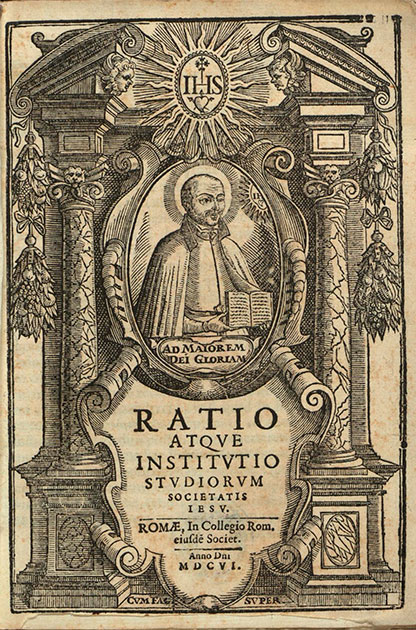
Ratio studiorum cover page (Rome, 1606)
According to the “Ratio studiorum”, the head of all educational establishments was the Order’s general. The provincials, his deputies in the provinces, had broad powers. The provincial governed the educational establishments which were on the territory assigned to him. He appointed prefects and teachers, decided on the time of the beginning and the end of classes, on the duration of holiday period and etc. Moreover the provincial selected a candidate for a post of a college rector and then submitted the person to the general for approval. The rector headed the college. He controlled the activity of the institution and then submitted written annual reports about it to the provincial.
But the direct governing of the college was in the hands of the prefect. Yet only the members of the Order could get this post, since they had excellent education, great experience and merits in the pedagogical field. The prefects had to visit one of the lessons of each teacher every month, and check pupils’ written works from time to time. They were responsible for the school disputes, the organization of oral and written examinations, they accepted new students, give their consent to transfer the students to higher grades and so on.
Education was carried out by teachers whose training was a matter of special concern of the Society of Jesus. Initially, a young man who intended to make pedagogy their destiny had to undergo two-year training in the novitiate. Three monastic vows were made on its finishing: a vow of poverty, a vow of chastity and a vow of obedience. As a result, they became Scolastics. During the following two years they were obliged to undertake an in-depth study of the classics and the modern language of the country where a young teacher was supposed to be sent by the administration. Successful mastery of languages provided them with the possibility to study philosophy, physics and mathematics. If a Scholastic displayed a good potential for one subject or more, in order to deepen the knowledge, he could additionally study in junior classes, where they were to work for three years under a close control of the rector. The Scholastics who proved themselves in practical activity were given the possibility to study theology, law, church history and deepen the knowledge in modern and classical languages during four years. In the Order’s higher educational establishments only those scholastics who passed all their examinations with an excellent mark were permitted to teach the most complex and responsible disciplines. They were the only ones who were allowed to make the fourth monastic vow, i. e. to obey the Pope unquestioningly. Thus, the preparation of the Jesuit teacher normally took 15 years!
Creation of the unified educational system became the pinnacle of Jesuit schools achievements. Concise and clear prescriptions referring the curriculum, students’ and teachers’ timetables facilitated the teachers’ and rectors’ work. Later the “Ratio Studiorum” was accused of not being open to innovations, in particular, to rapidly developing sciences. For example, experimental physics, which was in great demand for the victory of the scientific revolution in XVII c., was introduced into the Jesuit education only in 1730. Nevertheless, the fact that the “Ratio Studiorum” was in force until the XIX c. with minor modifications can’t but admit its high quality. A great advantage of Jesuit education was its free-of-charge basis which opened the way to knowledge to representatives from various strata of society. The critics of the Order always jeered at Jesuit “as-if-free” education. But the methods of raising the financial and material resources, which were used by the government of Jesuit Colleges, from the external world as well as from parental donations were rather efficient and nowadays they are considered to be perfectly acceptable for school directors and are respectably called “fundraising”. One more important principle of Jesuit education organization was its availability to the representatives of all Christian denominations. It explains the fact that a lot of Uniates and Orthodox studied at all establishments of the Society of Jesus.
Polotsk Jesuit College was a five-form gymnasium intended for 6-7 years of studying. The first form was called “inferior (the first) grammar” or “infims” (infima classis grammaticae, infima). If its program lasted for two years, the first year was called “infima minor” (parva), and the second – “infima major”. In the second form of “medium (second) grammar” or just “grammar” (media classis grammaticae, grammaticae) the study of the Latin language finished and the study of Greek started. The classes in the third form of “superior (the third) grammar” or “syntax” (suprema classis grammaticae) aimed for learning Greek and improving the knowledge in Latin. After finishing grammar school, a pupil was transferred to the class of “humanitas” or as it was often called “poetry” (poesis). Careful selection of the best ancient pieces of work: those of Cicero, Virgil, Horace, Caesar, Seneca, Plato, Plutarch and Hesiod, allowed to solidify the knowledge acquired in the field of the Classics and lay a solid foundation for future classes in eloquence. The final stage was devoted to the classes of “rhetoric” (rethorica) and lasted for two years. The students mastered the theory of public-speaking and developed their own parlance. The latter was supported by doing lots of exercises and participating in oratory skills challenges. It’s possible that, as in other important colleges, in Polotsk appeared the form “proforma’, which provided students with the elementary knowledge of reading and writing. In other words it was a preparatory form. But most often the students had already acquired the primary education from a school or from a private teacher hired by the parents.
There were only 5 boys studying in the first year of education. Despite the low number of students, the new educational initiative found its supporters among the local aristocracy. Among the first students there were close relatives of the Order’s ardent opponents: the son of the above mentioned waywode, and the nephew of orthodox bishop Theophanes (of Rypinsk). The rest descended from the local Catholic gentry, which was not yet numerous at those times.
Initially it was planned to build all the Jesuit establishments on the island on the Dvina River at the place of the cloister of John, the forerunner of Christ. But, as large stone buildings on the island could be used by an enemy during the siege of the town, the upper chamber of the Commonwealth parliament permitted to build there only the college for the sake of safety. Later, the buildings of the cloister, church and college were built on the high right bank of the Dvina River not far from the St. Sophia’s church, between the Upper Castle and the market square. The Jesuit church, which joined to the complex of Jesuits buildings, was blessed in honor of the Annunciation of the Virgin Mary and St. Stephen, the patron of heaven.
From that time the number of students was increasing. In 1591/1592 academic year the classes were held in the three grammar forms, and starting from 1595/1596 academic year, the classes in the form of poetry started as well.
Before his untimely decease in 1586, Stephen Bathory had had time to establish 8 Jesuit colleges. The Jesuits themselves could not keep up to such tempo of building of the new establishments. The Head of the Polish province of the Society of Jesus complained in his letter: “… To staff the colleges with people of the present condition is absolutely impossible because I do not have them. And what is worth, right now I do not just dispose mighty colleges, I do not have any of them at all”. To establish a college in Grodno, which became an unofficial capital of the Polish-Lithuanian Commonwealth, Stephen Bathory sent a special letter to Pope Gregory XIII with a request to find trained teachers in provinces with a better situation with the staff. The King’s death postponed the establishing of the Jesuit colleges in Grodno for thirty years!
Nevertheless, the widening of the net of Jesuit colleges continued. The period of king Sigismund III Vasa reigning (1587-1632) was a real “golden age” for the Jesuits of the Polish-Lithuanian Commonwealth. New colleges were established from year to year: in Lutsk (1606), Lvov (1608), Orsha (1612) Brest (1632) and in other towns. On December 6, 1605 Pope Paul V in his brief approved the establishing of Polotsk Jesuit College at the request of the Polotsk rector Valenty Matysevich.
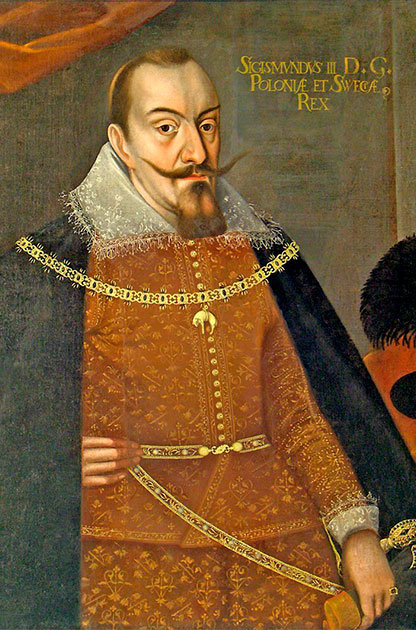
Sigismund III Vasa (author unknown, around 1620)
Initially the Jesuits in Polotsk faced some staff supply problems. For example, it is known that in 1591/1592 academic year none of three teachers had the rank of professor. The first mentioning of this rank was found in the documents of the years 1593/1594. In 1605/1606 academic year three teachers gained the rank of professors. In 1649/1650 academic year there appeared one more professor. In total, they made up only the half of the whole pedagogical staff of the college.
The staff instability was a common phenomenon in Jesuit establishments. Firstly, the Society of Jesus practiced actively the teachers’ rotation, so the teachers did not work at the same place for more than three years. Secondly, the political and military circumstances of that time influenced their work as well. These problems were common to another ancient college on the territory of modern Belarus – Nyasvizh college, which was founded in 1586. But the number and the proportion of professors there were much higher: 7 out of 7 in 1615/1616, 5 out of 5 in 1616/1617 and 8 out of 8 in 1648/1649.
Jesuits sought to use music in the process of education in the atmosphere of devotion to the Catholic church and the spreading of its influence over the territory of the GDL. The activity of bourses was based on this principle. During 1586-1597, when the new wooden buildings appeared in disposal of the Society of Jesus, Polotsk Jesuit Bourse was founded. It was a musical school for the poor gentry children who were capable of music. The students were given board and lodging by the Jesuits and studied science and music for free. The students of bourses took part in divine service and in other church and social events of the town.
The absence of class and confessional restrictions and free-of-charge character of Jesuit education promoted its attractiveness. Initially the pragmatic language policy of the Society of Jesus could help to expand the student audience. The directorship of the Order decided to include the Belarusian language as a separate discipline in the curriculum of the Jesuit educational establishments opened on the territory of the GDL. The first mentioning of its teaching appeared in 1584, literally in a few years after it had been introduced by the Jesuits from Vilna. If to judge by the metropolitan data, as the accurate information about Polotsk is missing, twice a day the students read and wrote and then translated and learned by heart the extracts from the “Gospel” or “Catechism” chosen by their teacher. There is no doubt that the Belarusian language played a secondary role in the Order’s education. As it was recognized by the Jesuits themselves, the native language was taught only “for the children to get used to the Latin letters and ceremonies”. But in the new “Ratio studiorum” the studying of the local languages was forbidden in Jesuit establishments and it was even banned to use them on the alma mater territory. But in practice the Polish language was used on the territory of the Polish-Lithuanian Commonwealth both in the process of teaching new material and during the extracurricular activities.
The opening of the students’ theatre in 1585 could not but assist further spreading of Jesuit influence and popularity of their college. The theatre had existed till 1819. The plays were staged on religious, mythological and historical subjects. Usually the plays were staged in Latin (less often in Polish), but sometimes even in Belarusian (f. ex. in 1603).
Even the unfavorable circumstances of the early XVII century did not hinder the development of the educational establishment. For example, in 1601 a lot of citizens starved or died from an epidemic (they say 15 thousand people died!). But the Jesuits managed to benefit from these difficulties. In 1600 they gave food to several hundreds of hungry citizens of Polotsk who looked for salvation in the town. Without any doubt such charity couldn’t but be of a good service in the promotion of their education among local population. By 1605 a secondary school was opened after the introduction of the rhetoric course in the college.
Polotsk Jesuit College quickly became one of the centers of Order’s teachers training. Originally the teachers working on the territory of the GDL were all from Polish establishments of the Society of Jesus. Together with the creation of the Lithuanian province in 1608, the core of which was the land of the GDL, the leadership of a new independent organization and territorial unit of the Order faced the mission of preparing teachers of its own. Polotsk Jesuit College was among the pioneers of this affair. The preparation of teachers of rhetoric here started in 1609/1610 academic year.
It is possible to talk about a pedagogical school appearance in Polotsk. Maciej Kazimierz Sarbiewski, the recent graduate from the academy of Vilna, started up its opening. At first, he taught rhetoric in Polotsk (1620), but then continued his education in Germany and Italy. Maciej Kazimierz Sarbiewski received the laurel wreath and a golden medal in the Eternal city directly from the hands of Pope Urban VIII for the poetry collection in Latin published in Cologne “Lyricorum libri tres” («Three Books of Lyrics», 1625). The famous Italian poets Dante Alighieri and Francesco Petrarca were once honoured this privilege. The reward can be compared to the modern Nobel Prize in the field of literature. Sarbiewski was appointed a teacher of rhetoric in Polotsk Jesuit College again in 1626.
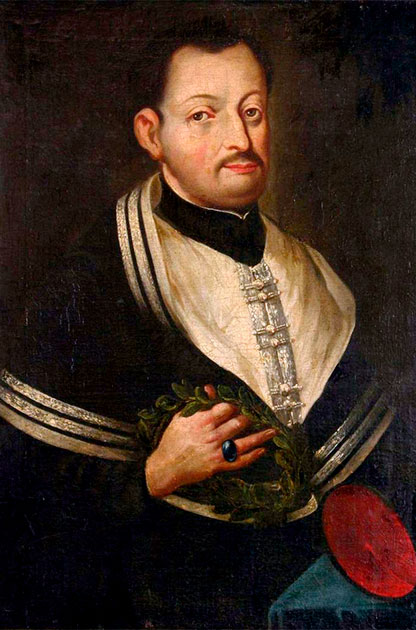
Maciej Kazimierz Sarbiewski (author unknown, the middle of the XVII c.)
Work in Polotsk played an important role in the formation of his creative personality. The future cultural luminary of the Polish-Lithuanian Commonwealth and Europe, a brilliant Neo-Latin poet, philosopher and theologian started his work on the profound study in the field of literary criticism and rhetoric exactly in the time of the first coming to Polotsk. His fundamental courses in the theory of poesy, eloquence and ancient antiquities were first read exactly in Polotsk. It is not surprising that in 1627 quite a young teacher was sent to teach to the main educational establishment in the GDL – the University of Vilna.
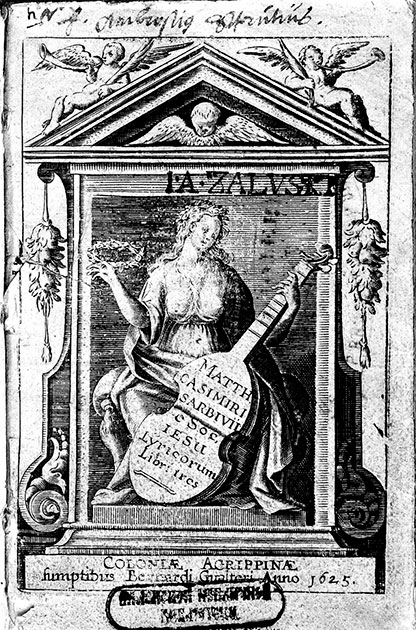
Title page of the Lyricorum libri by M. K. Sarbiewski (Cologne, 1625)
In 1632 the University of Vilna conferred him a Doctor of Philosophy degree and in 1636 – a Doctor of Theology degree, even more prestige one in those times. However, he gained prominence in the poetic field. The poet, called “Horace of Sarmatia” and “Cristian Horace”, published his works not only in Vilna, but in Wroclaw, Dijon, Cambridge, Leiden, London, Milan, Paris, Rome and other cities. His books became quite an event in the European cultural life. No wonder the Antwerp edition of the “Three Books of Lyrics” (1632) was decorated with engraving on copper by a great Flemish artist Peter Paul Rubens and turned out to be a five-thousand edition, an enormous one for those times.
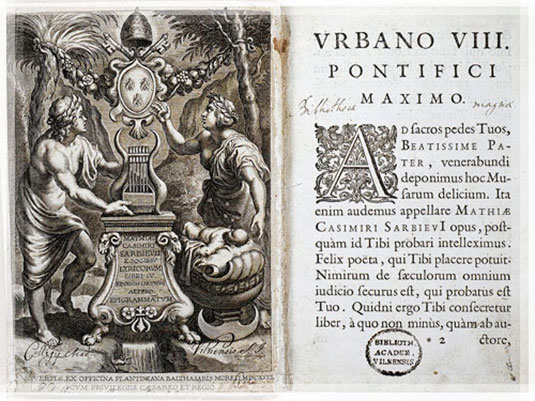
Frontispiece of the Lyricorum libri IV by M. K. Sarbiewski, decorated with engraving on copper by P. Rubens (Antwerp, 1632)
Sigismund Lauxmin, one of the students of M. K. Sarbiewski in Polotsk, carried on with Sarbiewski’s work. Sigismund Lauxmin was the author of the first local textbooks of the Greek Language, music and rhetoric. The work "Practical eloquence, or rules of rhetorical skill ..." was published in the Polish-Lithuanian Commonwealth two times, and eleven times abroad (Munich, Prague, Vienna, Cologne, etc.). This book did not lose its popularity till the very end of the XVIII century.
Regardless the general humanitarian and religious orientation of the curriculum in the Order’s establishments, the exact and natural sciences gradually won their place. Arithmetic was taught in some schools of the Polish province from the end of the XVI c. at the insistent request of the parents. Moreover from the beginning of the XVII c. Polish Jesuits appealed to Rome with requests to formally approve the new practice. By 1614 these efforts had succeed. Physics was later introduced to the curriculum by the same way.
The progressive tendencies reached Jesuit establishments with a delay because of the lack of appropriate teachers. The teaching of mathematics and physics in Polotsk Jesuit College started in 1649/1650 academic year. Polotsk was among the first testers of the updated curriculum. A few years earlier physics started to be taught in College of Orsha in 1646/1647 academic year and Mathematics – in Pinsk in 1647/1648.

